
CHFI Certification: Complete Guide to Computer Hacking Forensic Investigation
Pass the CHFI Certification: Complete Guide to exam with confidence. Practice questions with detailed explanations and instant feedback on every answer. 🔎
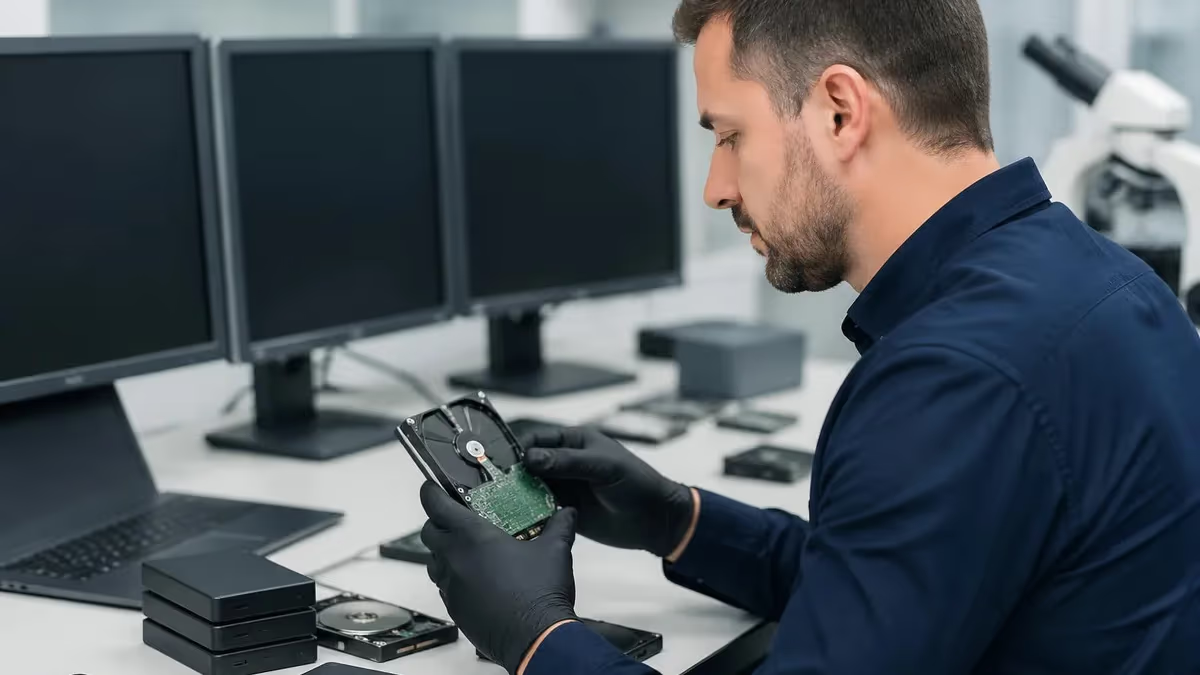
The CHFI — Computer Hacking Forensic Investigator — is EC-Council's professional certification for digital forensics practitioners. It validates expertise in the complete digital forensics investigation workflow: identifying, preserving, analyzing, and presenting digital evidence in ways that meet legal admissibility standards. For cybersecurity professionals, law enforcement officers, incident responders, and IT security specialists who work with digital evidence or who investigate cybercrime, the CHFI is the credential that formally documents forensics competency at a level that courts, government agencies, and employers across the security industry recognize.
Digital forensics is a discipline where the technical skill of finding evidence isn't enough by itself — the methods used to collect and preserve that evidence must follow established protocols that protect its legal admissibility. A forensic investigator who can recover deleted files but uses improper chain-of-custody procedures has gathered evidence that may be inadmissible in legal proceedings. CHFI training covers both the technical skills and the legal and procedural framework that makes digital evidence legally meaningful, which is what distinguishes formal forensics training from general security knowledge.
The CHFI exam consists of 150 multiple-choice questions with a 4-hour time limit and a passing score of 70% (105 correct answers). EC-Council recommends candidates have at least 2 years of IT security work experience before attempting the exam, though the formal prerequisite can be fulfilled through the official CHFI training course. The current version, CHFIv10, covers more than 14 forensic domains including OS forensics, network forensics, malware forensics, mobile forensics, cloud forensics, and email investigation — reflecting the breadth of digital environments where forensic investigation work actually occurs.
This guide covers the CHFI certification in detail: the exam structure, what each major domain covers, how to prepare effectively, what career paths the credential supports, and what the day-to-day reality of forensic investigation work looks like. Whether you're a cybersecurity professional considering CHFI as your next credential or an organization trying to understand what CHFI-certified investigators bring to your incident response capability, the information here provides a complete picture of what the certification represents.
One context point that matters for CHFI preparation: EC-Council's training curriculum and the exam are closely aligned — candidates who complete the official CHFI course will have seen most of the exam's content in the course materials. Self-study candidates using third-party materials need to ensure their preparation covers all 14+ modules at the technical detail level the exam tests. The official EC-Council course materials, practice exams, and labs are the most reliable preparation path; supplementing with targeted practice questions in specific weak domains is the most effective addition for candidates who want higher confidence on exam day.
Employers in banking, law enforcement, healthcare, and government actively seek CHFI-certified professionals to protect sensitive data and investigate security incidents that could otherwise go undetected. The credential also signals to hiring managers that you understand legal considerations around digital evidence, including proper seizure procedures, chain of custody documentation, and the rules governing admissibility in civil and criminal proceedings.
The CHFI exam's 150-question structure tests forensics knowledge across all domains covered in the CHFIv10 curriculum. Questions range from conceptual — what does a write-blocker do and why is it used — to procedural — in what order should evidence be collected from a live running system — to technical — what file system artifact would indicate a specific type of activity.
The 4-hour time limit gives candidates an average of 1 minute 36 seconds per question, which is workable for straightforward recall questions but tight for complex scenario-based questions that require working through a forensic scenario to identify the correct answer.
EC-Council exams are computer-based and administered through their online testing platform or at Pearson VUE testing centers. The exam version matters: CHFIv10 is the current version, and preparation materials need to match the version you're being tested on. EC-Council periodically updates exam versions to reflect changes in the digital forensics landscape — cloud forensics content, for example, received significantly expanded coverage in v10 compared to earlier versions. Confirming your exam version before purchasing preparation materials prevents preparing for content that isn't on your specific exam.
Hands-on lab experience is not tested directly on the CHFI multiple-choice exam, but the technical questions assume a level of practical familiarity with forensic tools and procedures that pure textbook study doesn't build. The CHFI forensic investigation process practice questions cover the procedural and conceptual content that appears most heavily across the exam's question distribution — working through these questions familiarizes you with how the exam frames forensic procedure questions and what level of procedural detail the correct answers require.
The CHFI data acquisition and duplication practice test addresses one of the most technically precise sections of the exam. Hash values, write-blocker functions, imaging tool selection, and acquisition verification are areas where the exam tests specific procedural knowledge rather than conceptual understanding. The correct answer to a question about forensic imaging isn't just conceptually correct — it reflects the specific protocol steps that maintain the forensic soundness of the evidence. Candidates who've worked through these questions under time pressure understand the level of specificity the exam expects.
Passing CHFI requires a 70% score — 105 correct out of 150 questions. This threshold is achievable for well-prepared candidates but requires solid knowledge across all domains rather than exceptional knowledge in one or two areas. CHFI has a better pass rate than EC-Council's more advanced certifications (CPENT, LPT), and candidates who complete the official course and supplement with targeted domain practice typically pass on their first attempt. Self-study candidates without the official course materials face a steeper preparation challenge, particularly for the technically detailed domains like malware forensics and hard disk analysis.
Many CHFI candidates find that combining video lectures with practical lab exercises accelerates retention, since the certification tests both conceptual understanding and hands-on forensic methodology. EC-Council recommends that candidates spend at least 40 hours on hands-on lab practice using industry-standard forensic tools before sitting for the exam, as a significant portion of the questions require applied knowledge rather than simple recall.

CHFI Certification: Key Areas in Depth
The CHFI Forensic Investigation Framework
The forensic investigation process is the CHFI's conceptual foundation. Every technical forensics skill — data acquisition, file carving, network analysis — operates within the investigation process framework. The process begins with first response: securing the scene, documenting the initial state, and making decisions about whether to prioritize volatile data collection (RAM, running processes, network connections) before shutting down a system. First response decisions can't be undone — the order and method of initial evidence collection permanently affects what's available for later analysis.
Chain of custody is the legal mechanism that links physical or digital evidence to the investigation record. Every transfer of evidence custody must be documented: who had the evidence, when, and in what condition. Digital evidence has additional integrity requirements — hash values computed at collection must match hash values computed later to prove the evidence hasn't been altered. The CHFI exam tests both the conceptual importance of chain of custody and the specific documentation practices that courts require to accept digital evidence as legally admissible.
Pursuing CHFI Certification: Honest Assessment
- +EC-Council brand recognized by employers in cybersecurity and digital forensics
- +Comprehensive curriculum covering the full digital forensics investigation domain
- +Directly applicable to incident response, cybercrime investigation, and e-discovery roles
- +Aligns with law enforcement and government agency requirements for digital evidence handling
- +Covers modern forensic environments including cloud, mobile, and malware investigation
- +Official EC-Council course provides structured lab experience alongside exam preparation
- −EC-Council certification costs are high: official training plus exam fees add up significantly
- −Multiple-choice exam doesn't directly test hands-on forensics skill execution
- −No hard prerequisite enforcement — less experienced candidates sometimes attempt the exam prematurely
- −3-year recertification cycle requires ongoing EC-Council continuing education credits (ECEs)
- −CHFI competes with GCFE (GIAC), EnCE, and other forensics certifications with different employer recognition profiles
- −Self-study without official EC-Council course materials is challenging due to proprietary content alignment
Pros and Cons at a Glance
| Pros | Cons |
|---|---|
| EC-Council brand recognized by employers in cybersecurity and digital forensics | EC-Council certification costs are high: official training plus exam fees add up significantly |
| Comprehensive curriculum covering the full digital forensics investigation domain | Multiple-choice exam doesn't directly test hands-on forensics skill execution |
| Directly applicable to incident response, cybercrime investigation, and e-discovery roles | No hard prerequisite enforcement — less experienced candidates sometimes attempt the exam prematurely |
| Aligns with law enforcement and government agency requirements for digital evidence handling | CHFI competes with GCFE (GIAC), EnCE, and other forensics certifications with different employer recognition profiles |
| Covers modern forensic environments including cloud, mobile, and malware investigation | Self-study without official EC-Council course materials is challenging due to proprietary content alignment |

CHFI Certification Preparation Checklist
- ✓Verify you meet EC-Council's 2-year IT security experience recommendation
- ✓Confirm you're preparing for CHFIv10 (current version) materials
- ✓Obtain official EC-Council CHFI course or courseware if possible
- ✓Work through practice questions in each of the 14+ forensics domains
- ✓Focus extra time on data acquisition, malware forensics, and cloud forensics domains
- ✓Understand forensic investigation process procedures at a procedural detail level — not just conceptually
- ✓Practice identifying hash function purposes and when each is used in forensic workflows
- ✓Review chain-of-custody documentation requirements and legal admissibility standards
- ✓Take at least two full-length timed practice exams before your actual exam date
- ✓Register through EC-Council's website and confirm exam logistics at least 2 weeks in advance
CHFI certification opens career paths in digital forensics, incident response, law enforcement cybercrime investigation, e-discovery, and enterprise security operations. The credential is recognized by federal agencies, defense contractors, law enforcement organizations, and enterprise security teams as evidence of formal forensics training and examination-verified competency. For cybersecurity professionals who want to specialize in investigative work — determining what happened after an intrusion, supporting legal proceedings with digital evidence, or performing forensic analysis in support of HR investigations and compliance audits — CHFI is the primary entry-level-to-intermediate forensics credential in the EC-Council ecosystem.
The digital forensics job market rewards a combination of technical skill and formal credential. Many forensic analyst positions in government and defense explicitly list CHFI or equivalent forensics credentials in their requirements. Private-sector incident response teams at major consulting firms and MSSPs increasingly require forensics certifications for investigators who may provide testimony or evidence in legal proceedings — where the credential itself demonstrates the formal training that gives the investigator credibility as an expert witness.
Salary ranges for CHFI-certified forensic investigators vary significantly by sector and experience level. Entry-level forensic analyst roles at private-sector firms typically start in the $60,000-$80,000 range; experienced investigators with 5+ years of forensic work and additional certifications (GCFE, GCFA, EnCE) commonly reach $100,000-$140,000. Government and law enforcement forensic investigator positions follow separate pay scales that may be lower on paper but often include benefits packages that compensate. Senior forensic investigators in management or consulting roles can significantly exceed these ranges depending on specialization and market.
EC-Council's recertification system requires accumulating ECE (EC-Council Continuing Education) credits over the 3-year validity period. ECE credits are earned through training courses, conferences, webinars, and professional development activities that EC-Council recognizes. Tracking ECE credits from certification day rather than scrambling to document three years of activity at recertification time makes the process straightforward. Many forensics professionals earn more than the required ECE credits naturally through conference attendance, training, and professional development that they'd pursue anyway — the recertification process formalized that existing behavior rather than adding a separate burden.
The relationship between CHFI and other forensics certifications is worth understanding for career planning. GIAC's GCFE and GCFA are highly regarded in the private security sector and are practical-exam based, which some employers prefer for their direct skill demonstration. EnCE (EnCase Certified Examiner) is tool-specific but carries strong recognition in law enforcement and legal contexts.
CHFI positions best as an entry-to-intermediate credential that establishes forensics fundamentals and EC-Council ecosystem membership; many experienced forensic investigators hold CHFI alongside one or more of these additional credentials to demonstrate both breadth and depth of forensics expertise. Whether examining a compromised enterprise network or supporting litigation involving digital evidence, CHFI professionals apply a disciplined chain-of-custody process that makes findings admissible in court. This is especially critical in cases involving ransomware, insider threats, or financial fraud where evidence integrity determines the outcome.

Preparing for the CHFI exam benefits from a dual approach: conceptual study of forensics principles and domain-specific practice questions. Conceptual study builds the mental model of how forensic investigation works — evidence volatility, legal admissibility, investigation methodology, and domain-specific forensic techniques. Practice questions test whether that conceptual understanding translates into correct answers under exam conditions. The gap between understanding forensics conceptually and answering CHFI exam questions correctly is larger than candidates often expect — the questions test procedural specificity and technical detail that general forensics knowledge doesn't always reach.
The CHFI's 14+ module scope means no single study session covers everything. A structured 10-12 week preparation plan that allocates specific weeks to specific domains — investigation process and data acquisition early, malware forensics and network forensics mid-program, cloud and mobile forensics near the end — is more effective than topic-hopping based on interest. Candidates tend to over-study the domains they find most interesting (often the attack-related content like malware forensics) and under-study the procedural domains (investigation process, legal standards) that appear heavily on the exam. A structured plan forces appropriate time allocation.
For cybersecurity professionals already working in security operations or incident response, the CHFI's practical content — particularly network forensics and malware analysis — will feel familiar from work experience. The unfamiliar content is often in the legal and procedural domains: chain of custody requirements, evidence admissibility standards, expert witness preparation, and the specific documentation protocols that distinguish forensic-grade evidence collection from standard security incident documentation. Investing study time proportionally — more in unfamiliar procedural areas — produces better exam outcomes than spending time reinforcing already-strong technical knowledge.
The CHFI certification, once earned, should be followed by deliberate skill development through hands-on practice. EC-Council's lab environment and the broader forensics community offer capture-the-flag (CTF) events specifically focused on forensics challenges, which build the practical investigation skills that the multiple-choice exam can't fully develop. Forensic investigators who combine their CHFI certification with regular hands-on practice scenarios — analyzing actual forensic images, working through CTF forensics challenges — develop the investigative judgment and tool proficiency that make the credential meaningful in real casework rather than just on paper.
Staying current with EC-Council's continuing education requirements through CPEs ensures that your CHFI credential remains active and that your skills keep pace with evolving threat landscapes. Building a strong professional network through EC-Council's alumni community and attending conferences like HTCIA or IACIS also accelerates career progression and opens opportunities that never appear on public job boards.
CHFI Practice Test Questions
Prepare for the CHFI - Computer Hacking Forensic Investigator exam with our free practice test modules. Each quiz covers key topics to help you pass on your first try.
CHFI - Computer Hacking Forensic Investiga...
CHFI Exam Questions covering - Computer Hacking Forensic Investigator Cloud Forensics. Master CHFI Test concepts for certification prep.
CHFI - Computer Hacking Forensic Investiga...
Free CHFI Practice Test featuring - Computer Hacking Forensic Investigator Data Acquisition and Duplication. Improve your CHFI Exam score with mock test prep.
CHFI - Computer Hacking Forensic Investiga...
CHFI Mock Exam on - Computer Hacking Forensic Investigator Forensic Investigation Process. CHFI Study Guide questions to pass on your first try.
CHFI - Computer Hacking Forensic Investiga...
CHFI Test Prep for - Computer Hacking Forensic Investigator Hard Disk and File Systems. Practice CHFI Quiz questions and boost your score.
CHFI - Computer Hacking Forensic Investiga...
CHFI Questions and Answers on - Computer Hacking Forensic Investigator Investigating Web Attacks. Free CHFI practice for exam readiness.
CHFI - Computer Hacking Forensic Investiga...
CHFI Mock Test covering - Computer Hacking Forensic Investigator Malware Forensics. Online CHFI Test practice with instant feedback.
CHFI - Computer Hacking Forensic Investiga...
Free CHFI Quiz on - Computer Hacking Forensic Investigator Mobile Device Forensics. CHFI Exam prep questions with detailed explanations.
CHFI - Computer Hacking Forensic Investiga...
CHFI Practice Questions for - Computer Hacking Forensic Investigator Network Forensics. Build confidence for your CHFI certification exam.
CHFI - Computer Hacking Forensic Investiga...
CHFI Test Online for - Computer Hacking Forensic Investigator Windows Operating System Forensics. Free practice with instant results and feedback.
CHFI Database Forensics
CHFI Study Material on Database Forensics. Prepare effectively with real exam-style questions.
CHFI Email and Social Media Forensics
Free CHFI Test covering Email and Social Media Forensics. Practice and track your CHFI exam readiness.
CHFI (312-49)
CHFI Exam Questions covering (312-49). Master CHFI Test concepts for certification prep.
A career as a CHFI-certified forensic investigator opens doors across a wide range of sectors. Federal agencies such as the FBI, DHS, and Secret Service employ digital forensic examiners to investigate cybercrime, national security breaches, and financial fraud. State and local law enforcement agencies increasingly rely on specialists who can extract and analyze evidence from mobile devices, hard drives, and cloud environments. Private sector roles include positions at consulting firms, managed security service providers, and Fortune 500 companies that need internal investigators capable of handling incident response and litigation support.
The daily work of a computer forensic investigator involves far more than technical analysis. You must document your findings precisely, write detailed reports that attorneys and juries can understand, and testify as an expert witness when cases go to trial. This combination of technical depth and communication skill makes the CHFI credential particularly valuable, since EC-Council's curriculum explicitly trains candidates to present evidence clearly and defend their methodology under cross-examination. Professionals who complete the certification report that the structured approach to evidence handling instilled during study translates directly into more rigorous, defensible investigations on the job.
Salaries for CHFI-certified investigators reflect the specialized nature of the work. Entry-level positions at consulting firms or regional law enforcement agencies typically start between $60,000 and $75,000 annually. Mid-career professionals with three to five years of practical experience and an active CHFI credential commonly earn between $90,000 and $115,000. Senior forensic investigators and team leads at large enterprises or federal agencies can exceed $130,000, particularly when paired with additional credentials such as the CEH or OSCP.
The combination of strong demand, limited supply of qualified examiners, and the high stakes of forensic investigations keeps compensation well above the broader IT average. Professionals who pair the CHFI with hands-on lab practice using tools like FTK, Cellebrite, or Autopsy find that real-world investigation skills develop faster and that the transition from certification to productive employment is significantly smoother.
Sample CHFI - Computer Hacking Forensic Investigator Practice Questions
Try these questions from our free CHFI - Computer Hacking Forensic Investigator practice tests. The correct answer and an explanation follow each question.
Computer forensic investigator Carlo is. He was given an assignment by a company to look into a forensic case. The computer at the crime site was turned off when Carlo arrived at the company to investigate the location. What do you think Carlo ought to do in this situation?
- A. He should leave the computer off
- B. He should turn on the computer
- C. He should turn on the computer and should start analyzing it
- D. He should turn on the computer and extract the data
Answer: A. He should leave the computer off
When a computer at a crime scene is found turned off, the best practice for a forensic investigator is to leave it off. Turning it on would alter the system's state, potentially overwriting volatile data in RAM and modifying timestamps or log files, thus compromising the integrity of potential evidence. The correct procedure is to transport the device to a forensic lab for a controlled examination, where a forensically sound acquisition can be performed without altering the original state.
In a Windows forensic investigation, an analyst discovers numerous `.pf` files in the `C:\Windows\Prefetch` directory. What is the primary forensic value of these files?
- A. They store user-specific application settings and configurations in a binary format.
- B. They provide a detailed, real-time log of all files accessed by the operating system kernel.
- C. They track application execution, including the execution count and last run time, to speed up future launches.
- D. They cache portions of web pages and scripts for faster browsing in Microsoft Edge.
Answer: C. They track application execution, including the execution count and last run time, to speed up future launches.
Prefetch files (`.pf`) are created by Windows to speed up application loading. Forensically, they are valuable because they record an application's name, an execution count, and up to eight timestamps of the last times the application was run. They also list the files and directories the application accessed upon startup.
What tool can a CHFI investigator use to read and analyze MySQL binary logs during a database forensic investigation?
- A. mysqlcheck
- B. mysqlbinlog
- C. mysqldump
- D. mysql_upgrade
Answer: B. mysqlbinlog
The mysqlbinlog utility reads MySQL binary log files, allowing investigators to reconstruct all SQL statements executed on the server.
A CHFI is called to investigate a potential data breach. The first step taken is to interview stakeholders, identify potentially affected systems (laptops, servers, mobile devices), and define the scope of the investigation. Which phase of the forensic process does this activity represent?
- A. Analysis
- B. Reporting
- C. Identification
- D. Preservation
Answer: C. Identification
The Identification phase is the initial step in the digital forensic process. It involves recognizing and determining what evidence is present, where it is stored, and what format it is in. This includes identifying all potential sources of digital evidence like computers, mobile devices, and cloud storage.
Take the full CHFI - Computer Hacking Forensic Investigator practice test
CHFI Questions and Answers
About the Author

Educational Psychologist & Academic Test Preparation Expert
Columbia University Teachers CollegeDr. Lisa Patel holds a Doctorate in Education from Columbia University Teachers College and has spent 17 years researching standardized test design and academic assessment. She has developed preparation programs for SAT, ACT, GRE, LSAT, UCAT, and numerous professional licensing exams, helping students of all backgrounds achieve their target scores.