
How to Pass the CDL Exam: Written Test & Skills Test Tips 2026 June
Free How to Pass the CDL Practice Test practice test with instant feedback and detailed answer explanations. Prepare for your exam. 🎯
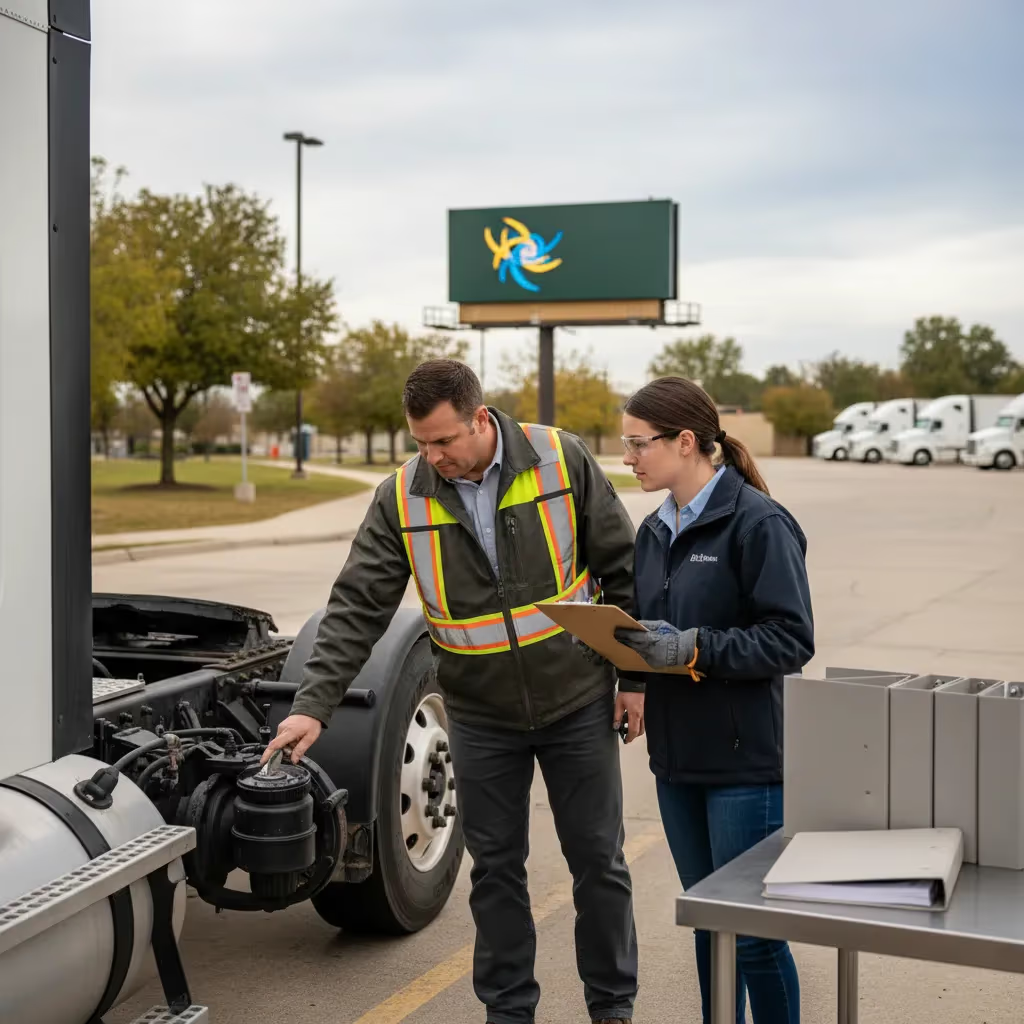
Passing the CDL exam isn't about cramming the night before — it's about knowing what each test section actually demands and preparing accordingly. The commercial driver's license exam has three distinct parts: a written knowledge test, a vehicle pre-trip inspection, and a behind-the-wheel road test. Most first-time failures happen on the pre-trip or skills portion, not the written section. That surprises people.
If you're figuring out how to pass cdl exam sections on the first attempt, you'll need a different strategy for each part. The written test rewards memorization and repetition — practice questions are your best friend there. The skills test rewards muscle memory you can only build behind the wheel. Trying to study for both the same way is the most common mistake new CDL candidates make.
This guide breaks down exactly how to pass the cdl exam from start to finish. You'll get specific techniques for the general knowledge written test, endorsement exams, the pre-trip inspection walkthrough, and the driving skills test. We're covering what actually works — not generic advice you've already seen. Everything here comes from the patterns that separate people who pass on the first try from people who don't.
Understanding how to pass the cdl exam means understanding that each section tests different skills entirely. The written portion is a knowledge check — can you recall air brake pressure thresholds, coupling procedures, hazmat placarding rules? The skills portion is a performance check — can you execute a straight-line back, an offset back, parallel park a 53-foot trailer? Two completely different preparation methods. Let's get into each one.

The written CDL exam is where most people start — and where the pass rate is actually highest. Knowing how to pass the cdl written exam comes down to repetition. You need to see enough practice questions that the real test feels familiar. The general knowledge test covers 50 questions, and you need 40 correct to pass. That's an 80% threshold with no partial credit.
Here's what trips people up: endorsement tests. If you're going for tanker, hazmat, doubles/triples, or passenger endorsements, each one adds another written exam. The questions overlap slightly with general knowledge but go much deeper into specific regulations. Hazmat alone covers 30 questions on placarding, shipping papers, emergency procedures, and loading rules. Don't treat endorsements as afterthoughts — they require dedicated study time.
When you're learning how to pass the cdl exam written portion, start with the CDL manual for your state. Every state publishes one for free online. Read it once cover to cover, then focus your practice questions on the sections you struggled with. Air brakes and combination vehicles are consistently the hardest endorsement tests — most training schools recommend spending 40% of your written-test study time on just those two areas.
The smartest approach to how to pass the cdl written exam? Take at least 500 practice questions before your test date. That's not an exaggeration. Most online practice platforms have question banks of 300-800 questions covering general knowledge and endorsements. When you're consistently scoring 90% or above on practice tests, you're ready. Below 85%, keep studying.
Understanding how to pass the cdl written exam requires knowing the question format. Every question is multiple choice with four answer options. There's no written response, no essay, no scenario simulation on the written portion. You're either choosing A, B, C, or D. The questions pull directly from the CDL manual — nothing obscure, nothing designed to trick you. But the wording can be specific in ways that catch people who only skimmed the material.
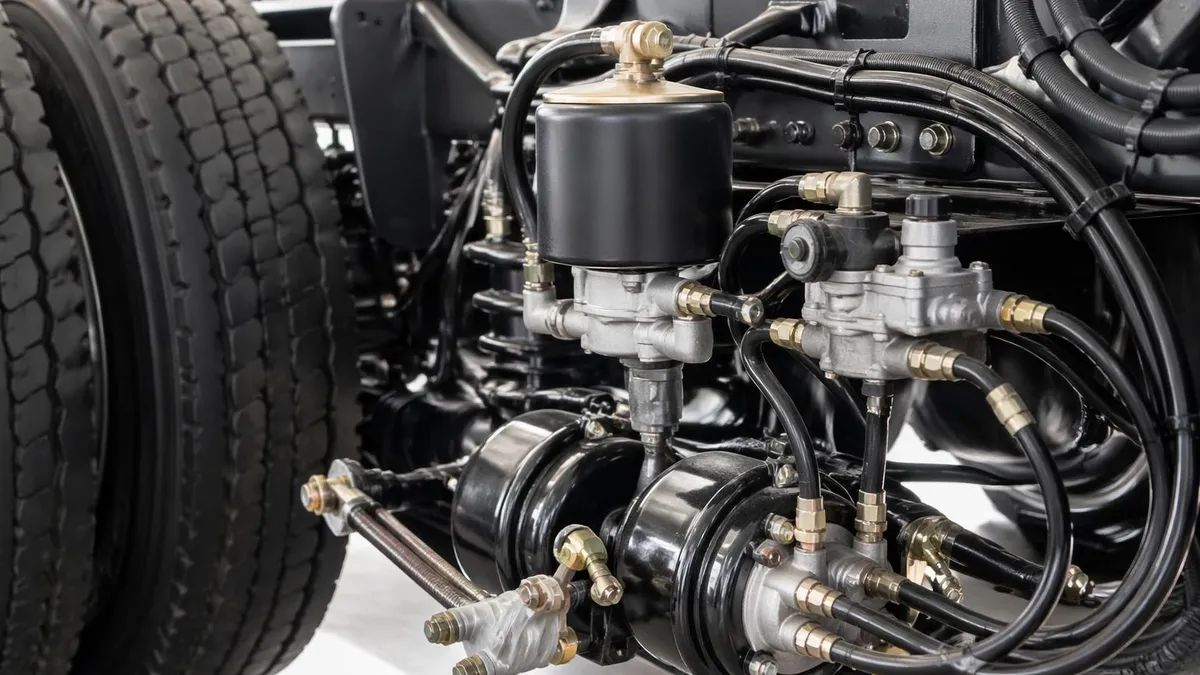
Air brake questions are notorious. You'll see questions about cut-in and cut-out pressures, spring brake activation thresholds, and the exact steps for performing an applied pressure test. The numbers matter — knowing that the governor should cut out at around 125 psi and cut in at around 100 psi is the kind of detail that separates passing from failing. Approximate knowledge doesn't cut it when four answer choices are all within 10 psi of each other.
Combination vehicle questions test coupling and uncoupling procedures in exact sequential order. Skip a step, reverse two steps — wrong answer. The test wants to confirm you know the safety-critical sequence, not just the general concept. Write out the coupling procedure from memory five times. That's more effective than re-reading it twenty times. Active recall beats passive review every time, and that principle applies across every section of how to pass the cdl written exam.
CDL Test Sections Explained
The general knowledge test is required for all CDL classes (A, B, and C). It covers 50 multiple-choice questions on vehicle inspection, basic control, safe driving, cargo handling, and federal regulations. You'll see questions about weight limits, hours of service, accident procedures, and distracted driving laws. Most states allow unlimited retakes with a 1-day waiting period between attempts. Study the CDL manual's chapters on basic vehicle control and cargo handling most carefully — those generate the highest volume of questions.
The pre-trip inspection is where confident candidates suddenly freeze. You've got roughly 30-45 minutes to walk around a commercial vehicle and demonstrate — out loud, to an examiner standing right there — that you can identify every safety-critical component and explain what makes it pass or fail. That's not an exaggeration of the pressure. It's real.
Knowing how to pass the cdl written exam helps you understand what each component does. But the pre-trip tests whether you can physically locate it on an actual truck and articulate the inspection criteria in real time. There's a big difference between reading about slack adjuster free play in a textbook and pointing at a slack adjuster under a trailer, grabbing it, and explaining that movement shouldn't exceed one inch.
Most CDL schools teach a systematic approach: start at the engine compartment, move to the front of the vehicle, walk down the driver's side, check the rear, come up the passenger side, then do the cab interior and in-cab brake checks. That's roughly 100+ individual items depending on vehicle type. Miss a critical item — like forgetting to check the air brake system — and you can fail the entire pre-trip section regardless of how well you do on everything else.
Practice your pre-trip on an actual vehicle at least ten times before test day. Walk around, talk out loud, time yourself. You should be able to complete the full inspection in under 25 minutes while hitting every item. The examiner isn't timing you strictly, but hesitation and uncertainty count against you. Smooth, confident delivery signals competence.
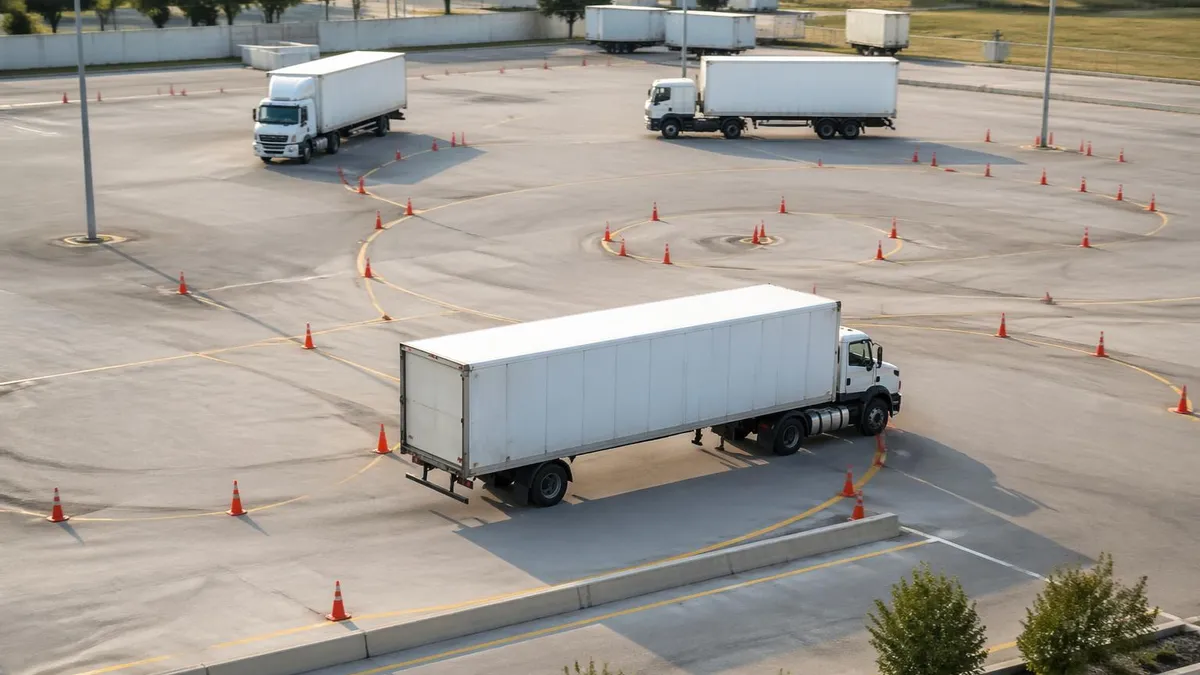
Backing maneuvers are the single biggest failure point on the CDL skills test. Not the road test, not the pre-trip — backing. The numbers bear this out: CDL testing data from multiple state DMV programs shows that offset backing and parallel parking produce more test failures than any other individual component. Understanding how to pass the cdl written exam is only half the battle when the skills portion demands physical precision you can't learn from reading.
Straight-line backing sounds simple. It isn't. You're reversing a 70-foot combination vehicle in a straight line between cones, using only your mirrors — no turning around to look out the back window. The moment your trailer drifts left or right, you need to correct immediately. Wait too long and you've used a pullup. Most states allow one or two pullups per maneuver before deducting points.
The offset back is harder. You'll start with the rear of your trailer aligned with a set of cones, then need to back the trailer into an offset space — imagine moving one lane over while going backward. This requires setting an initial angle with your tractor, then straightening as the trailer swings into position. The key insight most instructors share: get your angle within the first 15 feet of movement. After that, you're just straightening.
Parallel parking a commercial vehicle follows the same principles as a car but magnified. Your reference points shift. Your reaction time to steering input is delayed by the trailer's pivot point. You'll need to practice this maneuver specifically — car parallel parking skills don't transfer to a 53-foot trailer. Ten successful practice runs minimum before test day.
CDL Exam Preparation: What Works and What Doesn't
- +Practice tests reveal weak areas that manual review misses entirely
- +Pre-trip inspection follows a predictable, learnable sequence — pure memorization
- +Most states allow unlimited written test retakes with just a 1-day wait
- +CDL schools provide actual vehicles for skills practice — critical for backing
- +Free state CDL manuals cover 95% of written test material
- +Endorsement tests share content with general knowledge — study overlaps save time
- −Skills test requires vehicle access that self-study candidates often lack
- −Each failed skills test attempt costs $50-150 in retake fees
- −Pre-trip inspection has 100+ items — partial preparation leads to failure
- −Backing maneuvers need physical practice that no book or app can simulate
- −Hazmat endorsement adds TSA background check delays of 4-6 weeks
- −Test scheduling backlogs in some states mean 3-4 week waits between attempts
Your study timeline matters more than your study method. Starting too late is the number one predictor of CDL exam failure, especially for the written portion. You need at least two weeks of daily study for general knowledge and endorsements. Want to know how to pass the cdl written exam without stress? Start four weeks out. That gives you time to take practice tests, identify weak areas, study those areas specifically, then retest.
Don't study everything equally. Weight your time toward the sections where you score lowest on practice tests. If you're acing general knowledge questions but struggling with air brakes, spend 60% of your remaining study time on air brakes. This seems obvious but most people default to studying what they already know because it feels productive. Resist that impulse.
Flashcards work for the written test. Seriously. The CDL written exam tests recall of specific facts — pressure thresholds, distance requirements, procedural sequences, regulatory numbers. Flashcards are built for exactly this type of knowledge. Create cards for every numerical value in the CDL manual. When you can recall the correct number without hesitation, that card is done.
For how to pass the cdl written exam endorsements specifically, take each endorsement's practice test at least three times. Track your scores. If you're hitting 90%+ consistently on practice tests, you're ready. Below 85%, you've got gaps that will show up on test day. The endorsement tests are shorter than general knowledge but the questions are more specific — they expect deeper subject knowledge, not just broad awareness.
CDL Exam Study Checklist
- ✓Download your state's CDL manual and read it cover to cover once
- ✓Take a general knowledge practice test to establish your baseline score
- ✓Identify your three weakest subject areas from practice test results
- ✓Create flashcards for all numerical values — pressures, distances, weights
- ✓Complete at least 500 practice questions across all test sections
- ✓Practice the pre-trip inspection sequence on an actual vehicle 10+ times
- ✓Master straight-line backing before attempting offset or parallel
- ✓Schedule your written test when consistently scoring 90%+ on practice
- ✓Book skills test with at least 20 hours of behind-the-wheel practice logged
- ✓Do a full dress rehearsal — complete pre-trip, backing, and road test in sequence
The road test is the final section of the CDL skills test, and it's where your driving habits get evaluated under real conditions. You'll drive a predetermined route with the examiner in the cab, covering city streets, highway sections, intersections, railroad crossings, and potentially construction zones or school zones depending on your test location. Understanding how to pass the cdl written exam gave you the regulatory knowledge — the road test checks whether you actually apply it.
Shifting matters. If you're testing in a manual transmission vehicle, the examiner will watch your shift patterns. Grinding gears, missing shifts, or lugging the engine all count against you. Double-clutching technique should be second nature before you schedule the road test. If your CDL school offers automatic transmission testing, consider it — the restriction limits some job options but eliminates shift-related failures entirely.
Mirror usage is scored. Before every lane change, turn, merge, or curve, you should visibly check your mirrors. The examiner can't read your mind — they need to see your head move to confirm you checked. Exaggerate your mirror checks slightly. A quick glance that you know happened but the examiner missed gets scored the same as not checking at all.
Speed management on downgrades gets specific attention. The examiner will route you through at least one downhill section. You're expected to select the right gear before the descent, use engine braking appropriately, and maintain a controlled speed without riding the service brakes. This isn't just about technique — it's a safety evaluation. How to pass the cdl written exam questions about downgrade procedures translates directly to what the examiner watches on the road.
Test-day logistics trip people up more than they should. Bring every required document — your learner's permit or CLP, medical examiner's certificate (DOT physical card), proof of identity, and any state-specific forms your DMV requires. Missing a single document means rescheduling. That's not a minor inconvenience when test slots book 2-3 weeks out in many states.
Your DOT physical must be current on test day. Not expired the day before, not expiring that week — current. The medical examiner's certificate is valid for up to 24 months, but if yours expires between when you pass the written test and when you schedule the skills test, you'll need a new physical. Plan accordingly. Understanding how to pass the cdl written exam is important but passing the physical is a prerequisite that some candidates neglect until it's too late.
Dress for the job. Steel-toe boots or sturdy work boots — no sandals, no sneakers. You'll be climbing in and out of the cab, crawling under the vehicle during pre-trip, and walking on potentially wet or oily pavement. The examiner won't fail you for wearing sneakers, but proper footwear signals professionalism and keeps you safe during the inspection.
Eat breakfast. Drink water. Get enough sleep the night before. These aren't motivational poster suggestions — they're practical advice from CDL instructors who've watched hundreds of candidates fail because they showed up tired, hungry, or dehydrated on a 4-hour test day. Your cognitive performance drops measurably with poor sleep, and the CDL skills test is mentally demanding from start to finish.
Your Commercial Learner's Permit (CLP) is valid for only 180 days in most states. If your CLP expires before you complete the skills test, you'll need to retake the written exam and pay the permit fee again. Schedule your skills test at least 30 days before your CLP expiration to allow for potential rescheduling or retake attempts.
Common mistakes cost more points than people realize. During the pre-trip inspection, the biggest error is forgetting the in-cab brake checks. Candidates get so focused on the external walkabout that they rush through the interior portion. The applied pressure test, the static air pressure leak test, and the parking brake check — all three must be demonstrated in the cab. Skipping any one of them can result in failing the pre-trip section entirely. Knowing how to pass the cdl written exam air brake questions means you understand these tests conceptually; performing them on test day requires physical practice.
On backing maneuvers, the most expensive mistake is refusing to use pullups. A pullup costs you a few points. Hitting a cone or crossing a boundary fails the maneuver entirely. If your trailer is drifting off line and you're not confident in your correction, stop, pull forward, reset your line. That's what pullups exist for. Pride costs CDL candidates more test attempts than incompetence does. Use your pullups.
During the road test, rolling stops are the most common automatic failure. Not slow stops — rolling stops. If your vehicle doesn't come to a complete, momentary stop at every stop sign and red light, the examiner marks it as a critical error. Two critical errors typically fail the road test regardless of your other scores. Make your stops obvious and deliberate.
Forgetting to downshift before an intersection is another frequent deduction. You should be in a gear low enough to accelerate through the intersection if needed. Coasting through in neutral or in too high a gear shows poor vehicle control. The examiner knows the route and knows which intersections test this skill. They're watching for it specifically.
CDL Practice Test Questions
Prepare for the CDL - Commercial Driver's License exam with our free practice test modules. Each quiz covers key topics to help you pass on your first try.
CDL Alabama CDL Combination Vehicles Pract...
CDL Exam Questions covering Alabama CDL Combination Vehicles Practice Test. Master CDL Test concepts for certification prep.
CDL Alabama CDL General Knowledge Practice...
Free CDL Practice Test featuring Alabama CDL General Knowledge Practice Test #. Improve your CDL Exam score with mock test prep.
CDL Alabama General Knowledge CDL Practice...
CDL Mock Exam on Alabama General Knowledge CDL Practice Test. CDL Study Guide questions to pass on your first try.
CDL Airbrakes Practice Test
CDL Test Prep for Airbrakes Practice Test. Practice CDL Quiz questions and boost your score.
CDL Air Brakes Practice Test
CDL Questions and Answers on Air Brakes Practice Test. Free CDL practice for exam readiness.
CDL CLASS A COMMERCIAL DRIVER'S LICENSE PR...
CDL Mock Test covering CLASS A COMMERCIAL DRIVER'S LICENSE PRACTICE TEST. Online CDL Test practice with instant feedback.
CDL Class B Commercial Driver's License Pr...
Free CDL Quiz on Class B Commercial Driver's License Practice Test. CDL Exam prep questions with detailed explanations.
CDL Combination Vehicles Practice Test
CDL Practice Questions for Combination Vehicles Practice Test. Build confidence for your CDL certification exam.
CDL Doubles and Triples Practice Test
CDL Test Online for Doubles and Triples Practice Test. Free practice with instant results and feedback.
CDL Doubles Triples Practice Test
CDL Study Material on Doubles Triples Practice Test. Prepare effectively with real exam-style questions.
CDL General Knowledge Practice Test
Free CDL Test covering General Knowledge Practice Test. Practice and track your CDL exam readiness.
CDL General Knowledge Practice Test1
CDL Exam Questions covering General Knowledge Practice Test1. Master CDL Test concepts for certification prep.
CDL Hazardous Materials (Hazmat) Practice ...
Free CDL Practice Test featuring Hazardous Materials (Hazmat) Practice Test. Improve your CDL Exam score with mock test prep.
CDL Hazardous Materials Hazmat Practice Test
CDL Mock Exam on Hazardous Materials Hazmat Practice Test. CDL Study Guide questions to pass on your first try.
CDL Hazmat Practice Test
CDL Test Prep for Hazmat Practice Test. Practice CDL Quiz questions and boost your score.
CDL Passenger Transport Practice Test
CDL Questions and Answers on Passenger Transport Practice Test. Free CDL practice for exam readiness.
CDL Road Signs and Signals Practice Test
CDL Mock Test covering Road Signs and Signals Practice Test. Online CDL Test practice with instant feedback.
CDL School Bus Endorsement Practice Test
Free CDL Quiz on School Bus Endorsement Practice Test. CDL Exam prep questions with detailed explanations.
CDL School Bus Endorsement S Practice Test
CDL Practice Questions for School Bus Endorsement S Practice Test. Build confidence for your CDL certification exam.
CDL Tanker Practice Test
CDL Test Online for Tanker Practice Test. Free practice with instant results and feedback.
CDL Class A Commercial Driver's License Pr...
CDL Study Material on Class A Commercial Driver's License Practice Test -1. Prepare effectively with real exam-style questions.
CDL Class A Driver's License Practice Test -2
Free CDL Test covering Class A Driver's License Practice Test -2. Practice and track your CDL exam readiness.
CDL Class A Driver's License Practice Test -3
CDL Exam Questions covering Class A Driver's License Practice Test -3. Master CDL Test concepts for certification prep.
CDL Class A Driver's License Practice Test -5
Free CDL Practice Test featuring Class A Driver's License Practice Test -5. Improve your CDL Exam score with mock test prep.
CDL Class B Commercial Driver's License Pr...
CDL Mock Exam on Class B Commercial Driver's License Practice Test -2. CDL Study Guide questions to pass on your first try.
CDL Class C CDL with Hazmat Endorsement Pr...
CDL Test Prep for Class C CDL with Hazmat Endorsement Practice Test. Practice CDL Quiz questions and boost your score.
CDL Class C CDL with Hazmat Endorsement Pr...
CDL Questions and Answers on Class C CDL with Hazmat Endorsement Practice Test -2. Free CDL practice for exam readiness.
CDL Class C CDL with Hazmat Endorsement Pr...
CDL Mock Test covering Class C CDL with Hazmat Endorsement Practice Test -3. Online CDL Test practice with instant feedback.
After you pass all three sections — written, pre-trip, and driving — you'll receive your CDL at the DMV. Some states issue it on the spot with a temporary paper license until your physical card arrives. Others mail it within 7-10 business days. Either way, your CDL is valid nationwide regardless of which state issued it. Federal regulations standardize the licensing requirements. How to pass the cdl written exam and skills test is the same fundamental process in Alabama, California, Texas, or New York — the content standards are federal.
If you fail a section, most states let you retake just that section without repeating the portions you already passed. Written test retakes are usually available the next business day. Skills test retakes typically require rescheduling, which can mean a 1-3 week wait depending on your testing center's availability. Use that waiting period productively — practice the specific maneuver or section that caused the failure.
Retake fees vary by state but typically run $25-75 per attempt for written tests and $50-150 for skills tests. Some CDL schools include retake fees in their tuition package. Ask about this before enrolling — it can save you hundreds of dollars if you need multiple attempts at the skills test.
The CDL exam process rewards consistent preparation over cramming. Candidates who study daily for 3-4 weeks pass at dramatically higher rates than those who study intensively for 3-4 days. Spaced repetition works. Daily practice works. Last-minute panic studying doesn't — not for the written test and definitely not for the skills test. Build your preparation timeline backward from your target test date and stick to it.
CDL Questions and Answers
CDL Career Overview: Driving Jobs, Salaries, and How to Get Started
CDL Exam Eligibility: DOT Requirements, Medical Exams, and How to Qualify

CDL Hazardous Materials Study Guide and Essential Study Materials
CDL General Knowledge Test: What You Need to Know About Subject Knowledge

CDL Certification Guide: DOT Requirements, Study Tips & Endorsements
About the Author
Licensed Driving Instructor & DMV Test Specialist
Penn State UniversityRobert J. Williams graduated from Penn State University with a degree in Transportation Management and has spent 20 years as a certified driving instructor and DMV examiner consultant. He has personally coached thousands of applicants through written knowledge tests, skills assessments, and commercial driver licensing programs across more than 30 states.
Join the Discussion
Connect with other students preparing for this exam. Share tips, ask questions, and get advice from people who have been there.
View discussion (6 replies)