
EPA 608 Certification — Your Complete Refrigerant Handling Exam Guide for 2026
Pass your EPA 608 certification exam with free practice tests, study tips, and cost breakdowns. Learn about all four certification types and how to prepare.
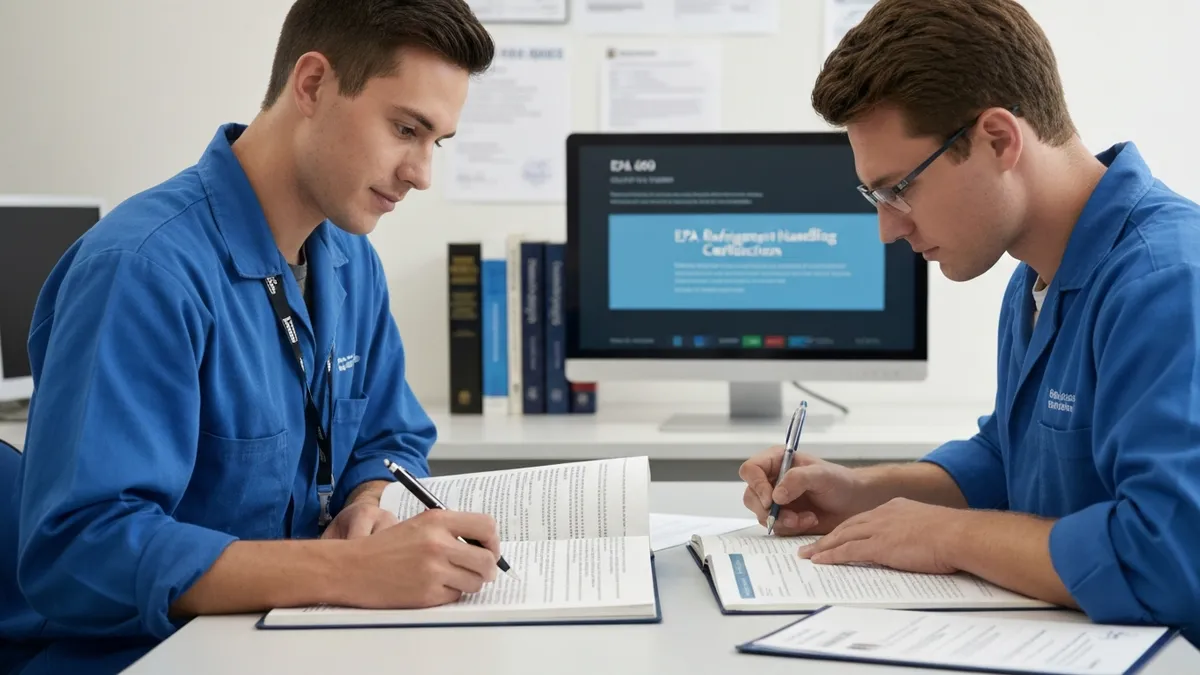
If you work with refrigerants — or want to — you need an EPA 608 certification. It's not optional. Federal law requires every technician who handles regulated refrigerants to hold this credential before touching equipment. Whether you're breaking into HVAC, already wrenching on commercial chillers, or pivoting from a related trade, this certification opens doors that stay locked without it. And the good news? You can earn your epa 608 certification faster than most people expect.
The exam itself covers four areas: a Core section everyone takes, plus Type I (small appliances), Type II (high-pressure systems), and Type III (low-pressure systems). Most technicians aim for Universal certification, which means passing all three Type sections along with the Core. That single credential covers every refrigerant scenario you'll encounter on the job. You can also pursue your epa 608 certification online through EPA-approved proctors — no classroom seat required.
This guide breaks down everything you need: what's actually on the test, how much it costs, where to study, and which practice exams will prepare you best. We'll cover the differences between certification types, walk through the registration process, and point you toward free resources that work. No filler. Just the information that gets you from "thinking about it" to certified.
Every year, thousands of technicians earn this credential. Some study for a weekend. Others take a month. The timeline depends on your background — experienced HVAC workers often pass with minimal prep, while newcomers to the trade need more time with the material. Regardless of where you're starting, the path forward is clear and achievable.
EPA 608 Certification at a Glance
One of the biggest shifts in recent years is how accessible testing has become. You can now complete your epa 608 certification online through multiple EPA-approved platforms. No driving to a testing center. No scheduling headaches. Just a webcam, a stable internet connection, and your knowledge of refrigerant handling. Platforms like SkillCat EPA 608 certification programs have made the entire process — studying, practicing, and testing — available from your phone or laptop.
That said, online isn't your only path. Trade schools, community colleges, and HVAC supply houses still offer in-person proctored exams. Some employers even host testing days where a certified proctor comes on-site. The format doesn't change your credential — passing is passing, regardless of where you sit for the exam. What matters is that your proctor holds EPA approval.
Before you pick a testing method, check whether your employer has a preference. Some union shops require in-person testing through specific organizations like ESCO Institute or RSES. Others don't care as long as you've got the card. Either way, the content is identical — 25 Core questions plus 25 per Type section you attempt. The playing field is completely level no matter which testing route you ultimately choose.
Nothing replaces actual practice when you're preparing for the 608 EPA certification exam. Reading study guides matters, sure. But the technicians who pass on their first attempt almost always credit one thing: taking an epa 608 certification practice test repeatedly until the question patterns clicked. The real exam recycles question formats — different numbers, same concepts. Once you recognize those patterns, the test feels familiar instead of intimidating.
Practice tests also expose your weak spots before they cost you points. Maybe you know leak detection cold but freeze up on recovery requirements. Or you've memorized refrigerant types but blank on pressure-temperature relationships. A good practice exam shows you exactly where to focus your remaining study time. That's efficient prep, not busywork. You wouldn't study for a driving test by only reading the handbook — you'd want to see the actual questions.
We've built free EPA 608 practice quizzes covering every major exam topic — leak detection, ozone depletion, recovery procedures, and regulations. Each quiz mirrors the format and difficulty of actual exam questions. Take them timed to simulate real conditions, or untimed to learn at your own pace. Either way, you'll walk into exam day knowing what to expect. Most test-takers report feeling significantly more confident after just two or three full practice rounds.
EPA 608 Certification Types Compared
Type I covers small appliances containing 5 pounds or less of refrigerant. Think window AC units, household fridges, vending machines, and PTAC units. Technicians with this certification can recover refrigerant from these systems but aren't authorized for high- or low-pressure equipment. If you're working in appliance repair or property maintenance, Type I might be all you need. The exam section has 25 questions focused on small appliance recovery techniques, self-contained recovery equipment, and proper disposal practices.
Understanding the distinction between certification types helps you decide what to aim for. The EPA section 608 certification framework was designed so technicians only handle equipment they're trained on. That's smart from a safety perspective — low-pressure chillers operate under vacuum, which creates entirely different hazards than high-pressure split systems. Different physics, different procedures, different risks.
Most working technicians go straight for the EPA 608 universal certification. Here's why: you take one exam session, answer questions on all three Types plus the Core, and walk out with the broadest credential available. There's no extra fee for attempting Universal versus a single Type. If you pass all sections, great — you're Universal. If you only pass two sections, you still get certified for those Types. Zero downside to trying for all of them.
The Universal path also future-proofs your career. Today you might only service residential equipment. But two years from now, a commercial service opportunity lands in your lap. Without Universal certification, you'd need to retest. With it, you're already qualified. The time you invest studying for all three Types pays dividends every time your career takes an unexpected turn. Many technicians who started with Type II only end up retesting for Universal within a year — save yourself the hassle and do it right the first time.
Core Exam Topics You Must Know
Understand how CFCs and HCFCs destroy stratospheric ozone, the role of chlorine atoms in the catalytic cycle, and why the Montreal Protocol phased out certain refrigerants. Expect 3-5 Core questions on this topic.
Know the penalties for venting refrigerants, required record-keeping timelines, and which refrigerants fall under Section 608 versus Section 609. Regulatory questions make up a significant portion of the Core section.
Master the difference between recovery, recycling, and reclaiming. Know required vacuum levels for different system sizes and refrigerant types. This topic bridges the Core and every Type-specific section.
Learn pressure-temperature relationships, refrigerant toxicity levels, proper ventilation requirements, and what to do if a large release occurs. Safety questions appear throughout every section of the exam.
Let's talk money. EPA 608 certification cost ranges from about $20 to $40 for the exam alone — that's the proctor fee, which goes to whichever EPA-approved organization administers your test. Some proctors charge on the lower end for in-person group testing, while online-proctored exams sometimes run slightly higher due to platform fees. Compared to other trade certifications, it's remarkably affordable.
Where costs climb is when you add training. A full EPA 608 certification course through a trade school or online platform typically runs $150 to $500, depending on whether it includes hands-on lab time. SkillCat offers app-based courses on the lower end. ESCO Institute and RSES provide more traditional classroom formats. Community colleges sometimes bundle EPA 608 prep into broader HVAC programs, which spreads the cost across a semester's tuition.
Here's a money-saving move most people miss: you don't need a paid course to pass. The EPA doesn't require any specific training before testing — it only requires a passing score. If you're disciplined enough to study independently using free resources and practice tests, your total out-of-pocket could be under $30.
Pair a free study guide with our practice quizzes, review for two weeks, and you're ready. The exam isn't designed to trick you. It's designed to confirm you understand safe refrigerant handling. Plenty of technicians have passed spending less than $30 total — proof that expensive prep programs aren't necessary if you're willing to put in the study hours independently.
Pros and Cons of EPA 608 Certification
- +Lifetime certification — never expires or requires renewal
- +Low exam cost ($20-$40) compared to most trade credentials
- +Universal option covers all refrigerant equipment types
- +Online testing available from home with webcam proctoring
- +Required by law — guaranteed demand from every HVAC employer
- +No prerequisite courses or experience hours required
- −Must pass each section separately with 70% — no averaging across sections
- −Study materials vary in quality and some paid courses aren't worth the price
- −Online proctoring can be finicky with camera and internet requirements
- −Doesn't replace hands-on training or substitute for field experience
- −Some employers want additional certifications beyond EPA 608
- −Universal exam takes 2-3 hours to complete all 100 questions
After you pass, you might wonder how to verify your credential. EPA 608 certification lookup works differently than you'd expect — there's no single national database where anyone can search your name. Your certifying organization maintains your records, and they issue a wallet-sized certification card as proof. Lose that card? Contact your original proctor for a replacement. Some organizations charge a small reissue fee; others don't.
The EPA 608 certification test format itself is straightforward: multiple choice, closed book, proctored. You get a set amount of time per section — typically 30 minutes for the Core and 30 minutes per Type section. For Universal, budget about 2 to 2.5 hours total. There's no penalty for guessing, so never leave a question blank. Mark uncertain answers, move on, and circle back if time allows.
One detail that trips people up: you can't use reference materials during the exam. No pressure-temperature charts, no cheat sheets, no phone. Everything must come from memory. That's why practice tests matter so much — they force you to internalize the information rather than just recognize it on a page. By the time you've completed five or six full practice exams, the key numbers and rules stick. Repetition transforms unfamiliar material into second nature — and that's exactly the confidence you want walking into a proctored testing environment.
Your EPA 608 Certification Prep Checklist
The EPA universal 608 certification remains the gold standard in the HVAC trade. Employers don't just prefer it — many won't consider candidates without it. Job postings for service technicians, installers, and maintenance mechanics almost always list EPA 608 as a minimum requirement. It's the baseline credential that says you understand federal refrigerant handling laws and can work safely with regulated substances.
What exactly does EPA Section 608 technician certification authorize you to do? In practical terms, it allows you to purchase regulated refrigerants, recover refrigerants from systems being serviced or decommissioned, and perform maintenance on equipment containing those refrigerants. Without it, you can't legally buy refrigerant in quantities over 2 pounds — which means you can't charge a system after repair. That's a career dead-end for any HVAC tech.
The certification also signals professionalism. When a customer sees your EPA card, they know you're not some handyman who watched a YouTube video. You've demonstrated knowledge of environmental regulations, safe handling procedures, and proper recovery techniques. In a trade where trust matters — you're working inside people's homes and businesses — that credential carries weight beyond its legal requirement. It separates professionals from amateurs in a field where the distinction matters for safety, liability, and client confidence.
Focus on Recovery Vacuum Levels
The most commonly missed questions involve required vacuum levels for recovery equipment. Remember: systems manufactured before November 15, 1993 have different requirements than newer systems. The EPA distinguishes between systems containing more or less than 200 pounds of refrigerant. Make flashcards for these specific numbers — they're almost guaranteed to appear on your exam, and mixing them up is the fastest way to lose easy points.
Building an effective EPA 608 certification study guide routine doesn't require complicated planning. Start with the Core section material — ozone science, Clean Air Act basics, and general safety. These concepts underpin every Type-specific section, so learning them first creates a foundation that makes the rest easier. Spend your first week on Core content alone.
As an EPA 608 technician certification candidate, you'll find that Type sections share overlapping concepts. Recovery procedures appear in all three Types, just with different equipment specifications and vacuum requirements. Leak detection principles are similar across system sizes, though allowable leak rates differ. Once you understand the Core logic, each Type section adds specific details rather than entirely new concepts.
Effective study sessions look like this: 30 minutes of reading, then immediately take a quiz on what you just read. Don't wait until you've finished all the material to start testing yourself. The act of recalling information — not just recognizing it — is what moves knowledge from short-term to long-term memory. Psychologists call this the testing effect, and decades of research back it up. It works. Use it every single study session. Our free practice quizzes are built around this exact principle.
Every EPA-approved proctor requires a valid government-issued photo ID on exam day. For online proctored exams, you'll need to show your ID to the webcam before starting. Expired IDs, student IDs, and work badges are not accepted. If you're testing in person, arrive 15 minutes early with your ID ready. Forgetting it means rescheduling — and potentially paying another exam fee.
Wondering about EPA 608 certification training options beyond self-study? Structured training programs offer a few advantages that books can't match. Hands-on labs let you physically practice recovery procedures using actual equipment — connecting gauges, pulling vacuums, weighing refrigerant charges. That tactile experience reinforces concepts in ways that reading about them simply doesn't.
An EPA 608 certification class at a community college typically runs 1-2 days for the exam prep portion, though some programs embed it within longer HVAC coursework. Trade schools like Universal Technical Institute, Lincoln Tech, and local vocational programs include EPA 608 prep as part of their HVAC curriculum. If you're already enrolled in an HVAC program, the certification prep is probably built into your schedule.
For working technicians who need flexibility, online self-paced courses fit better. Platforms like SkillCat, TPC Training, and HVAC Excellence offer app-based or web-based courses that you can work through during lunch breaks or after hours. Most include built-in practice exams and progress tracking. The quality varies — read reviews before paying. And remember, the exam doesn't care how you studied. It only cares whether you know the material. Pick whatever format fits your schedule and learning style — then commit to actually finishing it before exam day.
Earning your universal EPA 608 certification isn't just about checking a regulatory box. It's a career accelerator. HVAC technicians with Universal certification earn 10-15% more on average than those with single-Type credentials, according to industry salary surveys. The reason is simple: Universal techs can take on any job that walks through the door. Commercial service call on a chiller? Covered. Residential AC repair? Covered. Walk-in cooler at a restaurant? Also covered.
So how to get EPA 608 certification if you're starting from scratch? Here's the shortest path: spend two weeks studying using free online resources and our practice tests. Focus one week on Core material and one week rotating through Type-specific content. Take at least three full-length practice exams, scoring 80% or higher consistently before you schedule the real thing. Then register with an EPA-approved proctor, pay the $20-$40 fee, and sit for the exam.
That's it. No prerequisite classes. No experience requirements. No waiting period. The EPA designed this certification to be accessible because they want every technician handling refrigerants to be properly trained. The barrier to entry is low on purpose — but the knowledge requirements are real. Study seriously, practice consistently, and you'll join the millions of certified technicians who keep the world cool without harming the atmosphere. Your future self — and your paycheck — will thank you for investing these two focused weeks of preparation.
EPA 608 609 Questions and Answers
About the Author
Attorney & Bar Exam Preparation Specialist
Yale Law SchoolJames R. Hargrove is a practicing attorney and legal educator with a Juris Doctor from Yale Law School and an LLM in Constitutional Law. With over a decade of experience coaching bar exam candidates across multiple jurisdictions, he specializes in MBE strategy, state-specific essay preparation, and multistate performance test techniques.