
Where to Take a Drivers Test Near Me: Complete Guide to BMV Testing Locations, Scheduling, and Passing
Find where to take a drivers test near me. Complete guide to BMV testing locations, appointments, requirements, and passing tips for first-time drivers. ⏳
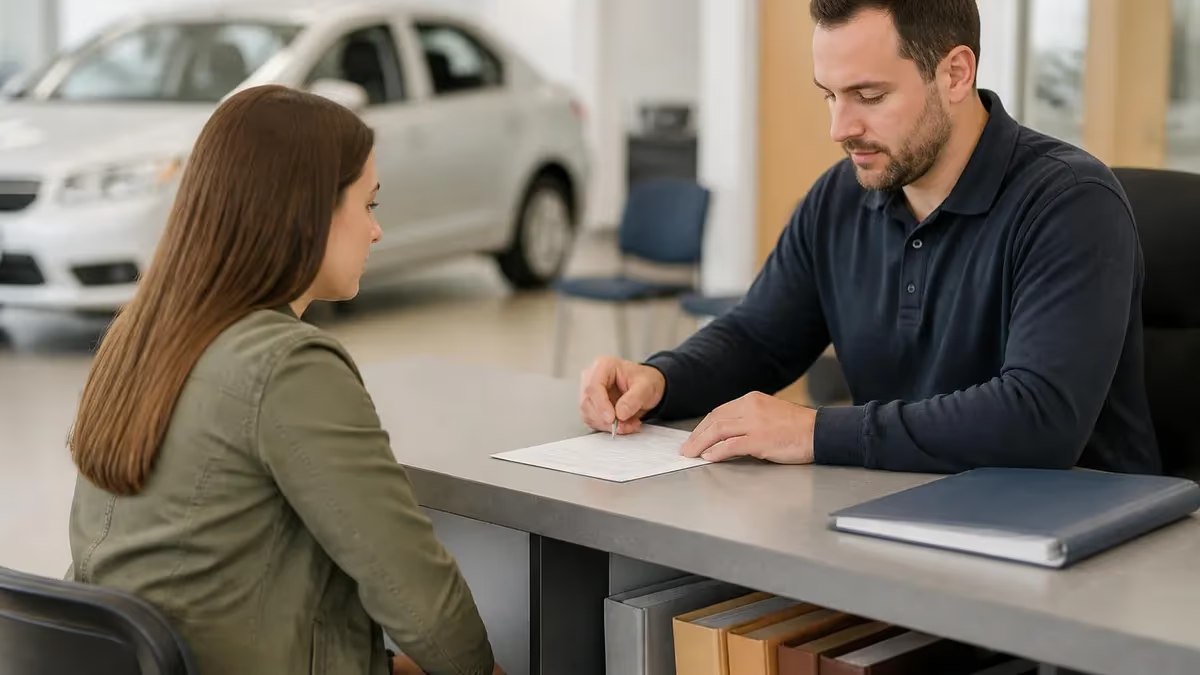
Figuring out where to take a drivers test near me is one of the most common questions new drivers ask, and the answer depends on your state, your license type, and whether you need the written knowledge exam, the behind-the-wheel road test, or both. Most states administer driving tests through their Bureau of Motor Vehicles (BMV), Department of Motor Vehicles (DMV), or an equivalent agency, with testing centers spread across urban, suburban, and rural areas to serve every community. Knowing exactly where to go saves you hours of confusion and prevents missed appointments.
Your nearest testing location is almost always a state-run BMV branch office, although some states contract with third-party testing providers, driving schools, and AAA offices to handle road tests during high-demand periods. To find the closest official site, visit your state agency website, enter your ZIP code into the locator tool, and filter by services offered, since not every branch administers road tests. Some branches handle only license renewals, registrations, or written knowledge tests, while larger regional centers conduct the actual driving exams on designated courses.
Before heading to a testing center, you must satisfy the prerequisites: a valid learner's permit held for the minimum required period, completion of any state-mandated driver education courses, and a properly insured, registered vehicle that passes a pre-test safety inspection. The age requirement varies by state, with most allowing teenagers to test for a provisional license at 16 after completing supervised driving hours. Adults over 18 face fewer restrictions but must still demonstrate the same skills behind the wheel.
Scheduling is where many applicants stumble. The most popular branches book out four to eight weeks in advance, especially during summer when school is out and teen testing volume peaks. Online appointment portals usually open new slots Monday mornings, and refreshing the page at exactly 7 a.m. local time often catches cancellations and freshly released windows. Walk-in testing is available at some smaller branches, but you should arrive 30 to 45 minutes before opening and bring patience along with your paperwork.
Preparation determines whether your trip ends with a license in hand or a return visit on your calendar. Statewide pass rates for first-time road test takers hover around 50 to 60 percent, meaning nearly half of all applicants must retest. Common reasons for failure include rolling stops, improper lane changes, parallel parking errors, and failing to check mirrors and blind spots consistently. Practicing in the actual neighborhood surrounding the testing center gives you a significant edge, since examiners typically use the same routes day after day.
Bringing the correct documents prevents the most frustrating outcome of all: being turned away at the counter. You need proof of identity, proof of residency, your learner's permit, completion certificates if required, a vehicle insurance card, current registration, and the testing fee. Some states accept credit cards, others require cash or money orders, so verify payment methods before driving over. If you're under 18, a parent or guardian signature on the application is mandatory.
This guide walks through every step of locating, scheduling, and succeeding at your nearest driving test location. If you also need to coordinate office logistics, check the hours of Ohio BMV and similar branches in your state, since arriving outside service windows wastes a trip. By the end, you'll know exactly where to go, what to bring, and how to walk out with your license on attempt number one.
Driving Test Locations by the Numbers
Types of Testing Locations Available
Government-operated centers that handle written knowledge tests, road tests, vision screenings, and license issuance under one roof. These are the most common testing sites and offer the official examiner experience with standardized routes.
Privately authorized providers contracted by the state to administer road tests during peak demand. They often have shorter wait times, charge slightly higher fees, and report results directly to the BMV for license issuance.
Some accredited driving schools are authorized to conduct the road test as the final component of their driver education program. Students who complete the course can often test on familiar routes with their instructor's vehicle.
Select AAA branches in participating states offer driving tests to members, providing a convenient alternative with extended hours and online scheduling. Membership requirements and availability vary by region.
Some states operate mobile testing units that visit rural counties on a rotating schedule, ensuring residents without nearby branches still have access to licensing services without traveling long distances.
Scheduling your driving test correctly is half the battle, and most states have moved nearly all booking to online portals to reduce phone wait times and counter congestion. Start by visiting your state's official BMV or DMV website, never a third-party site that charges a fee for free government services. Create an account with your permit number, date of birth, and email address. Once logged in, the system displays available appointment windows across nearby branches, and you can compare dates, times, and travel distances side by side.
If you have a flexible schedule, choose a weekday morning slot between 8 and 10 a.m. Examiners are freshest, traffic is moderate, and you avoid the post-lunch backlog that builds throughout the afternoon. Friday afternoons and Monday mornings are the busiest periods due to weekend cancellations and rebookings. Some applicants deliberately book at the smallest branch within a 30-mile radius, since these offices process fewer tests per day, have less traffic on their routes, and often run on schedule rather than the urban branches that fall behind by midday.
Cancellation alerts are one of the most underused scheduling tools available. Several states now offer notification systems that text or email you when earlier slots open due to no-shows or reschedules. Sign up the moment you book your initial appointment, even if your scheduled date is months away. Many applicants who use these alerts cut their wait from six weeks to less than two. Third-party services exist that scrape state portals and send push notifications, but they cost $20-40 and the official state notifications are free.
Walk-in testing remains possible at some smaller branches, particularly those in rural counties with low daily volume. Arrive 45 minutes before opening, bring all required documents, and ask the desk clerk for the walk-in queue. Success depends on cancellations earlier in the day. If you bring a properly prepared vehicle and your paperwork is complete, you may test by 10 a.m. and walk out with your license before lunch. This approach saves weeks compared to waiting for an online slot.
Special accommodations are available for applicants with disabilities, language barriers, or scheduling conflicts due to work or military service. Most states allow you to bring an interpreter for the written exam, request additional time, or use adaptive vehicle equipment for the road test. Submit accommodation requests at least two weeks before your scheduled appointment, since some branches need time to assign specialized examiners or prepare alternate testing materials.
If you need to reschedule, do it at least 48 hours before your appointment to avoid losing your fee. Many branches charge a rebooking penalty for late cancellations, and chronic no-shows can be temporarily blocked from booking online for 30 days. Plan around weather forecasts when possible, since most states cancel road tests during heavy rain, snow, or icy conditions, and the system rebooks you automatically into the next available slot, which may be weeks later.
For applicants who completed driver education recently, you may qualify for an expedited testing track. Schools that hold state contracts can submit completion certificates electronically, and some states waive the road test entirely for students who pass an in-school evaluation. Coordinate with your BMV appointment scheduler to confirm whether your school participates and what documentation must be presented at check-in to unlock the faster pathway.
BMV Practice Test Questions
Prepare for the BMV - Test exam with our free practice test modules. Each quiz covers key topics to help you pass on your first try.
BMV Basic BMV Practice
BMV Exam Questions covering Basic BMV Practice. Master BMV Test concepts for certification prep.
BMV Alcohol, Drugs, and Impaired Driving Laws
Free BMV Practice Test featuring Alcohol, Drugs, and Impaired Driving Laws. Improve your BMV Exam score with mock test prep.
BMV Licensing Requirements
BMV Mock Exam on BMV Licensing Requirements. BMV Study Guide questions to pass on your first try.
BMV Traffic Laws
BMV Test Prep for BMV Traffic Laws. Practice BMV Quiz questions and boost your score.
BMV Vehicle Operations
BMV Questions and Answers on BMV Vehicle Operations. Free BMV practice for exam readiness.
BMV Parking, Right-of-Way, and Intersections
BMV Mock Test covering Parking, Right-of-Way, and Intersections. Online BMV Test practice with instant feedback.
BMV Road Signs and Markings
Free BMV Quiz on Road Signs and Markings. BMV Exam prep questions with detailed explanations.
BMV Safe Driving and Hazard Awareness
BMV Practice Questions for Safe Driving and Hazard Awareness. Build confidence for your BMV certification exam.
Understanding Each Type of Drivers Test
The written knowledge test is a computer-based or paper exam that measures your understanding of traffic laws, road signs, right-of-way rules, and safe driving practices. Most states require between 25 and 50 multiple-choice questions, with a passing score of 75 to 80 percent. The exam is taken inside the BMV branch, usually in a small testing room with a timer that gives you about 30 minutes to finish.
You take this test before being issued a learner's permit, and the questions come directly from your state driver's manual. Studying the official handbook is the single most reliable preparation method. Online practice tests that mirror real question formats give you exposure to wording patterns and tricky scenarios. If you fail, most states allow a retake the next business day for a small additional fee, though some impose a one-week waiting period.
State BMV vs Third-Party Testing Centers
- +Official state branches issue your license the same day after passing
- +Standardized routes and consistent examiner training across locations
- +Lower testing fees compared to private third-party providers
- +Direct access to records and immediate correction of any paperwork errors
- +Walk-in testing sometimes available at smaller rural branch offices
- +Free online appointment scheduling with cancellation alert notifications
- −Longer appointment wait times during peak summer and holiday seasons
- −Limited weekend availability with most branches closed Saturday and Sunday
- −Crowded urban branches frequently run behind schedule by midday
- −Strict cancellation policies that can result in lost fees
- −Older facilities with limited parking and minimal indoor seating
- −Less route variety since examiners reuse the same neighborhood streets daily
Pros and Cons at a Glance
| Pros | Cons |
|---|---|
| Official state branches issue your license the same day after passing | Longer appointment wait times during peak summer and holiday seasons |
| Standardized routes and consistent examiner training across locations | Limited weekend availability with most branches closed Saturday and Sunday |
| Lower testing fees compared to private third-party providers | Crowded urban branches frequently run behind schedule by midday |
| Direct access to records and immediate correction of any paperwork errors | Strict cancellation policies that can result in lost fees |
| Walk-in testing sometimes available at smaller rural branch offices | Older facilities with limited parking and minimal indoor seating |
| Free online appointment scheduling with cancellation alert notifications | Less route variety since examiners reuse the same neighborhood streets daily |
Day-of-Test Documents and Items to Bring
- ✓Valid learner's permit or temporary instruction permit issued by your state
- ✓Government-issued photo identification such as passport or state ID card
- ✓Two proofs of residency including utility bill and bank statement
- ✓Social Security card or W-2 form showing your full SSN
- ✓Driver education completion certificate if required by your state
- ✓Parent or legal guardian signature on application for applicants under 18
- ✓Current vehicle insurance card listing the test vehicle's VIN
- ✓Current vehicle registration showing valid expiration date
- ✓Testing fee in accepted payment form, cash, card, or money order
- ✓Eyeglasses or contact lenses if needed for vision screening test
Refresh the portal at 7:01 a.m. Monday morning
State BMV scheduling systems typically release new appointment inventory at the start of business hours each Monday. Logging in within the first 60 seconds of release dramatically improves your chances of securing a same-week slot rather than waiting four to eight weeks. Set a phone alarm and have your permit number ready to copy and paste.
Day-of-test strategy begins the night before, not the morning of your appointment. Get a full eight hours of sleep, lay out all documents in a folder, and check the weather forecast. If rain or storms are predicted, call the branch first thing in the morning to confirm tests are still being administered. Pack a bottle of water and a light snack, since waits at the counter can stretch to an hour even with a scheduled appointment. Stress reduces your performance, so anything that smooths logistics helps your driving.
Arrive at least 30 minutes early to give yourself time to find parking, locate the testing entrance, and check in at the counter without rushing. Many branches require you to complete a final paperwork form at check-in, present your documents for verification, and pay any outstanding fees before being assigned an examiner. The check-in clerk may also inspect your vehicle preliminarily to verify the VIN matches your insurance card, so park where the staff can easily see your car.
Once seated in the waiting area, do a final mental review of the maneuvers you'll be tested on. Visualize parallel parking, three-point turns, lane changes, and intersection handling. Take slow, deep breaths to calm pre-test nerves. When the examiner calls your name, walk confidently to your vehicle, smile, and introduce yourself. First impressions matter, since examiners are human and a polite applicant who appears prepared tends to receive the benefit of the doubt on borderline judgment calls during the test.
Before starting the engine, complete a visible pre-drive routine. Adjust your seat, mirrors, and steering wheel. Fasten your seatbelt and check that your passenger has theirs on. Test the horn briefly if asked. Confirm you understand the examiner's instructions for the route and ask any clarifying questions before pulling away from the curb. Examiners appreciate methodical preparation because it signals you've been trained properly and reduces the likelihood of careless errors during the test itself.
While driving, narrate your actions silently in your head. Check mirrors every five to eight seconds, verify blind spots before lane changes, and signal at least 100 feet before turns. Maintain a steady speed at or just below the posted limit, since speeding even slightly results in deductions. Come to complete stops at stop signs, counting to two with your foot firmly on the brake before proceeding. Rolling stops are the single most common reason for road test failure nationwide, costing tens of thousands of applicants their license each year.
If you make a small mistake during the test, do not panic or apologize repeatedly. Examiners expect minor imperfections and only fail applicants for accumulating too many points or committing a critical safety error. Reset mentally, focus on the next instruction, and continue driving deliberately. Overreacting to one error often causes a cascade of additional mistakes, while staying calm and finishing strong frequently turns a borderline performance into a passing one.
Examiners often use the same residential streets, school zones, and shopping center parking lots day after day, which means practicing those exact routes in the weeks before your test gives you a decisive edge. Drive past the testing branch on a weekend and identify the most likely test streets. Note the school zones, speed limit transitions, and tricky intersections. The applicants who pass on the first attempt almost universally report having driven the actual test route multiple times during preparation.

Some errors trigger automatic failure regardless of how well you performed otherwise. These include running a red light or stop sign, causing the examiner to physically grab the steering wheel or brake, striking a curb or another vehicle, exceeding the speed limit by more than 10 mph, or driving recklessly. One critical error ends the test immediately, and you must rebook for another day.
After your road test concludes, the examiner will direct you back to the branch parking lot and review your scorecard inside the vehicle or at a desk inside. If you passed, congratulations, the celebration is well earned. The examiner signs your test report, hands it to you, and instructs you to bring it inside to the licensing counter where staff will process your photo, collect any remaining fees, and issue a temporary paper license valid for 30 to 60 days while your permanent card is printed and mailed.
The permanent license typically arrives by mail within two to three weeks. Until it arrives, carry both the temporary paper document and your old learner's permit together, since law enforcement officers in some states want to verify the chain of documentation. If your permanent license has not arrived after four weeks, contact the BMV using the case number printed on your temporary license to investigate possible mailing delays, address errors, or printing backlogs that occasionally affect new licensees.
If you did not pass, take a deep breath and listen carefully as the examiner explains the specific errors that led to the failing score. This feedback is extraordinarily valuable for your retest. Ask clarifying questions about each deduction, request a copy of the scoring sheet to take home, and avoid the temptation to argue or make excuses. Examiners document the test thoroughly, and disputes rarely change the outcome. Use the feedback constructively and build a focused practice plan for your weak areas before rebooking.
Most states require a waiting period between failed attempts ranging from one to 30 days, with additional fees for each retest. Use that time strategically. Hire a professional driving instructor for one or two targeted sessions, since instructors who train students for tests at your specific branch know exactly what examiners look for and can address your weak spots faster than untrained practice with a parent or friend. Two hours of professional instruction often makes the difference between passing and failing the second attempt.
After three or more failed road tests in some states, you may be required to complete additional driver education before being allowed to retest. This rule prevents repeated attempts by drivers who clearly need more preparation. Treat each failed test as a learning experience rather than a permanent setback. Most successful drivers report that even after passing, they continued to improve through ongoing practice over their first six months of solo driving with their new license.
Once licensed, remember that the test simply certifies you meet the minimum competency standard. Real-world driving requires continuous skill development. Enroll in a defensive driving course, take a winter driving workshop if you live in a snowy climate, and practice highway merging, parallel parking in tight urban spaces, and night driving in low-traffic areas. Insurance companies often offer discounts for completing approved advanced courses, and your driving record stays cleaner with these professionally taught skills.
If you ever need to take another test in the future, such as when transferring your license between states or upgrading to a commercial license, the process resembles your original test with some variations. For an out-of-state transfer, you typically only need the vision screening and possibly the written knowledge test, not the full road test. Check your new state's reciprocity rules early to avoid surprises, and consider reviewing the Ohio BMV driving test standards if relocating there.
Practical preparation for your driving test extends far beyond memorizing rules and racking up practice hours. Pay attention to the details that examiners notice but applicants often overlook. Always use both hands on the steering wheel in the recommended 9-and-3 or 10-and-2 positions throughout the test. Drivers who casually rest one hand at the bottom of the wheel or drive with their wrist on top signal inexperience, even if their car control is otherwise solid. Examiners watch your hand position constantly.
Mirror checks are another area where applicants lose points without realizing it. Every state requires you to check mirrors before every lane change, before slowing down, and at regular intervals while cruising. Make these checks visible by physically turning your head slightly toward the mirror rather than just shifting your eyes. The examiner needs to see you doing it, since they cannot read your mind or know that you glanced. An obvious mirror check earns full credit, while a subtle eye flick may be marked as missed.
Speed management is often misunderstood. Driving too slowly is just as problematic as driving too fast. If the posted limit is 35 mph and you cruise at 25 mph, you'll lose points for impeding traffic flow. Aim to drive within 5 mph below the posted limit on residential streets and exactly at the limit on higher-speed roads. In school zones during posted hours, slow to the reduced limit and resume normal speed only after passing the end-of-zone sign, not before.
Parallel parking trips up more applicants than any other maneuver, even though it appears infrequently in real driving. Practice with two cones or markers spaced exactly 25 feet apart, since this matches most test cones. Pull alongside the front cone, reverse with a sharp wheel turn toward the curb, straighten as your vehicle reaches a 45-degree angle, then turn the wheel away to align parallel. Finish within 12 inches of the curb without striking either cone, and you'll secure those critical points.
Knowing the testing route is helpful but does not guarantee a pass. Examiners occasionally vary the route or add unexpected turns to test your decision-making under pressure. Stay alert to instructions delivered at the last moment, and never assume you know where you're going. If you miss a turn because you anticipated the wrong instruction, the examiner will note your lack of attention. Listen carefully, confirm if needed, and execute exactly what was asked.
Defensive driving habits demonstrated during the test impress examiners and often tip borderline scores into passing range. Leave plenty of following distance behind the vehicle ahead, count three to four seconds when conditions are good. Scan intersections actively even when you have the green light. Yield to pedestrians in crosswalks even when they have not yet stepped off the curb. These proactive behaviors signal that you understand driving is about anticipating other people, not just controlling your own vehicle in isolation.
Finally, remember that confidence built through preparation is the best defense against test-day anxiety. Take at least three full-length practice tests with a parent, instructor, or driving coach scoring you using your state's official examiner checklist. Score yourself honestly, identify recurring weak spots, and drill those specific skills until they become automatic. By test day, the actual exam should feel like just another practice run, only with the bonus of walking out with a real license that opens up a lifetime of independent travel.
Sample BMV Practice Questions
Try these questions from our free BMV practice tests. The correct answer and an explanation follow each question.
A driver who is turning left must yield to:
- A. Pedestrians only
- B. Oncoming traffic and pedestrians
- C. Nobody
- D. Vehicles behind them
Answer: B. Oncoming traffic and pedestrians
When turning left, you must yield to oncoming traffic and to pedestrians crossing.
What is the legal blood alcohol concentration (BAC) limit for drivers 21 and over?
- A. 0.08%
- B. 0.10%
- C. 0.05%
- D. 0.02%
Answer: A. 0.08%
The legal BAC limit for drivers 21 and over is 0.08% in all US states. Driving at or above this level constitutes DUI/DWI.
How does alcohol primarily affect a driver's ability?
- A. Improves focus by reducing anxiety
- B. Slows reaction time, impairs judgment, and reduces coordination
- C. Only affects vision at very high BAC levels
- D. Has no measurable effect below 0.05% BAC
Answer: B. Slows reaction time, impairs judgment, and reduces coordination
Even small amounts of alcohol slow reaction time, impair decision-making, and reduce the coordination needed for safe vehicle control.
What is the legal blood alcohol concentration (BAC) limit for drivers aged 21 and older in Indiana?
- A. 0.05%
- B. 0.06%
- C. 0.08%
- D. 0.10%
Answer: C. 0.08%
The legal BAC limit for drivers 21 and older in Indiana (and all US states) is 0.08%, above which a driver is presumed impaired.
BMV Questions and Answers
Driver Test Car Rental in Gastonia, NC: Complete BMV Road Test Vehicle Guide
Ohio BMV Driving Test: Maneuverability, Road and Pass Tips
DMV Testing Area No Cell Phones Allowed: Complete Rules Guide for Your Driving Exam
Hours of Ohio BMV: Complete Guide to Office Hours, Locations, and Visit Planning
BMV Appointment Guide: How to Schedule, Prepare, and Pass Your Visit on the First Try
About the Author
Licensed Driving Instructor & DMV Test Specialist
Penn State UniversityRobert J. Williams graduated from Penn State University with a degree in Transportation Management and has spent 20 years as a certified driving instructor and DMV examiner consultant. He has personally coached thousands of applicants through written knowledge tests, skills assessments, and commercial driver licensing programs across more than 30 states.
Join the Discussion
Connect with other students preparing for this exam. Share tips, ask questions, and get advice from people who have been there.
View discussion (9 replies)