
Kentucky Permit Test Practice: The Complete 2026 October Guide to Passing Your KY Learner's Permit Exam
Kentucky permit test practice guide with format, study plan, 🔎 sample questions, and pass tips to ace your KY learner's permit exam on the first try.

Starting your kentucky georgia permit test the right way is the single biggest factor that separates teens and adults who pass on the first try from those who walk out frustrated and have to pay to retake the exam. The Kentucky Transportation Cabinet administers a written knowledge test that covers traffic laws, road signs, safe driving habits, and alcohol awareness, and the failure rate for unprepared first-time applicants typically hovers around 40 percent. A focused two to three week study plan changes that outcome dramatically.
The Kentucky permit exam contains 40 multiple-choice questions drawn directly from the official Kentucky Driver Manual published by the Department of Vehicle Regulation. You must answer at least 32 correctly, which is an 80 percent passing score, and you can take the test on a computer at most regional driver licensing offices across Bowling Green, Louisville, Lexington, Owensboro, Covington, and other county seats during posted business hours.
What surprises most new drivers is how heavily the test leans on situational judgment rather than rote memorization. You will face questions about following distance at highway speeds, what to do at a flashing yellow arrow, when to yield in a four-way stop scenario, and how blood alcohol concentration affects reaction time. Memorizing speed limits alone will not get you to 80 percent. You need to understand why each rule exists and how to apply it.
Effective practice tests mirror the structure, difficulty, and topic distribution of the real exam. They reuse the wording style the Cabinet favors, give immediate feedback with full explanations, and let you retake sections until weak topics turn into strong ones. The goal is not to memorize answers but to build the kind of pattern recognition that lets you read any new question and immediately spot the right Kentucky-specific response.
This guide walks you through every part of the process, from eligibility and required documents to a topic-by-topic breakdown of what appears on the test, a realistic study schedule, common trap questions, and the day-of-test checklist that prevents avoidable mistakes. Whether you are a 16-year-old chasing your first instruction permit or an adult who relocated to Kentucky and needs to transfer a license, the same fundamentals apply.
If you are also still figuring out the logistics of the appointment itself, our bmv appointments walks through scheduling, document checklists, and what happens if you arrive late or with missing paperwork. Combine smart logistics with focused practice and you give yourself the cleanest possible path to walking out with a permit in hand on test day.
By the time you finish reading and complete two or three full-length practice exams, you should be scoring consistently above 90 percent. That cushion matters because test anxiety, an unfamiliar interface, and tricky wording can cost you four to six points you did not expect to lose. Aim high in practice so the real test feels almost easy when you sit down at the testing station.
Kentucky Permit Test by the Numbers
Key Facts at a Glance
| Item | Value | Details |
|---|---|---|
| Total Questions | 40 | Multiple choice format |
| Passing Score | 80% | 32 of 40 correct |
| Application Fee | $20 | Plus $15 permit fee |
| Minimum Age | 16 | For instruction permit |

Kentucky Permit Exam Format and Structure
The Cabinet pulls 40 questions from a rotating bank of roughly 250 items. Each test is randomized, so two people sitting next to each other see different questions. Topics are weighted to reflect real-world driving risks.
You take the exam on a touchscreen kiosk at a regional driver licensing office. The interface lets you flag questions, skip ahead, and review answers before submitting. Results print instantly when you finish.
You need 32 correct answers out of 40 to pass. If you fail, you can retake the test the next business day in most counties, though you will pay the testing fee again. Three failures may trigger a mandatory waiting period.
Before the written portion, you complete a vision screening and a brief road sign identification quiz. Both must be passed to proceed. Glasses or contacts are allowed and recorded on your permit if required.
Bring proof of identity, Social Security number, two proofs of Kentucky residency, and parental consent if you are under 18. Missing any single document means you go home without taking the test, regardless of preparation.
The Kentucky Driver Manual organizes content into roughly eight major domains, and your kentucky permit test practice should mirror that same distribution. Traffic signs and signals make up the largest single category, accounting for around 25 percent of the questions. You will see regulatory signs like stop and yield, warning signs for curves and merges, guide signs for routes and exits, and work zone orange diamonds. Memorize shapes and colors first because some questions show only an outline without text.
Right-of-way rules form the second-largest category. Expect questions about uncontrolled intersections, four-way stops, T-intersections, roundabouts, pedestrians in crosswalks, school buses with flashing reds, and emergency vehicles approaching from any direction. Kentucky law requires you to yield to pedestrians even when they cross illegally, a point that trips up many test-takers who think technicality of jaywalking removes their responsibility.
Speed limits and following distance show up in eight to ten questions per test. Know that Kentucky's default urban speed limit is 35 mph unless posted otherwise, rural two-lane highways default to 55 mph, and most interstates are posted at 65 or 70 mph. The three-second following rule, doubled in rain and tripled in snow, comes up almost every test. Stopping distances at highway speeds are also frequently tested.
Alcohol and impaired driving questions are heavily weighted because Kentucky enforces a zero-tolerance policy for drivers under 21. The legal BAC limit is 0.02 for minors and 0.08 for adults, with commercial drivers held to 0.04. Implied consent law means refusing a chemical test triggers automatic license suspension. Expect questions about hours of drinking, how food affects absorption, and which combinations of medication and alcohol are dangerous.
Sharing the road questions cover motorcycles, bicycles, pedestrians, large trucks with their no-zones, and school zones with reduced limits. Kentucky requires drivers to give cyclists at least three feet of clearance when passing. Truck blind spots extend roughly 20 feet in front, 30 feet behind, and across multiple lanes on the right side. These specific numbers appear in test questions verbatim.
Adverse conditions and emergency handling round out the major categories. You should know how to recover from a skid, what to do if your brakes fail, how to handle hydroplaning, and what fog driving requires. Kentucky's mountainous eastern region and frequent thunderstorms make these scenarios practically relevant, not just theoretical. Review the manual chapter on weather driving even if you grew up in Lexington and rarely see snow.
Finally, vehicle equipment, registration, insurance minimums, and license point penalties appear in five to seven questions. Kentucky requires liability minimums of 25/50/25, and accumulating 12 points within two years triggers a hearing. Knowing the consequences of specific violations, especially for under-18 drivers operating under the graduated licensing system, demonstrates the kind of comprehensive knowledge the Cabinet wants every new driver to have before unsupervised driving begins.
BMV Practice Test Questions
Prepare for the BMV - Test exam with our free practice test modules. Each quiz covers key topics to help you pass on your first try.
BMV Basic BMV Practice
BMV Exam Questions covering Basic BMV Practice. Master BMV Test concepts for certification prep.
BMV Alcohol, Drugs, and Impaired Driving Laws
Free BMV Practice Test featuring Alcohol, Drugs, and Impaired Driving Laws. Improve your BMV Exam score with mock test prep.
BMV Licensing Requirements
BMV Mock Exam on BMV Licensing Requirements. BMV Study Guide questions to pass on your first try.
BMV Traffic Laws
BMV Test Prep for BMV Traffic Laws. Practice BMV Quiz questions and boost your score.
BMV Vehicle Operations
BMV Questions and Answers on BMV Vehicle Operations. Free BMV practice for exam readiness.
BMV Parking, Right-of-Way, and Intersections
BMV Mock Test covering Parking, Right-of-Way, and Intersections. Online BMV Test practice with instant feedback.
BMV Road Signs and Markings
Free BMV Quiz on Road Signs and Markings. BMV Exam prep questions with detailed explanations.
BMV Safe Driving and Hazard Awareness
BMV Practice Questions for Safe Driving and Hazard Awareness. Build confidence for your BMV certification exam.
Smart Kentucky Permit Test Practice Strategies
Cramming the night before the Kentucky permit test produces the worst long-term retention and the lowest pass rates. Spaced repetition, where you review the same material across multiple short sessions spaced 24 to 72 hours apart, can double your recall accuracy compared to a single marathon session. Twenty minutes a day for two weeks beats six hours the night before every single time.
Structure your sessions to target specific topics in rotation rather than randomly jumping. Day one tackles signs and signals, day two covers right-of-way, day three focuses on alcohol laws, and day four returns to signs to refresh. By cycling through categories with a few days between revisits, your brain consolidates the information into long-term memory rather than dumping it after the test ends.

Online Practice Tests vs Manual-Only Study
- +Immediate feedback with explanations after every question
- +Realistic exam interface mirrors the actual testing kiosk
- +Track scores over time and see measurable improvement
- +Targets weak categories automatically through performance data
- +Available 24 hours a day on phone, tablet, or laptop
- +Free options exist that match paid app quality
- +Mimics question wording the Kentucky Cabinet actually uses
- −Some sites use outdated questions that no longer reflect current law
- −Quality varies wildly between free and paid platforms
- −Cannot replace reading the official manual for context
- −Easy to mindlessly click answers without learning the reasoning
- −Some apps push paid upgrades aggressively during sessions
- −No replacement for behind-the-wheel experience after passing
Your Kentucky Permit Test Practice Checklist
- ✓Download the current Kentucky Driver Manual from drive.ky.gov and read it cover to cover at least once
- ✓Take a baseline practice test before studying to identify your starting weak areas
- ✓Memorize every regulatory and warning sign shape plus color combination
- ✓Master the three-second following rule and its weather modifications
- ✓Learn Kentucky-specific BAC limits for adults, minors, and commercial drivers
- ✓Practice right-of-way scenarios for four-way stops, roundabouts, and uncontrolled intersections
- ✓Complete at least five full-length 40-question practice tests scoring 90 percent or higher
- ✓Maintain a personal error log and revisit missed topics every 48 hours
- ✓Gather all required documents the night before your appointment
- ✓Get a full night of sleep and eat a protein-rich breakfast on test day
Aim for 90 percent in practice, not the 80 percent passing threshold
Test-day anxiety, unfamiliar wording, and the slightly trickier real-exam questions typically cost prepared students four to six percentage points compared to their practice averages. If you are only hitting 80 percent in practice, you are gambling on test day. Push your practice scores into the 90 to 95 percent range before booking, and you turn a stressful gamble into a near-certain pass.
Even well-prepared students stumble on the Kentucky permit test because of a handful of predictable mistakes that have nothing to do with knowledge gaps. The first and most common is misreading the question. Kentucky uses negative phrasing frequently, asking which action is NOT permitted or which sign does NOT require slowing down. Skimming the question and answering based on the obvious-looking choice rather than the actual prompt is responsible for roughly a quarter of all preventable wrong answers on real exams.
The second pitfall is overconfidence after one strong practice test. A single 95 percent score does not guarantee anything because question banks rotate and the topics you got lucky on may not appear next time. Real readiness means hitting 90 percent or higher across three or four consecutive full-length practice tests on different days, ideally with at least one session in the morning since most appointments are scheduled before noon.
Confusing similar concepts costs points consistently. Flashing yellow arrows mean proceed with caution while yielding to oncoming traffic, while steady yellow arrows mean prepare to stop because red is imminent. School zone speed limits apply during posted hours, not whenever children are visible. Right turn on red is permitted in Kentucky after a complete stop unless a sign prohibits it. Each of these has nuance that surface-level study misses.
Underestimating the alcohol and drug section catches many adults off guard because they assume it only matters to teens. In fact, the section contains some of the longest scenario questions on the exam, often describing a specific number of drinks consumed over a specific period and asking you to estimate BAC. Knowing that one standard drink raises BAC by roughly 0.02 in an average adult and that the body metabolizes alcohol at about 0.015 per hour lets you reason through these systematically.
Skipping the road sign recognition portion is another rookie error. Some examinees treat it as a formality and stumble on signs they have driven past hundreds of times because they never consciously learned the meanings. Construction work zone signs are diamond-shaped and orange, regulatory signs are typically white rectangles, warning signs are yellow diamonds, and guide signs are green or blue. Color alone narrows the answer.
Many test-takers also fail to verify their appointment requirements. Kentucky's regional offices vary in walk-in policies, accepted document combinations, and payment methods. Calling the specific office where you plan to test, or checking the drive.ky.gov location page, prevents the heartbreaking scenario of arriving fully prepared only to be turned away for an expired Social Security card or the wrong parental signature form. Logistical preparation deserves as much attention as content study.
Finally, do not ignore the vision screening. Kentucky requires 20/40 in at least one eye with or without corrective lenses, and the screening happens before the written portion. If you suspect any decline in your vision, get an eye exam two weeks before your appointment so you have corrective lenses ready if needed. A failed vision screen wastes your trip just as completely as a failed written exam, and the disappointment is entirely avoidable.
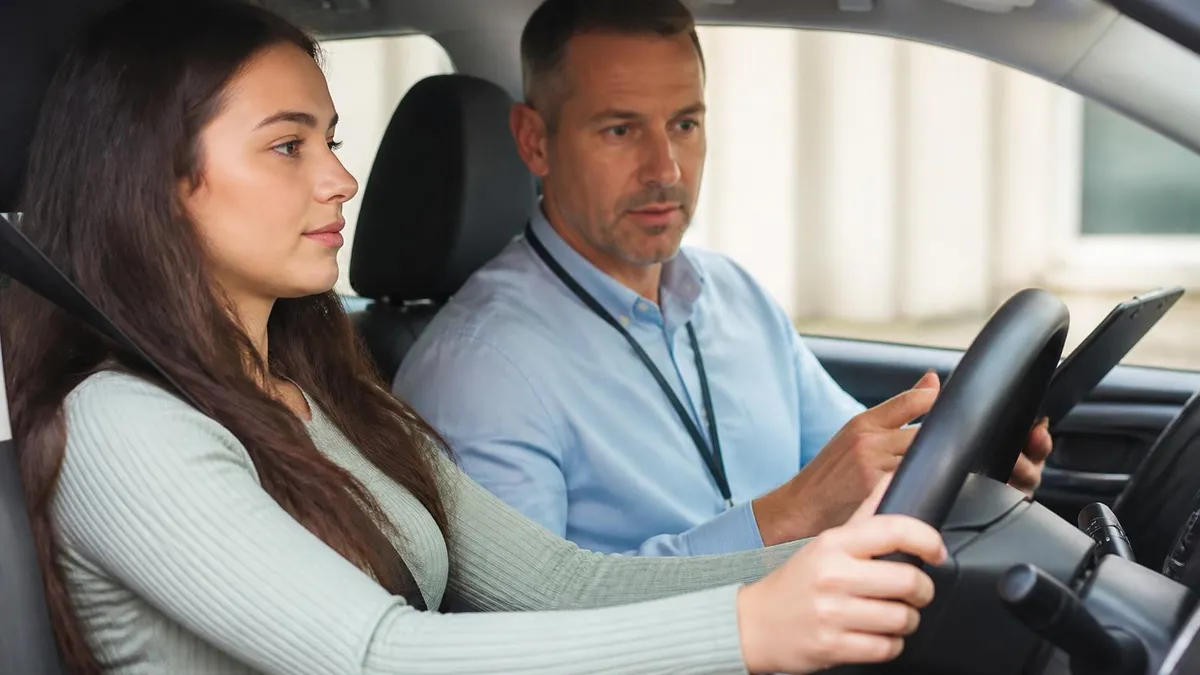
Drivers under 18 in Kentucky operate under graduated driver licensing rules that restrict nighttime driving from midnight to 6 AM and limit passengers in the first 180 days. Violations can extend the permit phase or delay your full license. Know these rules cold because they appear in three to five test questions per exam and apply to your driving for months after passing.
The morning of your Kentucky permit test should feel almost boring, and that is a feature, not a bug. Wake up two hours before your appointment, eat a balanced breakfast with protein and complex carbohydrates, and avoid heavy caffeine if you are not already a regular coffee drinker, because a sudden caffeine spike worsens test anxiety. Skip the last-minute cramming. Anything you do not know an hour before the test will not stick now, and review actively hurts confidence.
Double-check your document folder one last time before leaving the house. You need your birth certificate or passport for identity, your Social Security card or W-2 for the SSN requirement, two proofs of Kentucky residency such as a utility bill and bank statement dated within the last 60 days, and the signed parental consent and school compliance forms if you are under 18. Pile everything in a single labeled folder so the clerk can verify documents in one minute rather than ten.
Arrive 20 minutes before your scheduled appointment. Kentucky regional offices often run on a first-come basis even within appointment windows, and arriving early can mean testing 15 minutes ahead of schedule rather than waiting through delays. Use the waiting room time to breathe slowly, not to flip through flashcards. Your knowledge is already loaded. The goal now is to keep your heart rate down and your focus sharp.
When you sit down at the testing kiosk, take a full 30 seconds to read the instructions even though you already know the format. Confirm you can flag questions for review, navigate forward and back, and submit only when you are ready. Read every question twice before looking at the answer choices. This single habit prevents the negative-phrasing trap that costs unprepared students three to five questions per exam.
Use the flag-and-skip strategy for any question that takes more than 30 seconds. Move forward, answer everything you know first, and return to flagged questions with a clear head after seeing all 40. Often a later question contains context or wording that jogs your memory on an earlier one. Never leave a question blank because there is no penalty for guessing and a 25 percent chance beats zero every time.
For deeper logistics on what happens during your office visit, the Hours of Ohio BMV guide covers many shared principles around scheduling, peak times, and office workflow that apply across state DMV-equivalent offices including Kentucky's regional driver licensing centers. Knowing what the lobby looks like and how staff process applicants removes another layer of anxiety from an already nerve-wracking day.
Once you pass, the system prints a paper permit within minutes and your photo permit card mails within seven to ten business days. Your supervised driving phase begins immediately, and Kentucky requires 60 hours of behind-the-wheel practice including 10 nighttime hours before you can test for an intermediate license at age 16 and a half. Treat the permit as the start of real learning, not the finish line. The written test only proves you know the rules. Driving them well is the work ahead.
The final week before your Kentucky permit test is when smart preparation pays off most, and the temptation to overstudy can actually hurt your score. Stick to your established rotation of 30 to 45 minute sessions targeting weak areas from your error log. Take one full-length practice test every other day during the last week to maintain test-day stamina, and resist the urge to grind through six tests in a single Saturday because diminishing returns set in fast after the second consecutive test.
Build a topic-specific cheat sheet you can review during the last two days, but never read it during the actual exam. Include only the items you keep missing, such as exact BAC numbers, the specific passing distance for cyclists, school bus stop-arm distances for divided highways, and the point values for major violations. Writing the sheet by hand activates motor memory and reinforces retention even if you never look at it again.
Sleep is the most underrated test prep tool. Kentucky teens often book Saturday morning appointments after staying out late Friday night, and the resulting four to six hours of sleep can drop test performance by 10 to 15 percent. Aim for eight full hours the night before, and seven hours minimum for the three nights leading up to the appointment. Cognitive performance compounds over multiple nights of good sleep in ways a single rested night cannot replicate.
Mental rehearsal matters more than most people realize. Spend five minutes the evening before visualizing yourself walking into the office, presenting documents calmly, completing the vision screen, sitting at the kiosk, answering questions methodically, and seeing a passing score. This is not magical thinking. Sports psychologists have documented measurable performance gains from structured visualization across cognitive tasks, and the permit test is exactly the kind of structured cognitive task where this works.
Have a backup plan if you fail. Most Kentucky offices let you retake the exam the next business day, and acknowledging that possibility before walking in actually reduces anxiety. Failure on attempt one is not the end of the road. Some of the best lifelong drivers needed two attempts because they finally took the rules seriously after the first miss. The point of the test is competence, and competence sometimes requires a second look at the material.
After passing, immediately start logging supervised driving hours with a parent or licensed adult over 21. Kentucky's 60-hour requirement seems large until you realize most teens hit it naturally within six months of running errands and commuting to school. Track hours in a notebook or app because the intermediate license application requires the log, and forgetting to track them means starting over. The earlier you build the habit, the smoother your path to a full license.
Long term, treat the permit phase as the most valuable training period of your driving life. The supervised hours, the GDL restrictions, and the heightened legal stakes for any violation all combine to make this the moment where good habits get hardwired. Drivers who take the permit phase seriously have measurably lower crash rates in their first five solo years compared to drivers who treat it as a formality. Use the rules that helped you pass the test to actually drive better, not just to memorize answers.
Sample BMV Practice Questions
Try these questions from our free BMV practice tests. The correct answer and an explanation follow each question.
What is the minimum age to apply for a learner's permit in Ohio?
- A. 14 years
- B. 15 years and 6 months
- C. 16 years
- D. 18 years
Answer: B. 15 years and 6 months
Ohio allows teens to apply for a temporary permit at 15 years and 6 months.
You have to _________ until the other vehicle has safely passed you when it is passing you.
- A. Maintain your speed
- B. Brake suddenly
- C. Increase your speed
- D. Change lanes
Answer: A. Maintain your speed
When another vehicle is in the process of passing you, it is crucial to maintain your current speed. Increasing your speed would prolong the passing maneuver and create a dangerous situation, while braking suddenly could cause a rear-end collision. Maintaining a steady speed allows the passing driver to complete the maneuver safely and efficiently.
Which of the following scenarios does not permit you to use the leftmost lane when driving?
- A. When traveling at a higher speed than other vehicles
- B. When the left lane is designated for carpool use
- C. When driving within 10 mph of the speed limit
- D. When overtaking another vehicle
Answer: B. When the left lane is designated for carpool use
The leftmost lane on a multi-lane highway is typically designated for passing or faster traffic. However, if this lane is specifically marked as a High-Occupancy Vehicle (HOV) or carpool lane, its use is restricted to vehicles meeting specific criteria, such as carrying a minimum number of passengers. Driving in a carpool lane without meeting these requirements is a violation, meaning you are not permitted to use it in that scenario.
How long must a teen hold a temporary permit before taking the driving test?
- A. 30 days
- B. 3 months
- C. 6 months
- D. 12 months
Answer: C. 6 months
Teens under 18 must hold the permit for at least six months before the road test.
BMV Questions and Answers
Driver Test Car Rental in Gastonia, NC: Complete BMV Road Test Vehicle Guide

Ohio BMV Driving Test: Maneuverability, Road and Pass Tips

DMV Testing Area No Cell Phones Allowed: Complete Rules Guide for Your Driving Exam
Hours of Ohio BMV: Complete Guide to Office Hours, Locations, and Visit Planning

BMV Appointment Guide: How to Schedule, Prepare, and Pass Your Visit on the First Try
About the Author
Licensed Driving Instructor & DMV Test Specialist
Penn State UniversityRobert J. Williams graduated from Penn State University with a degree in Transportation Management and has spent 20 years as a certified driving instructor and DMV examiner consultant. He has personally coached thousands of applicants through written knowledge tests, skills assessments, and commercial driver licensing programs across more than 30 states.
Join the Discussion
Connect with other students preparing for this exam. Share tips, ask questions, and get advice from people who have been there.
View discussion (9 replies)