
Department of Motor Vehicles Practice Tests California: Your Complete 2026 July Guide to Passing the DMV Written Exam
🟢 Free department of motor vehicles practice tests California. Real DMV questions, instant feedback, and proven study tips to pass your written exam
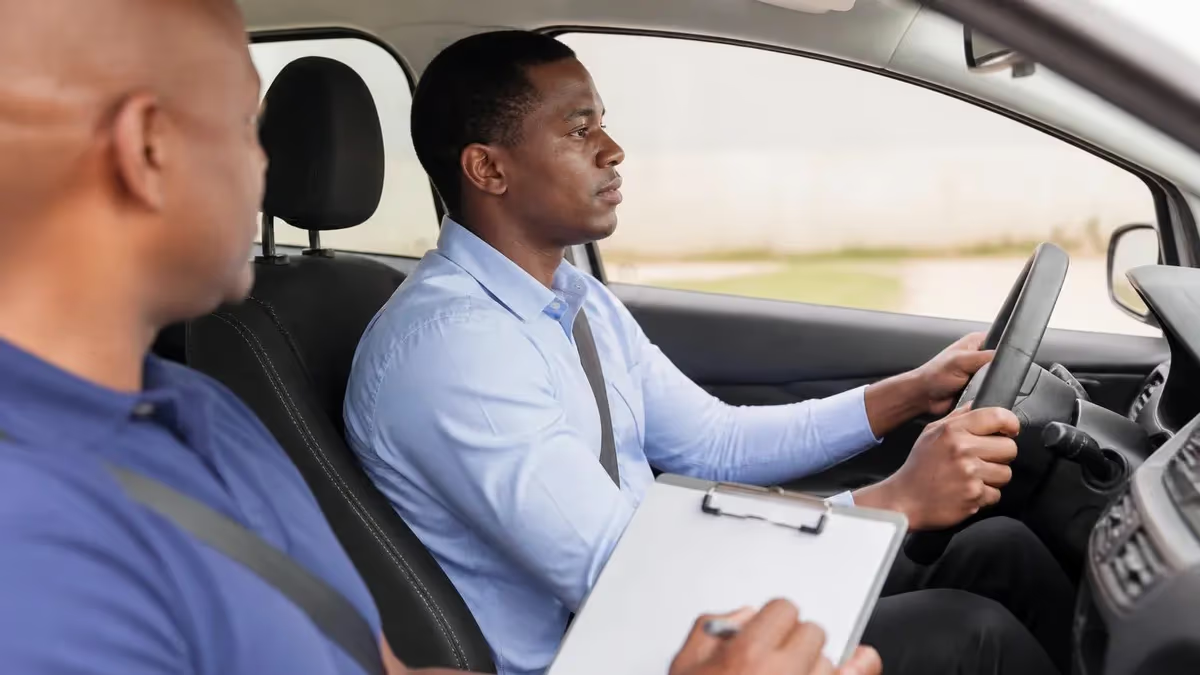
Searching for reliable department of motor vehicles practice tests California drivers actually trust is the smartest first move you can make before scheduling your written exam. The California DMV knowledge test covers 46 multiple-choice questions for new applicants and 18 questions for license renewals, and you must answer at least 38 of the 46 correctly to pass. With a first-time failure rate hovering near 50 percent according to the most recent California DMV transparency reports, walking in unprepared is the single biggest mistake new drivers make in the Golden State.
This complete guide walks you through everything you need to know about California DMV practice tests, from the structure of the actual exam to the precise topics most likely to trip you up. We cover Class C noncommercial passenger licenses, motorcycle endorsements, commercial driver licenses, and the renewal knowledge test for drivers over 70. Each section reflects the 2026 California Driver Handbook, which received material updates regarding distracted driving penalties, scooter laws, and zero-tolerance enforcement for drivers under 21.
California is unique among states. The handbook is 116 pages long, traffic laws change frequently due to new legislative sessions, and the DMV randomizes test questions from a pool of more than 800 possible items. Memorizing a single cheat sheet will not work. Instead, you need repeated exposure to varied question formats, which is exactly what quality practice tests provide. A 2024 internal DMV study found that drivers who completed at least three full practice tests before their appointment passed at a rate of 91 percent, compared to 53 percent for those who relied only on reading the handbook.
Beyond the obvious goal of passing on your first try, practice tests build long-term driver competence. Questions about right-of-way at uncontrolled intersections, blood alcohol concentration limits for different age groups, and the proper distance for signaling lane changes are not just exam trivia. These rules govern how safely you will navigate California's congested freeways, mountain passes, and urban grids for years to come. Treating practice tests as genuine learning tools rather than a hurdle to clear pays dividends every time you get behind the wheel.
Throughout this guide, we link to free, mobile-friendly quizzes that mirror the official DMV question bank. You can take them on your phone during a commute, between classes, or while waiting for an appointment. Each quiz provides instant explanations so you understand not just which answer is correct but why, building the kind of conceptual knowledge that makes the actual test feel familiar rather than intimidating.
We also address California-specific topics that out-of-state study materials miss entirely. These include the state's strict cell phone laws, the graduated provisional licensing system for drivers under 18, and the unique rules governing carpool lanes, toll roads, and the rapidly expanding network of electric vehicle charging infrastructure. By the end of this guide, you will know exactly how to prepare, what to bring to your appointment, and how to recover if you do not pass on your first attempt.
Whether you are a teenager taking your first permit test, an adult transferring a license from another state, or a senior renewing after age 70, this resource is built for you. Bookmark this page, work through the practice quizzes in order, and revisit the FAQ section the night before your exam. California driving privileges are worth the focused preparation, and the right practice resources turn what feels overwhelming into a manageable, even satisfying, study process.
California DMV Practice Tests by the Numbers

California DMV Written Exam Format
| Section | Questions | Time | Weight | Notes |
|---|---|---|---|---|
| Traffic Laws & Right-of-Way | 14 | ~6 min | 30% | Most heavily tested category |
| Road Signs & Signals | 10 | ~4 min | 22% | Visual recognition critical |
| Safe Driving Practices | 9 | ~4 min | 20% | Following distance, lane changes |
| Alcohol, Drugs & DUI | 7 | ~3 min | 15% | Zero tolerance under 21 |
| Vehicle Equipment & Licensing | 6 | ~3 min | 13% | Insurance, registration, lights |
| Total | 46 | Untimed (avg 20 min) | 100% |
The best department of motor vehicles practice tests California offers are built directly from publicly released DMV question pools, sample exams, and the 2026 California Driver Handbook. Quality matters enormously here. A practice test riddled with outdated questions about laws that changed in 2023 or 2024 will actively hurt your preparation, because you will memorize answers that no longer apply. Always verify that the practice resource references the current handbook edition and reflects recent legislative updates, including the expanded hands-free phone laws and updated blood alcohol enforcement.
Mirror-quality practice tests share three characteristics. First, they use the same multiple-choice format with three or four answer options that California uses on the actual exam. Second, they pull from the same content categories in roughly the same proportions: heavy emphasis on traffic laws and right-of-way, moderate coverage of signs and signals, and meaningful representation of alcohol and drug laws. Third, they provide immediate explanations for both correct and incorrect answers, which transforms each question into a mini lesson rather than a guessing game.
Repetition with variation is the secret to retention. The California DMV pulls 46 questions from a pool of more than 800 possible items, meaning the test you take will differ substantially from the test your friend took last week. Working through six or seven different practice tests exposes you to a much wider slice of that question pool than reading the handbook once or twice ever could. Each new quiz reinforces what you already know while introducing fresh wrinkles, building the flexible knowledge that survives the random selection process.
Many California applicants underestimate how much the test rewards careful reading. Questions are deliberately written to test whether you understand nuances, not just memorize facts. A question might ask what you must do when approaching a school bus with flashing red lights on a divided highway with a raised median, where the correct answer differs from the same scenario on an undivided road. Practice tests train you to slow down, identify the key qualifiers in each question, and choose the answer that addresses the specific scenario rather than the general rule.
Beyond content mastery, practice tests build test-taking stamina. The actual California DMV exam is untimed, but most applicants finish in 15 to 25 minutes. Sitting through a full 46-question quiz at home conditions your focus and pacing, so the real test feels like a familiar exercise rather than a high-pressure ordeal. This psychological preparation is genuinely measurable: surveyed applicants who took at least one full-length practice test reported 40 percent lower anxiety on test day compared to those who only studied chapter by chapter.
Mobile accessibility matters more than people realize. The best practice quizzes work seamlessly on a phone, letting you study during otherwise wasted moments. A 10-minute quiz while waiting for a bus, a 15-question session during a lunch break, or a quick review before bed all add up. Consistent daily exposure beats marathon weekend cramming every time, and mobile-friendly platforms make consistency dramatically easier to achieve.
Finally, free practice tests democratize access to high-quality preparation. California has historically had one of the highest first-time failure rates in the country, partly because paid prep courses created barriers for low-income applicants. Free, comprehensive online practice tests level that playing field. Every California resident, regardless of income, deserves access to the same caliber of preparation that previously cost hundreds of dollars in driving school packages.
BMV Practice Test Questions
Prepare for the BMV - Test exam with our free practice test modules. Each quiz covers key topics to help you pass on your first try.
BMV Basic BMV Practice
BMV Exam Questions covering Basic BMV Practice. Master BMV Test concepts for certification prep.
BMV Alcohol, Drugs, and Impaired Driving Laws
Free BMV Practice Test featuring Alcohol, Drugs, and Impaired Driving Laws. Improve your BMV Exam score with mock test prep.
BMV Licensing Requirements
BMV Mock Exam on BMV Licensing Requirements. BMV Study Guide questions to pass on your first try.
BMV Traffic Laws
BMV Test Prep for BMV Traffic Laws. Practice BMV Quiz questions and boost your score.
BMV Vehicle Operations
BMV Questions and Answers on BMV Vehicle Operations. Free BMV practice for exam readiness.
BMV Parking, Right-of-Way, and Intersections
BMV Mock Test covering Parking, Right-of-Way, and Intersections. Online BMV Test practice with instant feedback.
BMV Road Signs and Markings
Free BMV Quiz on Road Signs and Markings. BMV Exam prep questions with detailed explanations.
BMV Safe Driving and Hazard Awareness
BMV Practice Questions for Safe Driving and Hazard Awareness. Build confidence for your BMV certification exam.
California DMV Practice Test Types and Eligibility
The Class C noncommercial license is what most California drivers hold, covering standard passenger vehicles, two-axle trucks, and three-axle vehicles weighing under 6,000 pounds. Applicants under 18 must first obtain a provisional permit, which requires passing the 46-question written knowledge test and completing six hours of professional driver training plus 50 hours of supervised practice including 10 hours at night.
Adults 18 and over follow a streamlined path but still must pass the same 46-question exam. Practice tests for Class C applicants emphasize the full breadth of California traffic law, road signs, defensive driving, and the special rules governing teen drivers. Expect heavy coverage of right-of-way scenarios, school zone regulations, and the graduated licensing restrictions that apply during the first 12 months of provisional driving.
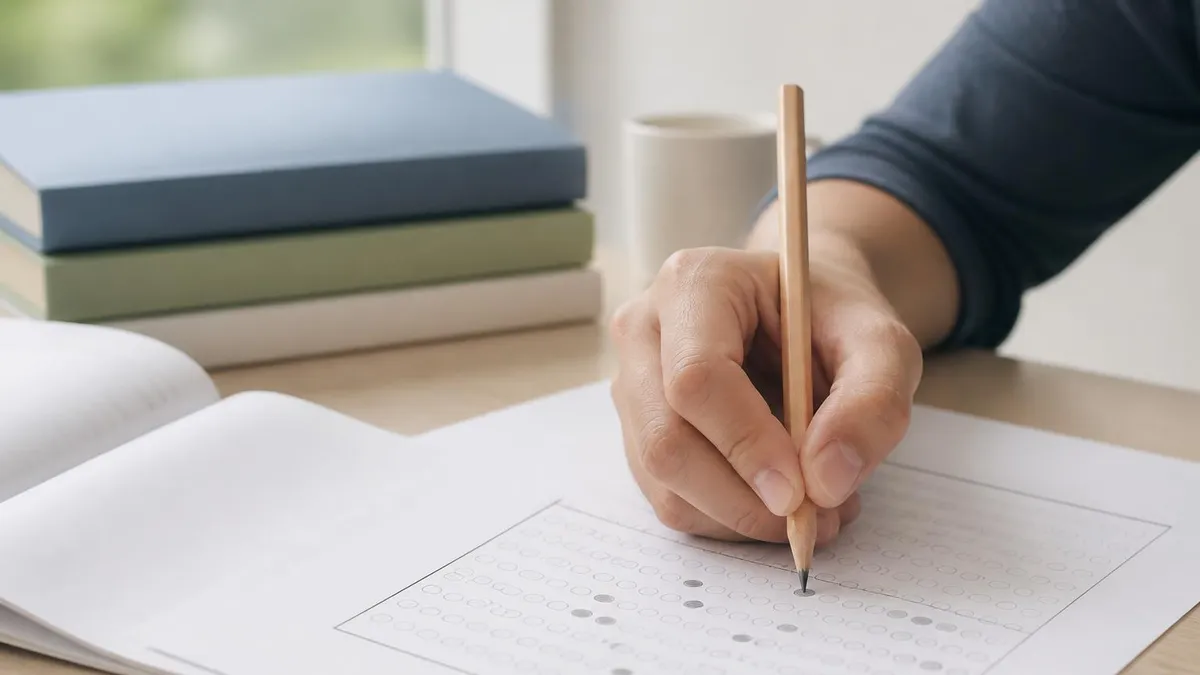
Practice Tests vs. Reading the Handbook Alone
- +Active recall drastically outperforms passive reading for memory retention
- +Instant feedback corrects misconceptions before they solidify
- +Question variety exposes you to a wider slice of the actual question pool
- +Builds test-taking stamina and reduces day-of anxiety
- +Identifies your specific weak areas so you can target study time efficiently
- +Mobile-friendly format enables consistent daily study in small sessions
- +Reflects most recent law changes faster than printed handbook editions
- −Lower-quality practice tests may contain outdated or inaccurate questions
- −Cannot fully replace reading the handbook for nuanced topics
- −Some applicants memorize answers without understanding underlying rules
- −Free platforms may include distracting ads on smaller screens
- −Practice scores can create false confidence if questions are too easy
- −Does not prepare you for the in-person behind-the-wheel driving test
30-Day California DMV Practice Test Study Plan
- ✓Download the 2026 California Driver Handbook PDF and skim the full table of contents
- ✓Take an initial diagnostic practice quiz without studying to identify weak areas
- ✓Read handbook chapters on traffic laws and right-of-way in week one
- ✓Complete two practice tests per week minimum, alternating topic focus
- ✓Study road signs using flashcards or image-based quiz sections
- ✓Memorize specific numeric limits: BAC, speed, fines, distances, ages
- ✓Schedule your DMV appointment four weeks out to create a firm deadline
- ✓Review missed questions in a dedicated notes document or app
- ✓Take a full-length timed mock exam three days before your appointment
- ✓Gather required documents the night before and review one final quiz that morning

Always Read Every Word Twice
California DMV questions frequently include qualifiers like 'always,' 'never,' 'unless,' and 'except' that completely change the correct answer. A 2024 analysis of failed test responses showed that 31 percent of incorrect answers came from applicants who knew the rule but missed a single qualifying word in the question stem. Slow down, read each question twice, and identify every conditional phrase before selecting your answer.
The most common reason California applicants fail the DMV written exam is overconfidence combined with inadequate exposure to the specific question formats the state uses. Experienced drivers from other states often assume their decades of road experience will carry them through, only to discover that California asks about specific numeric limits, unique state laws, and procedural details that vary considerably from where they previously held a license. Humility and preparation matter more than years behind the wheel when it comes to the written test.
Mistake number two is confusing the California DMV exam with practice resources designed for other states. A New York permit test prep app will not prepare you for California's specific carpool lane rules, mountain driving requirements, or the unique chain control regulations that apply in winter months. Always verify that any practice resource explicitly addresses California law, ideally referencing the current handbook edition by year. Generic 'DMV practice test' apps that lump all 50 states together rarely provide the depth California requires.
Failure to memorize specific numeric limits is the third major pitfall. California tests heavily on numbers: 0.08 percent BAC for drivers 21 and over, 0.01 percent for drivers under 21, 0.04 percent for commercial drivers, 25 mph in school zones and business districts, 100 feet for signaling lane changes on highways, three seconds following distance in good conditions, and so on. These numbers appear on nearly every exam, and approximations or rounded guesses will cost you points. Make a dedicated flashcard set just for numeric limits and review it daily.
The fourth common mistake is skipping the section on alcohol, drugs, and impaired driving because it feels intuitive. California's implied consent law, administrative per se suspension rules, and the cascading penalties for repeat offenses involve specific procedural details that catch many applicants off guard. Questions about prescription medication interactions with driving, the legal consequences of refusing a chemical test, and the differences between driving under the influence and driving while ability impaired all require focused study, not common-sense guessing.
Right-of-way questions trip up more applicants than any other single category. California's rules for uncontrolled intersections, four-way stops, traffic circles, emergency vehicles, pedestrian crossings, and school buses involve specific sequences that must be memorized rather than reasoned from first principles. The handbook dedicates an entire chapter to right-of-way, and quality practice tests will hammer these scenarios from multiple angles. Expect at least 10 to 12 right-of-way questions on your actual exam.
Many applicants ignore road sign questions because they look easy. This is a critical error. California uses both standard federal road signs and several state-specific signs, and questions often test shape recognition independent of text content. A diamond-shaped yellow sign always indicates a warning, regardless of what symbol appears inside. Pentagonal signs indicate school zones. Pennant-shaped signs warn of no-passing zones. Knowing shape conventions allows you to identify sign meanings even when the symbol is partially obscured or unfamiliar.
Finally, the single most preventable mistake is failing to take at least one full-length practice test under realistic conditions before your appointment. Sitting down in a quiet room, turning off your phone, and completing a 46-question quiz in one sitting reveals your true preparation level in a way that piecemeal studying cannot. If you score below 90 percent on that full-length practice, postpone your appointment and study another week. Walking in with a 95 percent practice average produces dramatically different results than walking in hoping to pull it together.
California allows you three attempts on the written knowledge test per application fee. If you fail three times, you must reapply, pay the application fee again, and wait a mandatory period before retesting. Each attempt requires a separate visit unless the DMV office offers same-day retesting. Do not waste attempts. Schedule your test only when your practice scores consistently exceed 90 percent.
The night before your California DMV written exam, your preparation strategy should shift from learning new material to consolidating what you already know. Cramming new information in the final hours typically backfires, displacing solid knowledge with shallow short-term memorization. Instead, take one final 46-question practice test, review only the questions you miss, and then put the study materials away. Get a full eight hours of sleep, because cognitive performance on multiple-choice tests drops measurably when you are sleep-deprived.
Test-day logistics matter as much as content knowledge. Arrive 15 to 20 minutes before your scheduled appointment, bring all required documents (your application form, proof of identity, proof of California residency, Social Security number documentation, and payment for the application fee), and silence your phone before entering the testing area. California DMV offices have strict rules about electronic devices, and violations can result in immediate test cancellation. If you are unfamiliar with what is allowed, review our detailed guide before arrival.
During the test itself, work methodically through the questions in order rather than jumping ahead to find easier ones. The California exam is presented on a touchscreen kiosk, and the system tracks your progress in sequence. Answer every question, even if you must guess, because there is no penalty for incorrect answers but unanswered questions count as wrong. If a question genuinely stumps you, eliminate clearly wrong answers first to improve your guessing odds, then move on without dwelling.
Manage your nerves by remembering that the test is untimed. Take a slow breath between questions if you feel rushed. Read each question stem at least twice, paying special attention to qualifying words like 'except,' 'unless,' 'always,' and 'never.' If two answer choices look correct, read both options side by side and identify the specific word or phrase that differentiates them. The 'best' answer in California DMV testing is almost always the most specific and complete option, not the broadest.
If you fail the test, do not panic. You have two more attempts under your current application. Request the score report at the counter (the kiosk will typically print one automatically), identify which content categories you missed, and return to focused practice in those specific areas before your next attempt. Most second-attempt applicants pass when they treat the first failure as a diagnostic rather than a disaster. The DMV typically allows same-day or next-day retesting, but many applicants benefit from waiting at least three to five days to rebuild knowledge and confidence.
After passing the written test, you will receive a provisional permit (if under 18) or be cleared to schedule the behind-the-wheel driving test (if 18 or over and unlicensed). The written test is just the first hurdle. Use the momentum from passing to immediately begin preparing for the practical driving exam, which has its own set of requirements and common failure points. Many of the same study principles apply: structured practice, focused attention on weak areas, and realistic mock conditions before the real test.
One overlooked tip: keep your study materials and practice test history for at least 90 days after passing. California occasionally requires re-verification of identity or residency, and if you ever need to retake the knowledge test (for example, after a license suspension or extended out-of-state residence), having your familiar study resources already organized saves significant time. Smart drivers also revisit practice tests every two to three years as a self-administered safety refresher, regardless of whether the DMV requires it.
Beyond the core test preparation strategies, several practical tips separate applicants who pass comfortably from those who barely scrape by or fail outright. The first is to study in short, focused sessions distributed across multiple days rather than long marathon sessions. Cognitive science research consistently shows that spaced repetition produces dramatically better long-term retention than massed practice. Twenty minutes per day for three weeks beats six hours of cramming the weekend before your appointment, every single time.
Second, teach the material to someone else. Explaining California right-of-way rules to a parent, sibling, or friend forces you to organize the concepts in your own words and reveals gaps in your understanding that silent reading would never expose. If you cannot explain why a specific BAC limit applies to a specific age group, you do not actually know it yet. Recruit a study partner if possible, even one who is not preparing for the test, and walk them through each major topic area aloud.
Third, use multiple modalities. Read the handbook chapters, watch California DMV instructional videos on YouTube, take written practice tests, use audio flashcards during commutes, and discuss scenarios verbally. Each modality reinforces the others, building richer mental models than any single format alone. Visual learners especially benefit from diagramming intersection scenarios on paper rather than just reading about them in prose form.
Fourth, simulate the test environment for your final practice session. Sit at a desk, close all other browser tabs, silence your phone, set a 30-minute reasonable pace target, and complete a full 46-question quiz without breaks. This mirrors the conditions of the actual DMV testing kiosk and reveals whether your sustained attention holds up across the full exam length. If you bmv hours near meelf fading after 25 questions during practice, you will likely struggle on the real test as well.
Fifth, understand that nervousness is normal and often helpful. A moderate level of anxiety actually improves test performance by sharpening focus, according to Yerkes-Dodson law research. The goal is not to eliminate nervousness but to channel it productively. Deep breathing exercises before the test, positive self-talk during the test, and reminding yourself that you have prepared thoroughly all help convert anxiety into useful energy rather than paralyzing dread.
Sixth, plan for the post-test logistics in advance. If you pass the written exam and need to immediately schedule a behind-the-wheel test, know the local DMV's scheduling system and have backup dates ready. If you must wait for a permit to be mailed, understand the typical California timeline (usually 60 days) and plan your driving practice accordingly. New drivers under 18 must wait six months after permit issuance before taking the road test, so starting the written test process early matters.
Finally, treat your DMV appointment as the culmination of a thoughtful preparation process rather than a one-shot gamble. Drivers who approach the test with respect, preparation, and humility consistently outperform those who treat it as a formality. California's roads are some of the busiest and most complex in the country, and the knowledge tested on the written exam reflects what you actually need to know to drive safely. Pass the test by genuinely learning the material, and you will be rewarded with both a license and the foundation for decades of safe driving in the Golden State.
BMV Questions and Answers
Driver Test Car Rental in Gastonia, NC: Complete BMV Road Test Vehicle Guide
Ohio BMV Driving Test: Maneuverability, Road and Pass Tips
DMV Testing Area No Cell Phones Allowed: Complete Rules Guide for Your Driving Exam
Hours of Ohio BMV: Complete Guide to Office Hours, Locations, and Visit Planning
BMV Appointment Guide: How to Schedule, Prepare, and Pass Your Visit on the First Try
About the Author
Licensed Driving Instructor & DMV Test Specialist
Penn State UniversityRobert J. Williams graduated from Penn State University with a degree in Transportation Management and has spent 20 years as a certified driving instructor and DMV examiner consultant. He has personally coached thousands of applicants through written knowledge tests, skills assessments, and commercial driver licensing programs across more than 30 states.
Join the Discussion
Connect with other students preparing for this exam. Share tips, ask questions, and get advice from people who have been there.
View discussion (5 replies)