
How Long Does BLS Certification Last? Complete 2026 October Renewal Guide
How long does BLS certification last? Learn the 2-year validity rule, ⏳ renewal timing, grace periods, and how to keep your AHA or Red Cross BLS card active.
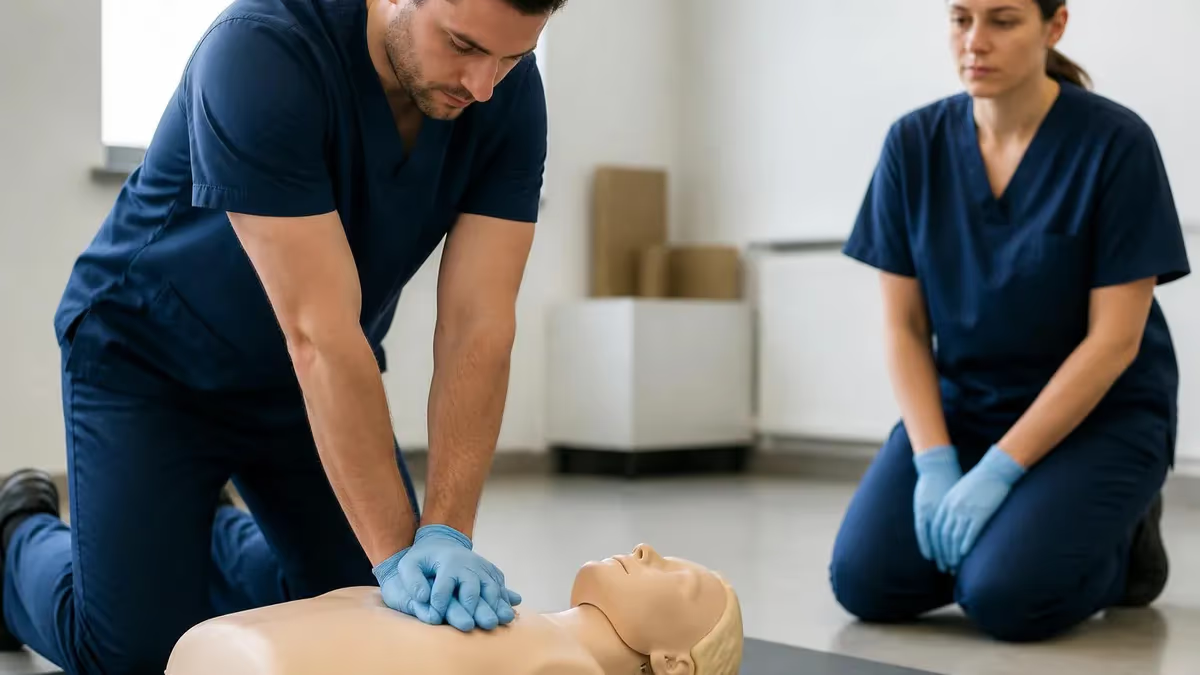
If you work in healthcare, public safety, childcare, or any field where you might respond to a cardiac emergency, one question comes up over and over: how long does BLS certification last? The short answer is two years from the date your course is completed, but the longer answer involves grace periods, employer policies, state nursing board rules, and the difference between American Heart Association and American Red Cross cards. Understanding the full timeline protects your job, your license, and ultimately the patients who depend on you.
Basic Life Support certification is the foundational credential that proves you can perform high-quality CPR, use an AED, relieve a foreign-body airway obstruction, and work as part of a resuscitation team. So is bls the same as cpr? Not exactly. BLS is a professional-level CPR course built around adult, child, and infant rescue, two-rescuer scenarios, and bag-mask ventilation, while consumer CPR classes are far shorter and less rigorous. That difference is one reason hospitals require BLS specifically rather than any generic CPR card.
The two-year window is not arbitrary. Resuscitation science evolves, compression depth recommendations shift, ventilation rates change, and skills like AED operation deteriorate measurably within six to twelve months of training. The American Heart Association and the International Liaison Committee on Resuscitation set the two-year recertification standard so providers refresh both their knowledge and their muscle memory before guidelines drift too far from practice. Some healthcare systems now require annual skill checks on top of the two-year card.
What does BLS stand for? It stands for Basic Life Support, and that name is intentional. It is the basic, universal starting point for any provider who will be first on scene during a cardiac arrest, respiratory emergency, or choking event. From there, providers can layer on Advanced Cardiac Life Support, Pediatric Advanced Life Support, and specialty courses, but every one of those advanced credentials assumes your BLS is current. Let your BLS lapse and your ACLS card often becomes administratively void as well.
This guide walks you through exactly when your card expires, how long you can wait before you have to retake the full course, what AHA and Red Cross actually print on the credential, how to read the expiration date correctly, and what employers do when they audit credential files.
You will also learn how to combine a renewal class with online practice tests so you walk into the skills station ready instead of rusty. By the end you will know precisely when to schedule renewal, how much it costs, and how to avoid the most common mistake providers make — assuming the card lasts until the end of the expiration month when in fact some employers enforce the exact day.
We will also cover the differences between in-person, blended, and fully online renewal options, the legal weight of digital eCards versus paper cards, what to do if your card is already expired, and how to document continuing competency between renewal cycles. Whether you are a brand-new nurse renewing for the first time, a paramedic on your tenth cycle, or a dental hygienist trying to figure out which provider your state board accepts, the answers are here in one place.
BLS Certification by the Numbers

Your BLS Certification Timeline
Day 1: Course Completion
Months 1-18: Active Status
Months 18-22: Renewal Window
Months 22-24: Final Window
Day 730: Expiration
Post-Expiration
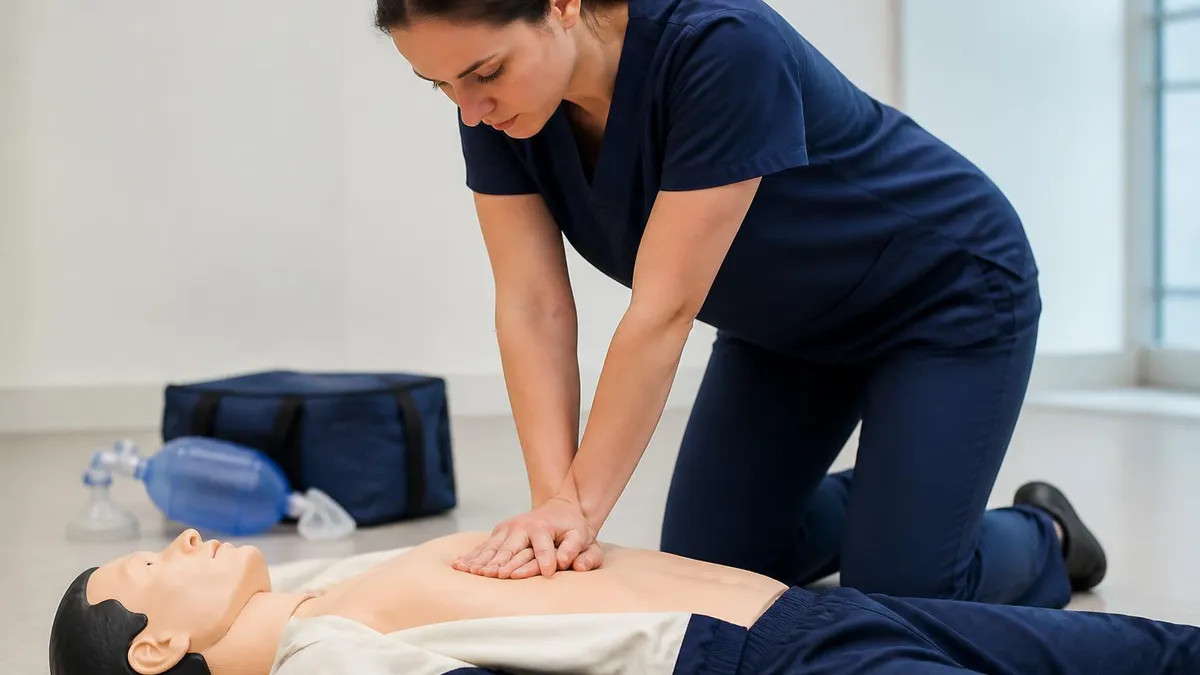
So basic life support renewal class options exist, but to understand why renewal matters you need to understand what BLS certification actually covers. The course teaches high-quality CPR with a focus on compression depth of at least two inches in adults, rate of 100 to 120 compressions per minute, full chest recoil between compressions, and minimizing interruptions to less than ten seconds. These metrics are now measured in many courses using feedback manikins that score your performance in real time.
The curriculum also covers the chain of survival for both in-hospital and out-of-hospital cardiac arrest, recognition of cardiac arrest versus a viable pulse, activation of emergency response, AED use including pad placement on adults, children, and infants, bag-mask ventilation using the E-C clamp technique, and relief of choking in responsive and unresponsive victims across all age groups. Two-rescuer scenarios train you to switch compressor roles every two minutes without losing tempo.
What is a BLS certification meant to prove? Competency in team dynamics is increasingly central. Modern BLS courses spend significant time on closed-loop communication, clear role assignment, knowing your limitations, and constructive intervention. Real cardiac arrests are not solo events — they involve a team leader, compressor, ventilator, monitor or AED operator, and IV access provider when available. Your card certifies that you can plug into that structure without slowing it down.
For basic life support for healthcare providers, the course differs from community CPR in important ways. Healthcare BLS includes pulse checks using the carotid or femoral artery, opioid-associated emergency response with naloxone administration awareness, recognition of agonal breathing, and the integration of advanced airways into the compression cycle. Lay rescuer courses simplify or skip these elements because the target learner will never use them.
The American Heart Association also includes a written cognitive exam, typically 25 multiple-choice questions, with a 84 percent passing threshold. The Red Cross structures its written exam slightly differently but requires the same demonstration of mastery. Both organizations require a hands-on skills test for adult and infant CPR, AED use, and bag-mask ventilation. You cannot pass with the written exam alone — the skills check is non-negotiable.
Knowing this scope explains why the two-year clock matters. Skills atrophy. Studies published in Resuscitation and Circulation consistently show meaningful degradation in compression quality, ventilation volume, and AED pad placement within months of initial training, with the gap widening sharply by twenty-four months. The renewal cycle exists not to generate revenue for training centers but because the evidence shows providers measurably lose competence on this exact timeline.
If you are renewing after a busy two years of frequent CPR participation, your skills will be sharper than someone whose only chest compressions were on a manikin. Either way, the renewal class enforces a baseline reset so guideline changes, new evidence, and skill drift all get addressed in one session. The two-year cycle is the floor, not the ceiling.
BLS Practice Test Questions
Prepare for the BLS - Basic Life Support exam with our free practice test modules. Each quiz covers key topics to help you pass on your first try.
BLS High-Quality CPR & Provider Skills
BLS Exam Questions covering BLS High-Quality CPR & Provider Skills. Master BLS Test concepts for certification prep.
BLS Special Situations & Scenarios
Free BLS Practice Test featuring BLS Special Situations & Scenarios. Improve your BLS Exam score with mock test prep.
BLS Adult, Child & Infant Resuscitation
BLS Mock Exam on Adult, Child & Infant Resuscitation. BLS Study Guide questions to pass on your first try.
BLS Airway Management & Ventilation
BLS Test Prep for Airway Management & Ventilation. Practice BLS Quiz questions and boost your score.
BLS Automated External Defibrillator (AED)...
BLS Questions and Answers on Automated External Defibrillator (AED) Use. Free BLS practice for exam readiness.
BLS Certification: Cardiac Arrest
BLS Mock Test covering Certification: Cardiac Arrest. Online BLS Test practice with instant feedback.
BLS Certification: Choking
Free BLS Quiz on Certification: Choking. BLS Exam prep questions with detailed explanations.
BLS Certification: Respiratory Arrest
BLS Practice Questions for Certification: Respiratory Arrest. Build confidence for your BLS certification exam.
BLS Chain of Survival
BLS Test Online for Chain of Survival. Free practice with instant results and feedback.
BLS CPR Techniques & Procedures
BLS Study Material on CPR Techniques & Procedures. Prepare effectively with real exam-style questions.
BLS Legal & Ethical Considerations
Free BLS Test covering Legal & Ethical Considerations. Practice and track your BLS exam readiness.
BLS Post-Resuscitation Care
BLS Exam Questions covering Post-Resuscitation Care. Master BLS Test concepts for certification prep.
AHA vs Red Cross: What Is a BLS Certification From Each?
The AHA basic life support exam is the most widely accepted BLS credential in U.S. hospitals and remains the gold standard for healthcare employer requirements. AHA cards are issued as digital eCards through the AHA Atlas portal within twenty business days of course completion. The card displays a unique QR code that employers and credentialing offices can scan to verify authenticity in seconds.
AHA BLS follows the 2020 Guidelines updated by interim science reviews. The course runs about four hours in classroom format or two to three hours skills-only when paired with HeartCode BLS online cognitive training. Renewal also lasts exactly two years, with the card expiring on the last day of the issue month. AHA does not officially recognize grace periods — when it expires, it expires.

Renewing Early vs Waiting Until Expiration
- +Eliminates risk of accidental lapse and last-minute scheduling stress
- +Some employers reimburse renewal only if completed before expiration
- +Keeps you eligible to pick up extra shifts or float assignments without compliance flags
- +Lets you bundle renewal with annual employer-mandated competencies
- +Locks in current pricing before training centers raise rates
- +Preserves continuous credentialing history for license applications
- +Allows time to retake the skills station if you do not pass on first attempt
- −Resets your two-year clock from the new completion date, slightly shortening total coverage time
- −Some employers won't reimburse if more than 60 days remain on the existing card
- −You pay full renewal cost rather than coordinating with employer-sponsored group classes
- −May overlap with other annual training, creating a heavy compliance month
- −Card issuance can take up to 20 business days, so the new card may not be in hand immediately
- −Early renewal does not waive any state board continuing education requirements
Pros and Cons at a Glance
| Pros | Cons |
|---|---|
| Eliminates risk of accidental lapse and last-minute scheduling stress | Resets your two-year clock from the new completion date, slightly shortening total coverage time |
| Some employers reimburse renewal only if completed before expiration | You pay full renewal cost rather than coordinating with employer-sponsored group classes |
| Keeps you eligible to pick up extra shifts or float assignments without compliance flags | May overlap with other annual training, creating a heavy compliance month |
| Lets you bundle renewal with annual employer-mandated competencies | Early renewal does not waive any state board continuing education requirements |
BLS Renewal Checklist: Don't Miss a Step
- ✓Locate your current BLS card and confirm the exact expiration date and issuing provider
- ✓Verify with your employer which BLS provider they accept (AHA, Red Cross, or other)
- ✓Schedule your renewal class at least 30 days before expiration to allow buffer time
- ✓Choose between in-person, blended (online cognitive plus in-person skills), or skills-only format
- ✓Complete any prerequisite online modules before your scheduled skills check date
- ✓Review the latest AHA or ILCOR guideline updates for any changes since your last certification
- ✓Practice high-quality CPR compressions on a manikin or feedback device beforehand
- ✓Take a free BLS practice test to identify knowledge gaps before the written exam
- ✓Bring photo identification and your current BLS card to the renewal session
- ✓Save your digital eCard to your phone and upload it to your employer's compliance portal within 48 hours
Your card expires at the end of the month — but your employer may not
AHA states that BLS cards are valid through the last day of the month printed on the card. However, many hospital credentialing systems mark you non-compliant on the first day of the expiration month, not the last. Always treat the first day of the expiration month as your true deadline to avoid being pulled from clinical duty.
The renewal process is more flexible than it used to be. A decade ago, renewing meant a full half-day in a classroom, sitting through slides you had seen four times before. Today, blended learning dominates the BLS renewal landscape. You complete the cognitive portion online at your own pace, then attend a one-to-two-hour in-person skills session where an instructor verifies your hands-on competence with manikins, AED trainers, and bag-mask devices. Total time invested often drops below three hours.
Step one is choosing your delivery format. HeartCode BLS from the AHA pairs online cognitive learning with either an in-person or voice-assisted manikin skills check. The Red Cross offers a similar blended option through its Learning Center. Both formats produce identical credentials — there is no asterisk on your card noting that you renewed via blended learning. Employers treat blended and traditional renewals the same.
Step two is preparation. Even if it is your third or fourth renewal cycle, skim the current provider manual. The 2020 AHA Guidelines updated compression-to-ventilation ratios for some scenarios, formalized the role of naloxone in opioid-associated emergencies, and refined recommendations on AED use in pregnant patients. A quick read through the recent updates ensures you are not caught off guard by a written exam question that reflects a change.
Step three is the cognitive exam. The AHA written test is 25 multiple-choice questions with a passing score of 84 percent, meaning you can miss four questions maximum. The Red Cross uses a similar threshold. Both exams are open-resource in some online formats but timed and proctored in others, depending on the specific course version. If you fail, you typically get one immediate retake; failing twice usually requires re-enrollment.
Step four is the skills test. You will demonstrate adult one-rescuer CPR with AED, adult two-rescuer CPR with bag-mask ventilation, infant CPR with two-thumb encircling technique, and adult and infant choking relief. Each station has explicit pass criteria — compression depth, rate, full recoil, correct hand placement, proper AED pad placement, and effective ventilation volume. Instructors use checklists, not subjective judgment.
Step five is card issuance. AHA digital eCards typically arrive in your Atlas account within seven to twenty business days after course completion, though some training centers issue them within forty-eight hours. Red Cross digital certificates are usually available immediately upon course completion. Save the digital card to your phone, screenshot it as a backup, and upload it to your employer's credentialing portal the same day.
Step six is documentation. Keep a personal record of every BLS renewal — date completed, training center, instructor name, and card expiration. If your employer ever audits credentials or your nursing board asks for proof of continuing competency, this record makes the process trivial. Many providers maintain a simple spreadsheet of all professional certifications and renewal dates, which doubles as a planning tool for the next cycle.

Heartsaver CPR AED is the AHA's community-level course aimed at lay rescuers, teachers, and parents. It is not equivalent to BLS and will not satisfy a hospital, nursing home, or EMS employer requirement. If your employer requires BLS for healthcare providers, a Heartsaver card will be rejected at credentialing. Verify the exact course name on any card before you assume it qualifies.
What happens if your BLS does expire? The consequences range from minor inconvenience to immediate suspension from clinical duties, and they depend on three factors: how long it has been expired, what your state nursing or EMS board requires, and your individual employer's policies. Let's walk through each scenario so you know exactly what to expect — and how to fix it fast.
If your card lapses by less than thirty days, most training centers will still let you take the standard renewal class rather than the full initial course. Some employers may temporarily pull you from direct patient care until the new card is uploaded, while others provide a brief grace window. The aha basic life support exam renewal pathway is generally still open during this window, saving you both time and money.
If your card has been expired between thirty and ninety days, the situation tightens. The AHA technically does not recognize any grace period, meaning some training centers will require you to enroll in the full initial BLS provider course rather than the shorter renewal. This adds an hour or two to your class time and may add cost. Employer policies vary widely here — some are flexible, others are strict.
If your card has been expired more than ninety days, you should expect to take the full initial BLS course. There is no shortcut. From a credentialing standpoint, an old expired card carries no weight, and you are treated as a new learner. The good news is the cognitive content is familiar, so the cost and time investment are predictable, even if slightly more than a renewal class.
State licensing implications can be serious. Several state nursing boards explicitly require current BLS certification as a condition of practicing as a registered nurse. Practicing with an expired card could theoretically constitute practicing outside your license conditions, exposing you to disciplinary action separate from any employer consequences. EMS providers face similar exposure through state EMS office regulations and protocol oversight.
Then there is the liability question. If an adverse event occurs during a resuscitation and your BLS card was expired at the time, plaintiff attorneys will absolutely use that fact in litigation, regardless of whether your actual performance was clinically appropriate. Hospital risk management offices know this, which is why credentialing departments are so aggressive about pulling expired providers from bedside duty.
The fastest recovery path is simple: if you discover an expiration, do not work clinically until renewed. Notify your manager honestly, schedule the soonest available class — many training centers offer next-day skills checks — and document the gap and remediation in writing. Most employers will treat an honest, quickly resolved lapse as a one-time issue rather than a disciplinary matter.
Now that you know exactly how long BLS certification lasts and how to renew, here are the practical tips that separate providers who breeze through renewal from those who struggle. The single most useful habit is calendaring your expiration date the day you receive your card, with reminders at six months, three months, and thirty days before expiration. Use whatever you actually check — phone calendar, work calendar, sticky note on your badge — but build the trigger now.
Practice with feedback. Manikins with real-time compression feedback are now widely available at training centers and many hospital simulation labs. Even a fifteen-minute practice session a week before your skills test will dramatically improve your compression depth, rate, and recoil scores. Healthcare workers consistently overestimate their own compression quality without feedback — the data is humbling but actionable.
Take free online practice questions. The written exam covers predictable topics: chain of survival, compression metrics, ratios for one and two rescuers, AED pad placement, choking relief sequence, and team dynamics. Spending an hour on quality practice questions before the exam catches the knowledge gaps that two years of clinical work may have left behind, especially in areas like infant CPR if you do not work pediatrics.
Bundle renewal with annual employer competencies if your employer offers in-house BLS classes. Many hospital education departments hold monthly or quarterly BLS sessions at no cost to staff, with built-in skills practice on the same equipment used clinically. The catch is scheduling — popular sessions fill quickly, so book the moment the calendar opens, often six to eight weeks ahead.
If you supervise other staff, coordinate group renewals. Many training centers offer reduced rates for groups of six or more, and scheduling everyone on the same day eliminates the staggered compliance tracking that plagues most departments. This is especially powerful for clinic managers, school nurses, dental practices, and small EMS agencies where a single coordinated renewal day can replace months of one-off scheduling chaos.
Keep both a digital and printed copy of your current card. Phones die, apps log out, and credentialing portals occasionally have outages. A printed wallet card or PDF saved to multiple locations means you are never the person delaying a hire date or shift assignment because no one can locate proof of your certification. This small redundancy has saved countless providers from administrative headaches.
Finally, treat each renewal as an actual learning opportunity rather than a checkbox. Guidelines do change, evidence does evolve, and your skills do decay even if your confidence does not. Approach the renewal with the same seriousness you brought to your first BLS class as a student. The patients who will benefit from your competence over the next two years deserve that effort, and your performance on the day it counts will reflect the seriousness you brought to renewal day.
Sample BLS - Basic Life Support Practice Questions
Try these questions from our free BLS - Basic Life Support practice tests. The correct answer and an explanation follow each question.
A post-arrest patient's CT scan of the head shows loss of gray-white matter differentiation. What does this indicate?
- A. Normal post-resuscitation finding
- B. Diffuse anoxic brain injury
- C. Intracranial hemorrhage
- D. Cerebral venous thrombosis
Answer: B. Diffuse anoxic brain injury
Loss of gray-white matter differentiation on CT indicates diffuse cerebral edema from anoxic brain injury, a poor prognostic sign.
How does early defibrillation affect survival from cardiac arrest caused by ventricular fibrillation?
- A. It has no proven benefit if CPR has already been started
- B. Every minute of delay reduces survival by approximately 7–10%
- C. It is only beneficial within the first 60 seconds of arrest
- D. Survival rates are not affected by defibrillation timing
Answer: B. Every minute of delay reduces survival by approximately 7–10%
For VF cardiac arrest, each minute without defibrillation reduces survival by approximately 7–10%, underscoring the importance of rapid AED use.
How long should a rescuer take to check for a pulse before beginning CPR?
- A. Up to 5 seconds
- B. No more than 10 seconds
- C. Up to 20 seconds to be certain
- D. 30 seconds using both carotid and radial pulses
Answer: B. No more than 10 seconds
Pulse checks should take no more than 10 seconds; if no pulse is felt within that time, begin CPR.
What does 'post-cardiac arrest myocardial dysfunction' typically involve?
- A. Permanent scarring of the myocardium
- B. Transient global ventricular dysfunction that usually recovers within 48–72 hours
- C. Immediate valve rupture requiring surgery
- D. Irreversible cardiogenic shock
Answer: B. Transient global ventricular dysfunction that usually recovers within 48–72 hours
Post-arrest myocardial stunning is transient and typically improves within 2–3 days with appropriate hemodynamic support.
BLS Questions and Answers
About the Author

Registered Nurse & Healthcare Educator
Johns Hopkins University School of NursingDr. Sarah Mitchell is a board-certified registered nurse with over 15 years of clinical and academic experience. She completed her PhD in Nursing Science at Johns Hopkins University and has taught NCLEX preparation and clinical skills courses for nursing students across the United States. Her research focuses on evidence-based exam preparation strategies for healthcare certification candidates.
Join the Discussion
Connect with other students preparing for this exam. Share tips, ask questions, and get advice from people who have been there.
View discussion (8 replies)