
Air Traffic Controller: How to Become One, Salary, and What the Job Is Really Like
Free Air Traffic Controller: How to Become practice test with questions and answer explanations. Prepare for the 2026 October exam with instant scoring. 🧠
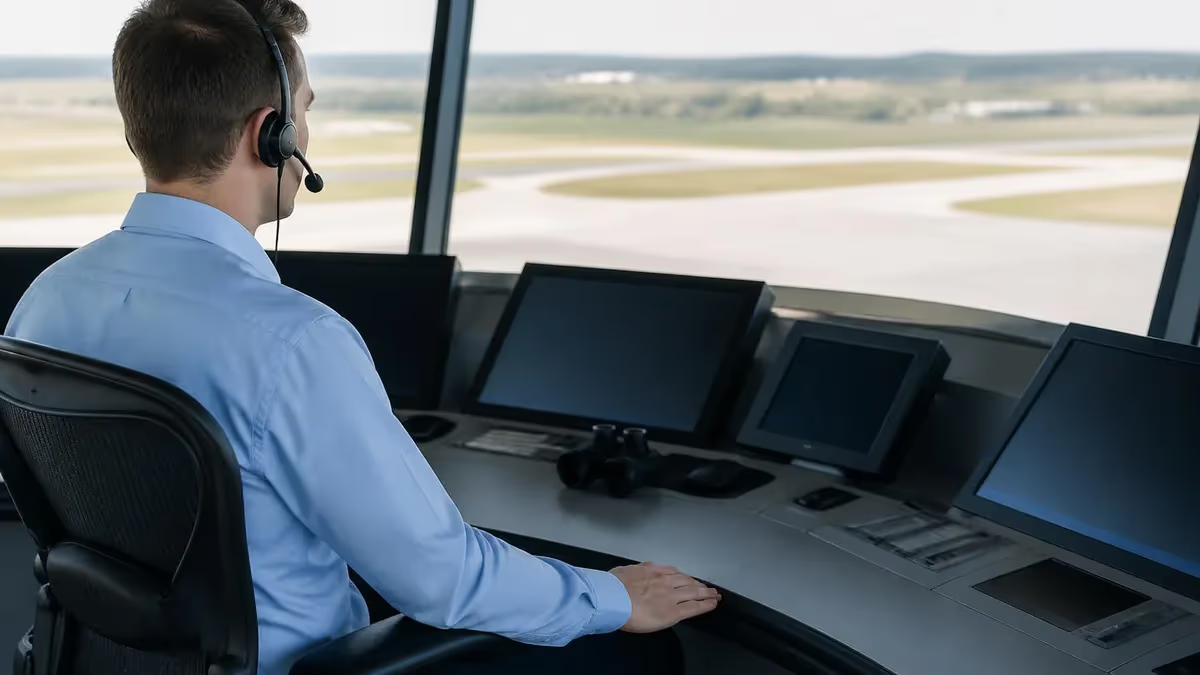
An air traffic controller manages the movement of aircraft through designated airspace and on airport surfaces — ensuring separation, sequencing traffic efficiently, and responding to emergencies in real time. In the United States, the FAA employs over 10,000 certified controllers at facilities ranging from small regional towers to major en route centers that handle high-altitude traffic over hundreds of miles. It's a high-stakes, technically demanding career that comes with one of the highest compensation packages in the federal government — and one of the most rigorous hiring and training pipelines in any field.
Entry requirements are strict and non-negotiable. Candidates must be U.S. citizens, hold at least an associate degree or equivalent work experience (typically three years of full-time progressively responsible work), pass a demanding medical exam, clear a security investigation, and — critically — must begin FAA Academy training before age 31. That age cutoff eliminates many otherwise qualified candidates who discover the field too late. If you're considering this career, the earlier you start, the more options you have.
The path from application to certified controller typically takes 3–5 years: FAA selection process, the 3–5 month academy program in Oklahoma City, then on-the-job training at an assigned facility that can take 2–4 more years depending on the complexity of the airspace. Not everyone makes it — roughly 30–40% of academy graduates don't complete facility certification. But those who do enter one of the most respected technical professions in aviation, with job security, strong union representation, and compensation that reflects the cognitive demands of the role.
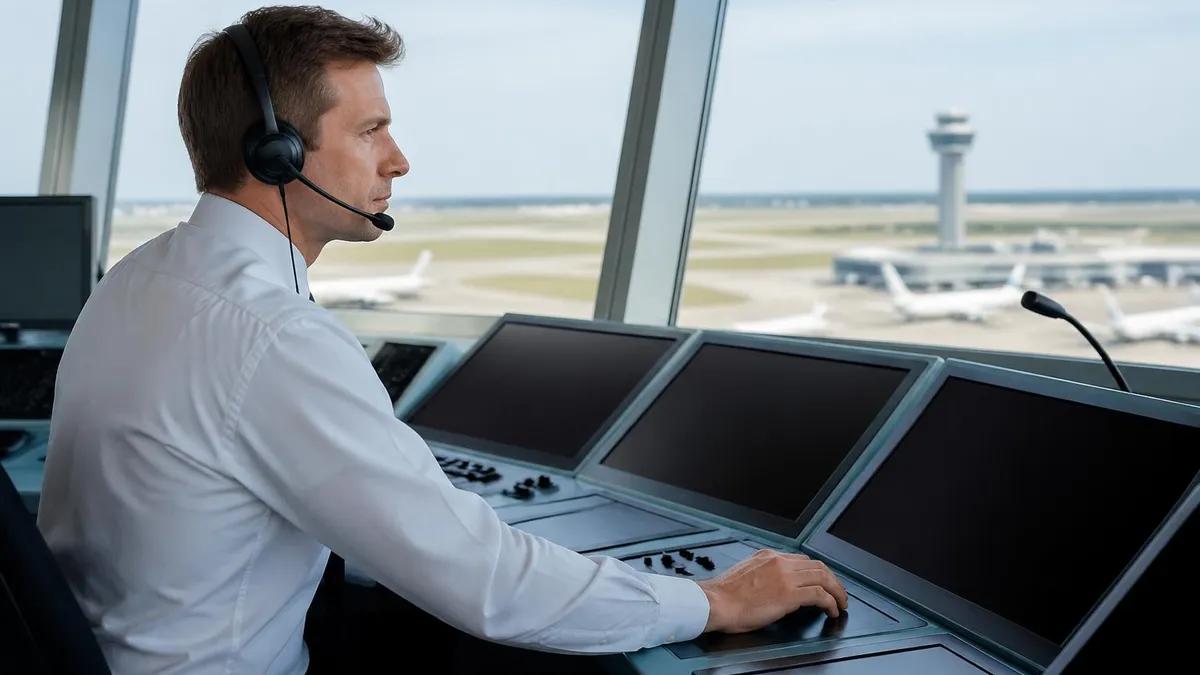
Air traffic control divides into two main domains: terminal control (managing aircraft arriving, departing, and taxiing at airports) and en route control (managing aircraft during the cruise phase of flight between airports). Terminal controllers work in airport control towers and TRACONs (Terminal Radar Approach Control facilities). En route controllers work in ARTCCs (Air Route Traffic Control Centers), tracking aircraft over vast geographic areas at high altitude. The cognitive demands, traffic volumes, and working environments differ substantially between the two.
FAA facilities are classified by complexity on a 1–12 pay scale — higher numbers mean more traffic, more complex airspace, and significantly higher pay. A Level 5 facility handles regional airport traffic; a Level 12 handles a major hub like LAX or O'Hare with hundreds of operations per hour. Controllers are typically assigned to a facility after academy graduation, and most spend years at that facility before transferring. Facility level directly determines base pay through the FAA pay band system negotiated with NATCA (National Air Traffic Controllers Association).
The job itself involves communicating with pilots via radio, issuing clearances and instructions, monitoring radar displays, coordinating with adjacent sectors, and managing emergencies — all simultaneously. During peak traffic, controllers manage 10–20 aircraft at once within their sector. The cognitive load is substantial: you must hold a mental map of every aircraft's position, altitude, speed, and route — while also anticipating conflicts 5–10 minutes ahead. Controllers describe it as playing 3D chess at high speed, with no pause button.
Airspace classification is foundational ATC knowledge — it determines what rules govern aircraft operations, what communication requirements apply, and how controllers manage different types of traffic. U.S. airspace is divided into Class A (18,000–60,000 feet, IFR only), Class B (major airports, most complex), Class C (medium airports, mandatory contact), Class D (tower-controlled airports), Class E (general controlled airspace), and Class G (uncontrolled). Each class has specific entry requirements, equipment requirements, and controller responsibilities that candidates must know cold before attempting certification.
Separation standards — the required minimum distances between aircraft — are another core competency. Radar separation in en route airspace is typically 5 nautical miles horizontally or 1,000 feet vertically. In terminal areas with higher traffic density, reduced separation standards apply under specific conditions. These standards aren't negotiable: violating them triggers a safety investigation, can end a career, and is treated with the same seriousness as a near-miss event in any other safety-critical industry.
Technology plays a central role in modern ATC. The main tools are radar displays showing aircraft positions, STARS (Standard Terminal Automation Replacement System) in terminal facilities, ERAM (En Route Automation Modernization) in ARTCCs, and VSCS (Voice Switching and Control System) for radio communications. Controllers also use flight strips (electronic or paper, depending on the facility) to track each aircraft's clearance, planned route, and current status. Understanding how these systems work together — and what to do when any one fails — is part of the training curriculum.
Air Traffic Controller Career Paths
Tower controllers manage aircraft on the ground and in the immediate vicinity of the airport. A typical tower position sequence includes Ground Control (taxiway management), Local Control (runway operations and pattern traffic), and Clearance Delivery (issuing IFR clearances before departure). At busy airports, each position is staffed separately; at smaller towers, a single controller may handle all positions during slow periods.
Tower work is highly visual — controllers look out the window constantly, supplemented by surface radar at larger facilities. The pace at major hubs like Atlanta or Dallas is intense and relentless during peak hours. At smaller regional airports, it's more measured but requires the same level of technical precision regardless of traffic volume.
FAA controller salary is structured through a pay band system negotiated by NATCA. Entry-level controllers (D Band) start around $38,000–$60,000 depending on location. Controllers at lower-complexity facilities (F/G Band) earn $70,000–$110,000. At high-complexity facilities like major ARTCCs or Tier 1 TRACONs, fully certified controllers earn $150,000–$180,000 in base pay, plus locality adjustments that push total compensation higher in expensive metro areas. Controllers also receive excellent federal benefits — pension, health insurance, and the option to retire at age 50 with 20 years of service (mandatory retirement at 56).
The mandatory retirement age of 56 is a defining feature of the career. Controllers hired in their late 20s get a full career; those hired at 30 have a shorter window. This is why the age 31 entry cutoff exists — it's designed to ensure candidates have a minimum working window before mandatory retirement. The FAA is currently facing significant staffing shortages driven by mass retirements from controllers hired in the early 1990s after the PATCO strike, creating substantial hiring demand through the late 2020s.
Pay also varies by shift differential, overtime availability, and annual leave accrual. Experienced controllers at busy facilities often earn $200,000+ in total compensation including overtime. The NATCA contract provides strong job protections, a well-defined promotion path, and input on scheduling. It's one of the few federal jobs where union membership meaningfully affects both compensation and working conditions for individual employees.

Radar and technology proficiency is a core competency tested throughout ATC training and recurrent qualification. The primary radar display in terminal facilities shows aircraft position, altitude, groundspeed, and data block information including callsign and flight plan details. En route ERAM displays add predicted conflict alerts (CA) and minimum safe altitude warnings (MSAW) that flag potential problems before they develop. Learning to manage display clutter while tracking multiple aircraft simultaneously is a skill that takes months of supervised practice to develop.
ATC radar uses two types: primary radar (returns from the aircraft's physical structure) and secondary surveillance radar (SSR, which interrogates the aircraft's transponder for altitude and identification). In modern ATC, SSR is the primary operational tool because it provides much richer data — mode C returns give altitude automatically, mode S transponders provide additional data including aircraft type and TCAS information. Areas with poor radar coverage use procedural separation based on position reports, time, and altitude rather than radar.
Technology failures — radar outages, communications issues, STARS system crashes — require controllers to revert to procedural separation immediately. This is a real scenario, not a theoretical one: radar facilities experience partial or full outages several times per year for various reasons. Controllers must maintain procedural skills alongside their radar skills. The ability to manage aircraft safely without radar is tested during training and periodically reviewed throughout a controller's career.
Air Traffic Control Career: Pros and Cons
- +Among the highest-paid federal jobs — median $137K, top earners exceed $200K total compensation
- +Mandatory federal retirement at 56 with excellent pension after just 20 years of service
- +Strong job security and union (NATCA) representation with defined promotion pathways
- +Intellectually demanding work that keeps you mentally sharp — no two shifts are identical
- +Significant staffing shortages through the late 2020s mean sustained hiring demand
- +Clear sense of purpose — you're directly responsible for the safety of thousands of passengers daily
- −Mandatory retirement at 56 limits total career length — especially for candidates hired in their 30s
- −Age 31 entry cutoff eliminates many qualified candidates who discover the field too late
- −3–5 year training pipeline with real washout risk — approximately 30–40% don't complete facility certification
- −Shift work is mandatory including nights, weekends, and holidays throughout the career
- −High chronic stress — errors carry real consequences and the cognitive load is sustained and intense
- −Geographic inflexibility early in career — facility assignments are determined by FAA, not the controller
The FAA hiring process begins with USAJobs.gov, where the FAA posts controller vacancies periodically — not continuously. The most common entry pathway is the Public vacancy (open to all qualified applicants) which requires the Air Traffic Skills Assessment (ATSA), a computer-based test administered at Pearson VUE centers. The ATSA tests multitasking ability, pattern recognition, abstract reasoning, and the ability to hold spatial information in working memory. It's specifically designed to predict success in ATC training — and the scoring is competitive, not pass/fail. Only top-scoring candidates advance.
Candidates who clear the ATSA move to medical screening (Class II or Class III medical based on facility type), security investigation, and a structured interview. The process from initial application to academy start can take 12–24 months. Veteran's preference applies and significantly improves selection odds for qualified veterans. CTI (Collegiate Training Initiative) graduates from FAA-approved aviation programs receive additional points in the selection process and may be able to skip portions of the academy curriculum.
The FAA Academy in Oklahoma City is a 3–5 month residential program covering the knowledge fundamentals: airspace structure, separation standards, radar interpretation, communications procedures, weather impacts on traffic management, and simulation exercises. Academy washouts are typically due to the radar simulation exercises rather than the written academics — the ability to mentally track multiple targets simultaneously either develops quickly or it doesn't. Candidates who struggle with the simulation component rarely pass the final academy checkride.

How to Become an Air Traffic Controller: Step-by-Step
- ✓Confirm eligibility: U.S. citizen, under age 31 at academy start, able to pass FAA medical exam
- ✓Meet education/experience requirements: associate degree or 3+ years of progressively responsible work
- ✓Monitor USAJobs.gov for FAA Air Traffic Controller vacancy announcements (openings are periodic)
- ✓Complete the Air Traffic Skills Assessment (ATSA) at a Pearson VUE testing center
- ✓Pass FAA medical screening and background/security investigation after ATSA selection
- ✓Complete the FAA Academy residential program in Oklahoma City (3–5 months)
- ✓Accept facility assignment — location is determined by FAA based on operational needs
- ✓Begin On-the-Job Training (OJT) at your assigned facility under a certified OJTI
- ✓Progress through facility position certifications — each position requires separate checkride
- ✓Achieve Certified Professional Controller (CPC) status — typically 2–4 years after academy graduation
On-the-job training (OJT) at the facility is where most washouts occur. Each position at a facility (Ground, Local, Approach, Departure, etc.) requires separate certification through a training progression followed by a formal evaluation. A controller in training works alongside a certified OJTI who can take over instantly if needed. As the trainee's skills develop, the OJTI becomes progressively less involved — first actively coaching, then monitoring, then simply present. The final evaluation is a formal observed session where the trainee must demonstrate independent, safe control of the position.
Trainees who fail position certifications are given additional training opportunities up to a point — but if progress is insufficient, they may be reassigned to a less complex facility or, in some cases, separated from the controller workforce. The FAA takes the quality of its controller workforce seriously, and washing out of OJT is a recognized outcome rather than an edge case. This is why candidates are encouraged to understand the demands of the job before beginning the process — not just academically, but at a practical level of self-assessment.
Once certified at all required positions, a controller holds CPC status (Certified Professional Controller) and becomes a fully independent controller. CPCs undergo proficiency checks every few years, take recurrent training on emergency procedures and new systems, and must maintain currency on each certified position. Controllers who return from extended leave must complete recurrency training before working independently again. Certification isn't a one-time achievement — it's maintained continuously throughout the career.
ATC separation standards are the non-negotiable rules that define how far apart aircraft must be maintained under different conditions. In radar airspace, the standard horizontal separation is 5 nautical miles; vertical separation is 1,000 feet below FL290 and 2,000 feet at FL290 and above (reduced to 1,000 feet in RVSM airspace where equipped aircraft participate). These aren't guidelines — exceeding the minimums isn't optional, and any reduction in separation triggers an Operational Error investigation that can affect a controller's career regardless of outcome.
Wake turbulence separation — the additional spacing required behind heavy or super-heavy aircraft — adds another layer of complexity. A Boeing 777 (heavy) requires specific separation from following aircraft because of the powerful wingtip vortices it generates. Those vortices persist for several minutes and can roll a smaller aircraft uncontrollably. Controllers must apply wake turbulence separation rules in addition to standard separation, especially during approach sequencing where aircraft are following each other at close intervals onto the final approach course.
Weather impacts on separation deserve special attention. Instrument approaches during low-visibility conditions require controllers to space aircraft further apart to allow time for missed approach maneuvers. Thunderstorms cause aircraft to deviate from filed routes, requiring dynamic rerouting and coordination across sectors and centers. Controllers who work high-traffic facilities during summer convective season deal with constant rerouting, holding, and traffic management coordination — arguably the most demanding cognitive environment in the entire ATC system.
The working schedule for a fully certified controller follows a rotating pattern — most facilities use a 2-2-1 or similar schedule that cycles through days, evenings, and midnight shifts over a two-week period. Shift work is non-negotiable for most of a controller's career; senior controllers with enough seniority bidding may eventually get day shifts, but junior controllers typically work all shift variations. The FAA enforces mandatory rest periods between shifts (typically 9 hours minimum), and NATCA has negotiated provisions limiting the most extreme schedule variations.
Physical and mental health management matters enormously in this career. Controllers are prohibited from consuming alcohol within 8 hours of their shift and must report any medication use to aviation medical examiners. Certain medical conditions (hypertension, uncorrected vision below standard, some psychological diagnoses) require special issuance or can disqualify candidates entirely. Controllers who develop disqualifying conditions mid-career face difficult options — medically separated controllers may qualify for disability benefits or reassignment to administrative roles, but the physical standards are strictly enforced throughout the career, not just at entry.
The community of air traffic controllers is tight-knit — most controllers work with the same colleagues for years at a single facility, and NATCA provides a strong union culture. Professional pride in technical mastery is universal among working controllers. Passing the ATSA, making it through the academy, completing OJT, and earning CPC status creates a shared experience that defines professional identity in a way few other careers replicate. If you make it through, you'll know exactly why the standards are so high.
ATC Practice Test Questions
Prepare for the ATC - Air Traffic Controller exam with our free practice test modules. Each quiz covers key topics to help you pass on your first try.
ATC Airspace Classification
ATC Exam Questions covering Airspace Classification. Master ATC Test concepts for certification prep.
ATC Radar and Technology
Free ATC Practice Test featuring ATC Radar and Technology. Improve your ATC Exam score with mock test prep.
ATC Separation Standards
ATC Mock Exam on ATC Separation Standards. ATC Study Guide questions to pass on your first try.
ATC Challenges and Stressors
ATC Test Prep for Challenges and Stressors. Practice ATC Quiz questions and boost your score.
ATC Communication Procedures
ATC Questions and Answers on Communication Procedures. Free ATC practice for exam readiness.
ATC Emergency Procedures
ATC Mock Test covering Emergency Procedures. Online ATC Test practice with instant feedback.
ATC Responsibilities and Duties
Free ATC Quiz on Responsibilities and Duties. ATC Exam prep questions with detailed explanations.
ATC Skills and Qualifications
ATC Practice Questions for Skills and Qualifications. Build confidence for your ATC certification exam.
If you're preparing for the Air Traffic Skills Assessment (ATSA) or building foundational knowledge for the FAA Academy, systematic practice is the most effective preparation strategy. The ATSA tests specific cognitive abilities — multitasking, spatial reasoning, working memory — that can be developed through deliberate practice over weeks rather than crammed in days. Our ATC practice quizzes cover the knowledge domains you'll encounter at the academy and in facility training: airspace classification, radar and technology systems, and separation standards.
Practicing these topics actively — working questions, reviewing explanations for incorrect answers, understanding the why behind each rule — builds the mental models that make ATC training click. The rules aren't arbitrary; they exist because of specific accident histories and aerodynamic physics. Understanding that context makes the rules easier to remember and easier to apply correctly under the time pressure of real control situations.
Whether you're at the very beginning of exploring this career or actively preparing for academy content, the time you invest now pays dividends throughout the training pipeline. Controllers who arrive at the FAA Academy with a solid theoretical foundation progress faster, require less remediation, and carry more confidence into the simulation exercises where the real selection pressure is applied. Start early, practice systematically, and approach the certification process with the same precision the job itself demands.
ATC Questions and Answers
About the Author
Commercial Pilot & FAA Certification Specialist
Embry-Riddle Aeronautical UniversityCaptain Jennifer Walsh graduated with honors in Aerospace Engineering from Embry-Riddle Aeronautical University and holds FAA Airframe & Powerplant and Airline Transport Pilot certificates. With 11 years of commercial aviation experience and 6 years as a ground school instructor, she guides aviation mechanics and student pilots through FAA written exams and practical tests.
Join the Discussion
Connect with other students preparing for this exam. Share tips, ask questions, and get advice from people who have been there.
View discussion (8 replies)