
Advanced Placement Online Courses: AP Prep Guide 2026 October
Free Advanced Placement Online practice test with instant ❓ feedback and detailed answer explanations. Prepare for your exam.
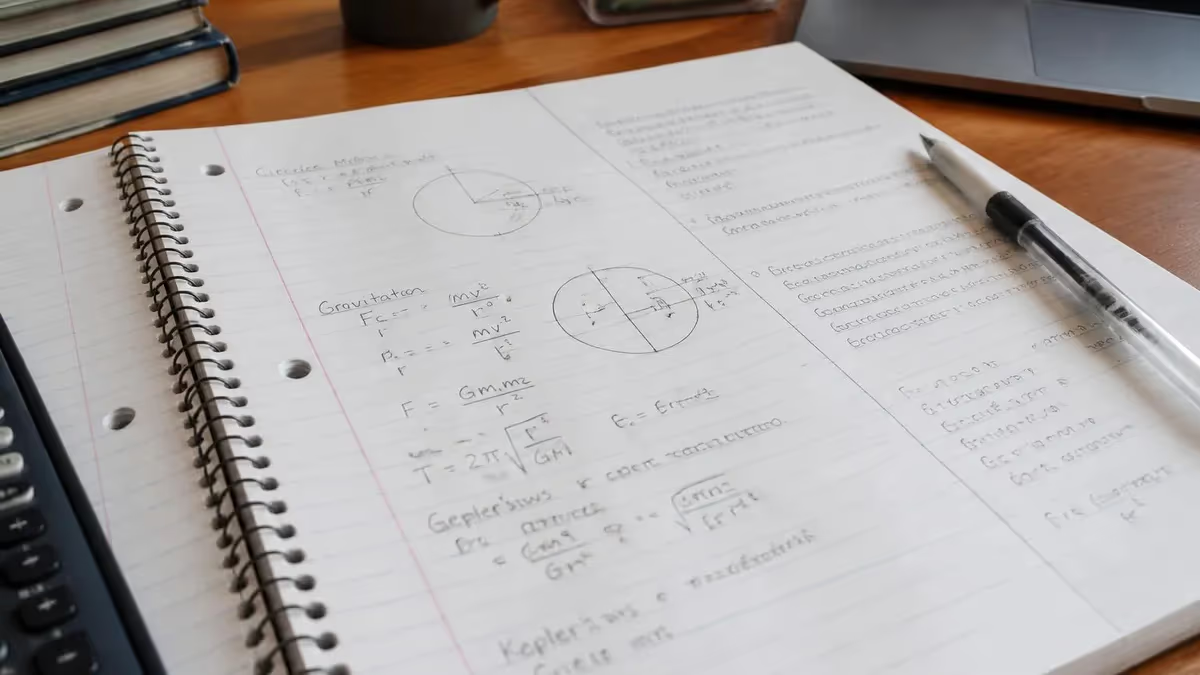
Advanced Placement online courses have become a legitimate alternative to in-person AP classes—and in some cases, the better option. Whether your school doesn't offer a specific AP course, you want to add an AP subject outside your school's catalog, or you're homeschooled and building your own academic program, online AP options have expanded significantly over the past few years.
This guide covers what online AP courses actually look like, which providers are worth considering, what's available for free vs. paid, and how online AP preparation compares to a traditional classroom when it comes to exam performance.
What Makes a Course "AP-Worthy"?
The College Board doesn't certify specific online AP courses the way they certify AP classes in schools. When your school offers an AP course, it goes through the AP Course Audit process, and the teacher submits syllabi that the College Board reviews. Online providers outside of schools typically don't go through this process—which means the label "AP prep" or "AP online course" is used broadly.
For students, the key distinction is: you don't need to take an AP course (online or in-person) to take the AP exam. The AP exam is open to anyone who signs up. The course is just preparation for the exam. So when evaluating an online AP course, ask: does this content actually prepare me to score 3 or higher on the official College Board AP exam? That's the only outcome that matters.
Free AP Online Resources Worth Using
AP Classroom
If you're enrolled in a school that offers the AP course, you likely have access to AP Classroom through your teacher. AP Classroom provides instructional resources, practice questions tied to exam skills, progress checks by unit, and video lessons. It's the most directly exam-aligned resource available. Students enrolled in AP courses at participating schools get free access.
Khan Academy
Khan Academy has partnered with the College Board to offer official SAT prep, and their general content covers many AP subjects in depth—especially AP Physics, AP Calculus, AP Chemistry, AP Biology, and AP Statistics. The instruction quality is high and it's completely free. It won't walk you through every AP subject, but for the core STEM AP courses, Khan Academy is legitimately useful as a study tool.
Microsoft Learn and Coursera Free Tiers
For AP Computer Science Principles, platforms like Coursera and edX offer free introductory computer science courses that cover the same conceptual territory as the AP exam. These aren't AP-specific, but they teach the underlying content effectively.
College Board's AP Daily Videos
The College Board publishes AP Daily—a series of short instructional videos by AP teachers covering all AP subjects. These are available free on the College Board website and YouTube channel. Each video is tied to a specific AP learning objective, making them useful for targeted review of weak areas.
Pro Tip: Focus your AP study time on areas where you score lowest. Most exam questions test application of knowledge, not memorization.
Paid Online AP Courses: What to Look For
Several providers offer structured online AP courses with instruction, assignments, and sometimes live teacher interaction. These are worth considering if you're self-studying and want more structure than free resources provide.
Outlier.org
Outlier offers college-level courses taught by university professors, including courses that align with AP subjects like Calculus and Statistics. Courses cost around $400 and include actual college credit from an accredited institution—not just AP exam prep. If you're trying to earn both AP exam performance and guaranteed college credit, this model has advantages.
Johns Hopkins Center for Talented Youth (CTY)
CTY offers online courses for academically advanced students, including AP-aligned courses. These are rigorous, instructor-led, and use a structured school-year or accelerated format. Tuition runs in the $1,000–$2,000 range per course. They're accredited through Johns Hopkins and can sometimes appear on transcripts, which has value beyond exam prep alone.
APEX Learning
APEX Learning is used by many school districts to provide online courses, including AP courses that go through the College Board's AP Course Audit. If your school is an APEX partner, you may have access to AP courses through this platform at no additional cost. The courses are structured with assignments and assessments, making them suitable for students who need formal course structure.
Time4Learning and Connections Academy
For homeschooled students, these platforms offer full-year AP courses that include curriculum, assessments, and teacher support. They serve students in grades 9–12 and provide the kind of year-round instruction that the most demanding AP exams (like AP Chemistry or AP US History) genuinely need.
How Online AP Courses Compare to In-Person Classes
The honest answer is that AP exam performance correlates strongly with preparation quality—not with whether the course was online or in-person. Students who use high-quality resources consistently and work through substantial amounts of practice material perform well on AP exams regardless of the learning format.
Online courses have specific advantages: flexibility of pace, the ability to study subjects your school doesn't offer, and access to high-quality instruction that may not be available locally. They also have challenges: self-discipline requirements are higher, the feedback loop on understanding is slower without a live teacher, and laboratory science AP exams (Chemistry, Biology, Physics) are harder to prepare for without actual lab work.
For AP exams with strong conceptual written components—AP US History, AP English Literature, AP Comparative Government—the practice of writing AP-style free-response essays with feedback is critical. Make sure any online course or self-study approach you use includes regular essay writing practice, not just multiple-choice review.
The ap world history study guide and AP exam dates resources are useful complements to any online course—they provide the structured review framework and pacing that online self-study sometimes lacks.
AP Exams Without Taking a Course
Many students successfully take AP exams without enrolling in any AP course—online or in-person. This is especially common for self-motivated students who want to test out of college requirements in subjects they've studied independently. If you've been programming seriously for three years and want to take AP Computer Science A, you may not need a formal course at all—structured self-study with College Board's curriculum framework and practice exams may be sufficient.
To register for an AP exam without being enrolled in a course, contact local schools in your area that serve as AP testing sites. Many schools accept outside students for AP exam registration, though you'll need to register early (typically by November for May exams). Your state's College Board coordinator can also help identify testing sites near you.
- +Industry-recognized credential boosts your resume
- +Higher earning potential (10-20% salary increase on average)
- +Demonstrates commitment to professional development
- +Opens doors to advanced career opportunities
- −Exam preparation requires significant time investment (4-8 weeks)
- −Certification fees can be $100-$400+
- −May require continuing education to maintain
- −Some employers may not require certification


Building a Realistic AP Online Study Schedule
The biggest risk with self-studying for AP exams—whether with an online course or free resources—is underestimating how much time serious preparation takes. AP exams are designed to reflect a full year of college-level coursework. Cramming six weeks before the exam works for some standardized tests; it generally doesn't work for AP exams, especially the ones with rigorous free-response components.
A realistic self-study timeline for most AP exams is 4–6 months of part-time study (1–2 hours per day, 4–5 days per week). That's enough time to cover the curriculum at depth, do multiple rounds of practice, and work through past free-response questions with serious attention to the scoring guidelines.
Start your online preparation in the fall if you're taking the May exams. Use the first two months to cover content by unit, the next month to do mixed practice, and the final month to focus on full practice exams and essay writing. Keep your study sessions focused—90 minutes of concentrated practice beats three hours of distracted reviewing every time.
The AP exam schedule and registration deadlines are published by College Board annually. Check them early in the school year so you can plan your study timeline backward from your exam date. Missing registration deadlines is an avoidable mistake that forces you to wait an entire year for the next exam window.
About the Author

Educational Psychologist & Academic Test Preparation Expert
Columbia University Teachers CollegeDr. Lisa Patel holds a Doctorate in Education from Columbia University Teachers College and has spent 17 years researching standardized test design and academic assessment. She has developed preparation programs for SAT, ACT, GRE, LSAT, UCAT, and numerous professional licensing exams, helping students of all backgrounds achieve their target scores.
Join the Discussion
Connect with other students preparing for this exam. Share tips, ask questions, and get advice from people who have been there.
View discussion (3 replies)