
Hs and Ts ACLS: Reversible Causes of Cardiac Arrest 2026 October
Hs and Ts ACLS guide: 5 Hs (hypovolemia, hypoxia, acidosis, hypo/hyperkalemia, hypothermia) + 5 Ts with treatment doses and bedside checks. 🟢
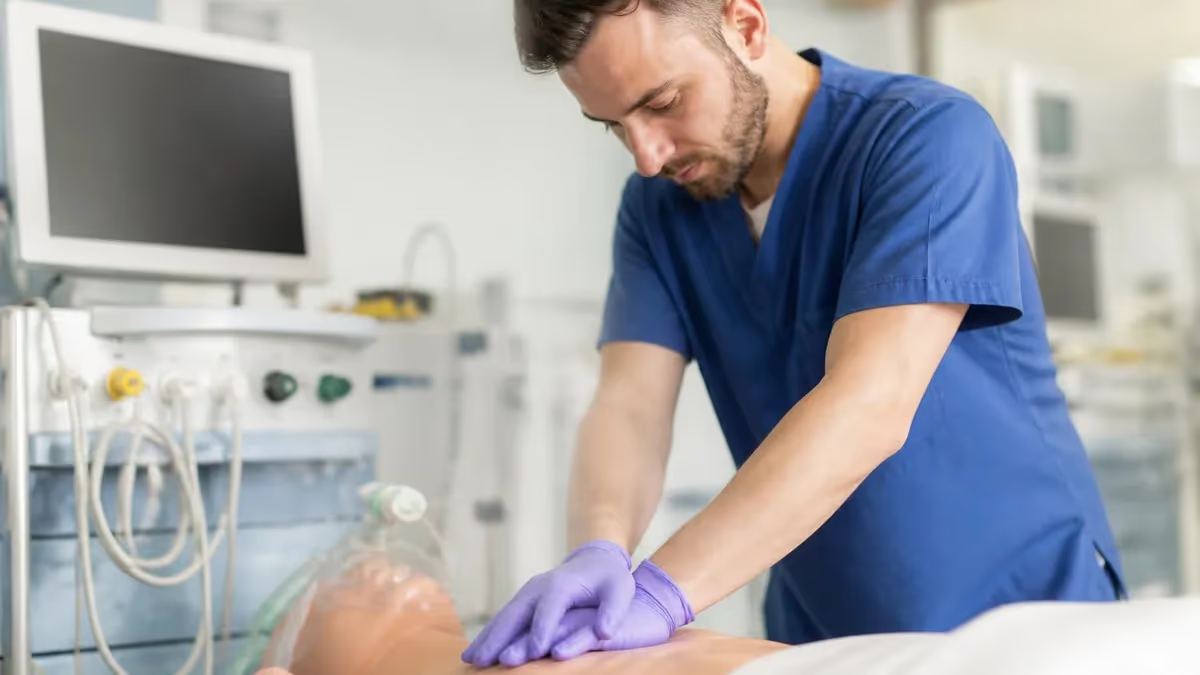
Hs and Ts ACLS: The 10 Reversible Causes of Cardiac Arrest
The Hs and Ts are the ten reversible causes of cardiac arrest you must rule out — and treat — during every ACLS resuscitation. Five start with H, five start with T, and together they cover roughly 95% of arrests that can actually be fixed at the bedside. Master them, and you stop running blind compressions while a treatable problem keeps the patient dead.
Here's the brutal truth most new ACLS providers miss. You can run a flawless megacode — perfect compressions, clean shocks, epi on the clock — and still lose the patient because nobody asked why the heart stopped. The algorithm gives you 2 minutes between rhythm checks. That window is when you screen the Hs and Ts, not when you stand watching the monitor wait for the next pulse check to come around.
This guide breaks down each cause with the bedside finding that points to it and the specific drug, dose, and procedure that fixes it. We'll cover the order to think through them, the mnemonics that actually stick, and how the AHA tests these in the acls precourse self assessment answers and full megacode scenarios. If you can rattle off all ten plus their treatments in 30 seconds, you're ready.
Pair this with the acls algorithm for the full cardiac arrest flow, and check the acls drugs page for pharmacology specifics. The reversible cause search is built into the algorithm — it's not optional, and skipping it is the most common reason megacode candidates fail.
One more setup point. The Hs and Ts apply to all four cardiac arrest rhythms: ventricular fibrillation, pulseless ventricular tachycardia, pulseless electrical activity, and asystole. PEA and asystole especially demand a deliberate reversible-cause search because there's no shockable rhythm to chase. If you see PEA on the monitor, your team should be hunting an H or a T within seconds.
The 5 Hs: Hypovolemia, Hypoxia, Acidosis, Potassium, Hypothermia
The 5 Hs cover what's wrong with the patient's circulating volume, oxygen, pH, electrolytes, and temperature. Each has a quick bedside check and a specific fix you can deliver inside the next 2-minute compression cycle.
Of the five, hypoxia and hypovolemia are the two you'll see most outside the cath lab. Hypoxia presents after respiratory failure, drowning, choking, or a failed intubation. Hypovolemia shows up after trauma, GI bleeds, ruptured aneurysms, or septic shock that progressed to arrest. Both are easy to fix — fluid for one, oxygen and a working airway for the other — provided you actually screen for them.
Acidosis, hyperkalemia, and hypothermia are less common but absolutely deadly when missed. The dialysis patient who codes with peaked T-waves doesn't need another round of epi. They need calcium, insulin, D50, bicarb, and albuterol within 90 seconds of arrival.
One subtle point on hypoxia worth flagging early. A patient can have a normal SpO2 reading and still be hypoxic if perfusion is poor or if methemoglobinemia or carbon monoxide poisoning is in play. The pulse ox lies in those scenarios. Confirm with an ABG measuring PaO2 directly, and ask the team for CO and methemoglobin levels if the history fits — house fire, faulty heater, garage door closed.
And on hypovolemia: pre-hospital crews are excellent at flagging this when they hand off. Listen to the report. If they say "blood loss of two liters at scene" or "the patient was tachycardic and dropping pressure on transport," treat hypovolemia first and ask questions later. Two large-bore IVs and a rapid infuser are non-negotiable.
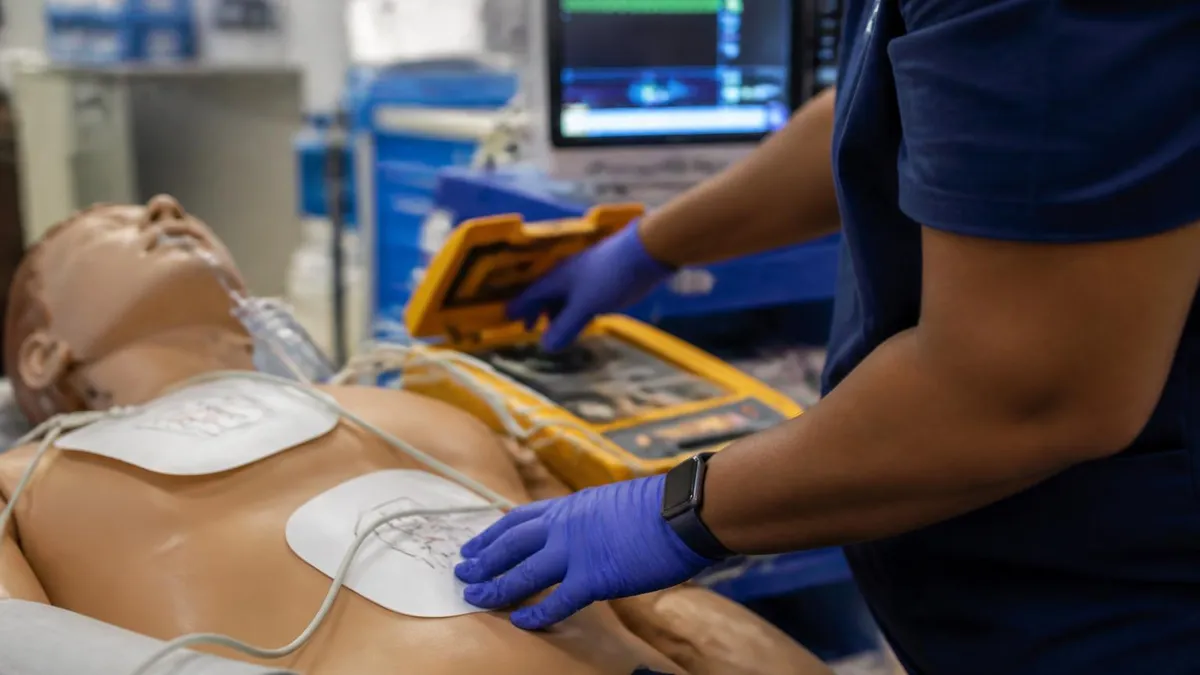
5 Hs: Hypovolemia · Hypoxia · Hydrogen ion (acidosis) · Hypo/Hyperkalemia · Hypothermia
5 Ts: Tension pneumothorax · Tamponade (cardiac) · Toxins · Thrombosis (pulmonary) · Thrombosis (coronary)
Screen all ten within the first 5 minutes of arrest. Treat what you find — don't just keep cycling epi and shocks while a fixable cause goes unaddressed.
The Hs, Ts, Treatments, and Memorization Aids
Hypovolemia — Low circulating volume. Trauma, GI bleed, sepsis, dehydration. Check: flat neck veins, history of bleeding, narrow pulse pressure pre-arrest. Fix: 30 mL/kg crystalloid (NS or LR) wide-open. Blood products if hemorrhagic.
Hypoxia — Inadequate oxygenation. Aspiration, mucous plug, drowning, respiratory failure. Check: cyanosis, SpO2 trend before arrest, breath sounds. Fix: 100% O2 bag-mask, advanced airway if unable to ventilate, confirm ETT placement with capnography.
Hydrogen ion (acidosis) — Severe metabolic acidosis (DKA, sepsis, prolonged arrest). Check: ABG pH < 7.1, known DKA or renal failure. Fix: sodium bicarb 1 mEq/kg IV for severe acidosis (pH < 7.1) or known hyperkalemia. Not routine.
Hypo/Hyperkalemia — Potassium too low or too high. Check: ECG peaked T-waves (high K+), flattened T or U-waves (low K+), dialysis patient. Fix high K+: calcium gluconate 10% 10 mL IV + insulin 10 units IV + D50 1 amp + bicarb 50 mEq + albuterol nebulizer. Fix low K+: KCl 20-40 mEq IV cautiously.
Hypothermia — Core temp < 30 °C (86 °F). Check: cold exposure history, cold skin, low rectal/esophageal temp. Fix: active rewarming (warm IV fluids, bair hugger, lavage). Below 30 °C, withhold further drugs and limit shocks to one until rewarmed above 30 °C.
Bedside Assessment: What to Check During the Code
Knowing the ten causes is half the job. Recognizing them at the bedside while compressions cycle is the other half. Build a 30-second screening loop you run between rhythm checks, and you'll catch reversible causes before the patient runs out of time.
The single highest-yield tool is bedside ultrasound. The RUSH protocol (Rapid Ultrasound for Shock and Hypotension) screens four of the ten causes in under 60 seconds: hypovolemia (flat IVC, empty heart), tamponade (pericardial effusion), tension pneumothorax (lung sliding absent), and pulmonary embolism (RV dilation, McConnell's sign). Most ED and ICU codes now build ultrasound into the pulse check.
Pull a point-of-care ABG and basic metabolic panel early — usually with the first IV access. The ABG flags acidosis (pH), hypoxia (PaO2), and ventilation (PaCO2). The BMP catches hyperkalemia or hypokalemia. A blood gas with electrolytes runs in 90 seconds on a hospital machine. The acls bradycardia algorithm includes electrolyte review for the same reason.
The ECG monitor itself is diagnostic. Peaked T-waves with wide QRS scream hyperkalemia. ST-elevation across multiple leads pre-arrest means coronary thrombosis. A massive S1Q3T3 with right axis deviation suggests PE. Tachycardia with widened QRS in a young person hints at TCA overdose. Read the strip during the pulse check, not just for shockable vs non-shockable.
Finally, do a physical exam in 10 seconds. Tracheal deviation and absent breath sounds equal tension pneumo. JVD with muffled heart sounds means tamponade. Cold extremities and low core temp signal hypothermia. Pinpoint pupils plus needle marks point to opioid toxicity. Track marks or pill bottles at the scene help narrow toxins fast — never ignore what EMS or family pulled from the bedside.
Capnography deserves its own line. End-tidal CO2 below 10 mm Hg after 20 minutes of high-quality CPR is a strong negative predictor of ROSC and tells you compressions probably aren't moving enough blood. A sudden ETCO2 spike above 35-40 is the first sign of ROSC, often before the monitor catches it. Capnography also confirms ETT placement and indirectly tracks acidosis correction.
Don't underestimate a 10-second focused history from family or EMS. Recent surgery points to PE or hemorrhage. Dialysis schedule points to hyperkalemia. Recent fever or sepsis course points to acidosis and hypovolemia. Medication list — beta-blockers, calcium-channel blockers, digoxin, tricyclics, anticoagulants — narrows toxins instantly. Assign one team member to gather this and report back inside 60 seconds.
How to Memorize the Hs and Ts for the Exam and the Megacode
Most ACLS students lose points on Hs and Ts not because the topic is hard, but because they panic and blank under timed pressure. The fix is structured rehearsal — not just reading the list once and hoping it sticks.
Three memorization tactics consistently work. First, write the table from memory five times before your course. Second, practice with timed flashcards — 30 seconds to recall all ten causes plus treatments. Third, do at least three full megacode simulations where you say the list out loud while compressions cycle. Muscle memory beats cramming every time.
Watch for the trick questions in the AHA exam. The classic stumbles: confusing hypo- and hyperkalemia treatments, forgetting that bicarb is given for TCA toxicity (not routinely for acidosis), and missing that tension pneumothorax is treated with needle decompression before X-ray confirmation. Each of these shows up on at least one megacode scenario somewhere in your testing day.
5 Hs Visual Breakdown
- Bedside clue: Flat neck veins, bleeding history, flat IVC on US
- Treatment: 30 mL/kg crystalloid bolus, blood if hemorrhagic
- Bedside clue: Cyanosis, low SpO2 pre-arrest, no breath sounds
- Treatment: 100% O2 via BVM, advanced airway, capnography
- Bedside clue: ABG pH < 7.1, DKA, renal failure, prolonged arrest
- Treatment: Sodium bicarb 1 mEq/kg IV (not routine)
- Bedside clue: Peaked T-waves (high K+), U-waves (low K+), dialysis
- Treatment: Calcium + insulin/D50 + bicarb + albuterol (high K+); KCl bolus (low K+)
- Bedside clue: Core temp < 30 °C, cold exposure, drowning
- Treatment: Active rewarming; below 30 °C limit shocks to one, withhold drugs

Cause Prevalence: What Actually Kills Patients
Not every H and T is equally common. If you only had time to screen for three, statistics tell you to focus on coronary thrombosis, hypoxia, and hypovolemia — they account for over 75% of treatable arrests in adults. Pediatric arrests skew heavily toward hypoxia. Trauma codes skew toward hypovolemia and tension pneumothorax.
That doesn't mean you skip the rest. Tamponade is rare overall but common in post-cardiac-surgery patients. Hyperkalemia is uncommon in young healthy adults but routine in dialysis patients and crush injuries. Toxin-driven arrest dominates in young patients with witnessed collapse and no medical history. Use the patient's context to weight your search.
The what is acls course material breaks down the population-level statistics, but the practical takeaway is this: scan the chart and the scene before the patient becomes a generic PEA arrest. A 70-year-old with chest pain at home — that's coronary thrombosis until proven otherwise. A 35-year-old with track marks — toxins. A trauma patient with chest deformity — pneumothorax. Pattern recognition cuts your screening time in half.
Order of Approach During a Code: When to Think About Hs and Ts
Timing matters as much as content. The AHA algorithm puts the reversible cause search inside the 2-minute compression cycles, not before. Here's the practical sequence the megacode evaluators want to see, broken down by minute.
Minute 0-2: Confirm arrest, start compressions, attach pads, deliver first shock if shockable. No Hs and Ts yet — secure the basics. Minute 2-4: First rhythm check. Push epi 1 mg if non-shockable or after second shock. While compressions resume, the team leader says out loud, "Let's think about Hs and Ts."
Minute 4-6: Second rhythm check. By now you should have an airway, IV access, and at least one ABG drawn. Screen the top three causes: thrombosis (coronary), hypoxia, and hypovolemia. Confirm advanced airway with capnography before moving on.
By minute 6-10, you should have ultrasound on the chest, labs back, and a working hypothesis. If you haven't found a reversible cause by minute 20, the chances of ROSC drop sharply unless hypothermia or tPA-eligible PE is on the table. Read more on full code sequence in the acls vf vt algorithm walkthrough — the Hs and Ts screen sits inside that algorithm.
One last principle: treat what you find, even if you're not 100% sure. Empirical calcium for suspected hyperkalemia in a dialysis patient. Empirical tPA for a witnessed massive PE. Empirical needle decompression for tension pneumo. Waiting for confirmation while a patient codes is how reversible causes become unreversible. The acls and pals pediatric framework uses the same Hs-and-Ts checklist, with pediatric-adjusted doses.
Team dynamics matter just as much as the checklist. Assign one team member the explicit role of reversible cause hunter — their only job is running labs, ultrasound, history, and the Hs/Ts list out loud. This frees the team leader to manage the algorithm. In high-performing codes, you'll hear the cause hunter announce findings every 2 minutes: "IVC flat, suspect hypovolemia" or "K is 6.8, hyperkalemia confirmed, giving calcium now."
Finally, debrief after every code. What did the team consider? What got missed? Even successful codes have gaps in the Hs and Ts search — the goal is to tighten that loop case after case until screening becomes automatic. Many programs use post-code worksheets that explicitly list the ten causes and ask the team to check off which were screened and which were treated.
If you're studying for ACLS recertification, the Hs and Ts content has not changed meaningfully across the 2010, 2015, 2020, and 2025 AHA updates — meaning every prior version still applies. The doses and bedside techniques (RUSH protocol use, capnography integration, ECPR for refractory cases) have evolved, but the core list of ten is stable. That makes Hs and Ts one of the highest-yield study targets for any exam attempt.
To pull it all together: memorize the list, drill the doses, run simulations, screen at every rhythm check, and treat what you find empirically when the pre-test probability is high. Master that pattern and you'll move from passing the megacode to actually saving lives at the bedside.
Cardiac Arrest Cause Prevalence (Adult, Hospital + OOH)
Common Mistakes on Hs and Ts Megacode Scenarios
Examiners design megacode scenarios specifically to surface the Hs and Ts gaps. Knowing the most common stumbles in advance is how you avoid them. After watching hundreds of candidates run scenarios, the same four mistakes show up over and over.
First, candidates announce "Hs and Ts" but never actually screen any. They say the words, the examiner nods, and the team moves on to another shock without checking labs, ultrasound, or history.
Examiners watch to see if you drive the search — name a specific cause, name the bedside check, name the treatment. "Concerned about hyperkalemia, K is back at 6.5, giving 10 mL calcium gluconate now" passes. Saying just "we're thinking about Hs and Ts" fails.
Second, candidates forget the rare causes. Tamponade and hypothermia are the two most-missed. Tamponade because it's uncommon and the diagnosis requires ultrasound, which junior providers skip. Hypothermia because it requires a core temp measurement that nobody thinks to take in a warm ED bay. Drill these specifically — if your scenario has any post-cardiac-surgery history or cold-weather exposure, mention them out loud.
Third, candidates apply the wrong treatment. Bicarb for routine cardiac arrest is wrong (only for severe acidosis, hyperkalemia, or TCA toxicity). Calcium for routine PEA is wrong (only for hyperkalemia or CCB toxicity).
Atropine for asystole was removed from AHA guidelines in 2010 — yet still appears on exam stems as a wrong answer choice. Re-check your medication list and dose sheet the night before test day and the morning of.
Fourth, candidates lose track of time and skip the reversible cause review entirely after the third round of epi. By minute 12-15 of a long code, fatigue sets in and the algorithm runs on autopilot. The best fix is a visual reminder — a printed Hs/Ts card on the code cart, or a designated team member calling the list out loud every 4 minutes. Tools like the acls practice tests and full megacode rehearsals make this automatic.
One more tip from veteran instructors: when the scenario freezes after a shock, immediately verbalize "airway, IV, monitor, Hs and Ts" as your four-point check. That phrase keeps you anchored to the right priorities during the chaos of timed testing and counts as visible competence to the examiner watching.
tPA vs PCI for Massive Pulmonary Embolism During Arrest
- +tPA can be given at the bedside in any setting
- +tPA dissolves clot within 20-30 minutes
- +tPA is the only option when PCI/IR thrombectomy is hours away
- +tPA does not require interrupting CPR
- −tPA carries a high bleeding risk (intracranial hemorrhage ~2-3%)
- −Surgical embolectomy or catheter thrombectomy at a center has higher survival in shock
- −PCI is preferred for coronary thrombosis — not for PE
- −Post-tPA CPR must continue 60-90 minutes — long codes
Hs and Ts Bedside Checklist During the Code
- ✓Quick history from family/EMS: meds, allergies, recent events
- ✓Bedside ultrasound: IVC, pericardium, lungs (sliding), RV size
- ✓ABG with electrolytes — pH, K+, lactate, glucose
- ✓Read ECG strip for peaked T, ST-elevation, S1Q3T3, wide QRS
- ✓Physical: tracheal deviation, breath sounds, JVD, core temp, pupils, track marks
- ✓Drug history: anticoagulants, beta-blockers, CCBs, digoxin, antidepressants
- ✓Trauma survey if mechanism unclear — log roll, FAST exam
- ✓Confirm advanced airway placement with capnography
- ✓Run mental checklist out loud: 'H1 H2 H3 H4 H5, T1 T2 T3 T4 T5' every 4 minutes
- ✓Treat empirically if pre-test probability is high — don't wait for confirmation
If core temperature is below 30 °C (86 °F), the standard ACLS algorithm changes: limit defibrillation attempts to one shock and withhold IV medications until rewarmed above 30 °C. The cold heart does not respond to drugs or repeated shocks, and you're wasting limited window. Focus all effort on active rewarming (warm IV fluids, bair hugger, peritoneal/thoracic lavage, ECMO if available). The saying is "nobody is dead until they are warm and dead" — patients have walked away after hours of CPR with profound hypothermia.
ACLS Questions and Answers
Related ACLS Articles

ACLS Algorithm: Master Cardiac Arrest, Bradycardia, and Tachycardia Protocols
ACLS VF/VT Algorithm: Step-by-Step Cardiac Arrest Pathway
ACLS Drugs and Medications: Complete Pharmacology Reference 2026
ACLS Bradycardia and Tachycardia Algorithms: Complete 2026 Provider Guide
ACLS Precourse Self-Assessment Answers — Your Complete 2026 Study Resource
About the Author

Registered Nurse & Healthcare Educator
Johns Hopkins University School of NursingDr. Sarah Mitchell is a board-certified registered nurse with over 15 years of clinical and academic experience. She completed her PhD in Nursing Science at Johns Hopkins University and has taught NCLEX preparation and clinical skills courses for nursing students across the United States. Her research focuses on evidence-based exam preparation strategies for healthcare certification candidates.
Join the Discussion
Connect with other students preparing for this exam. Share tips, ask questions, and get advice from people who have been there.
View discussion (8 replies)