
3D Product Animation Services 2026 October
📗 Prepare for the 3D Product Animation Services certification. Practice questions with answer explanations covering all exam domains.
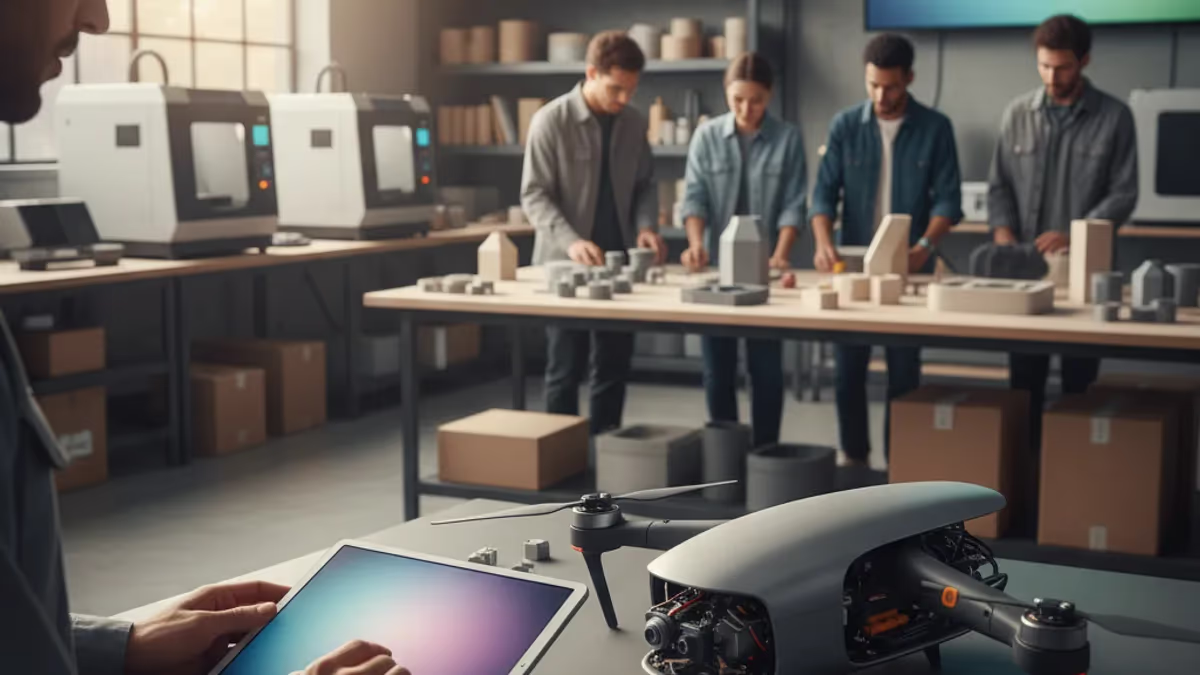
In the competitive world of marketing, businesses are constantly seeking innovative ways to bring their products to life and ignite the interest of potential customers. One such way is through 3D product animation services. With advancements in technology, 3D animations have become increasingly realistic and dynamic, allowing companies to showcase their products in an immersive and captivating manner. One of the key benefits of 3D product animation is its ability to demonstrate complex features or functions that may be difficult to convey through traditional media channels. Through complex visualizations and realistic movements, potential customers can get a clear understanding of how a product works and what sets it apart from competitors. Moreover, animation allows for creative storytelling opportunities, enabling businesses to evoke emotion and create memorable experiences for their audience.
Furthermore, 3D product animation services offer a level of flexibility that traditional photography or videos cannot match. Customization options allow businesses to tailor animations specifically for individual target markets or different advertising platforms. This adaptability not only helps companies reach specific audience segments effectively but also enables them to experiment with different messaging strategies without significant cost investments. With these advantages in mind, it's no wonder that more and more businesses are turning to 3D product animation services as part of their marketing efforts. Whether it's for online advertisements, trade show presentations, or even virtual reality experiences, using this advanced technology can give brands a competitive edge by making their products stand out in a visually saturated digital landscape.
Key Takeaway: 3D Product preparation requires consistent practice. Use our practice tests to identify and strengthen your weak areas.
- ✓Review the exam content outline
- ✓Take a diagnostic practice test
- ✓Create a study schedule
- ✓Focus on weak areas
- ✓Complete full practice exams
Sample 3D Product Practice Questions
Try these questions from our free 3D Product practice tests. The correct answer and an explanation follow each question.
What is 'Nylon (PA12)' commonly used for in 3D printing product applications?
- A. Functional, durable parts requiring flexibility, chemical resistance, and toughness — particularly in SLS printing
- B. High-detail, brittle decorative models in SLA printing
- C. High-temperature tooling jigs in FDM printing
- D. Transparent optical components in resin printing
Answer: A. Functional, durable parts requiring flexibility, chemical resistance, and toughness — particularly in SLS printing
Nylon PA12 is a tough, fatigue-resistant engineering polymer widely used in SLS printing for durable end-use parts like hinges, snap fits, brackets, and fluid system components.
What does 'functional integration' mean in Design for Additive Manufacturing?
- A. Adding electronic components inside a 3D printed shell
- B. Consolidating multiple traditionally separate components into a single printed part
- C. Integrating software simulation into the design workflow
- D. Using multiple filament materials in one print job
Answer: B. Consolidating multiple traditionally separate components into a single printed part
Functional integration leverages additive manufacturing's geometric freedom to merge several parts into one, reducing part count, assembly time, and potential failure points.
Which modeling technique builds shapes by adding or subtracting geometric primitives?
- A. Constructive Solid Geometry (CSG)
- B. NURBS modeling
- C. Sculpting
- D. Box modeling
Answer: A. Constructive Solid Geometry (CSG)
Constructive Solid Geometry (CSG) creates complex shapes through Boolean operations like union, difference, and intersection of simple primitives.
What is the 'staircase effect' and how can part orientation in the slicer help mitigate it?
- A. Skipped layers from filament runout; prevented by using a runout sensor
- B. Visible layer stepping on angled or curved surfaces; mitigated by orienting critical curved features closer to vertical
- C. Uneven first-layer adhesion; corrected by bed leveling
- D. Warping on large flat surfaces; corrected by using an enclosure
Answer: B. Visible layer stepping on angled or curved surfaces; mitigated by orienting critical curved features closer to vertical
The staircase effect is visible stepping on non-vertical surfaces caused by layer-by-layer deposition; rotating the part so important curves lie closer to vertical reduces the apparent stepping.
About the Author

Certified Professional Development Expert & Niche Certification Advisor
University of Pennsylvania Graduate School of EducationDr. Alexandra Kim holds a PhD in Professional Studies from the University of Pennsylvania and is a Certified Professional in Learning and Performance (CPLP) and Certified Professional in Talent Development (CPTD). With 17 years of corporate training and professional certification advisory experience, she helps professionals navigate specialized, emerging, and cross-industry certification programs.