
Notary Public Organizations: A Complete Guide to the Academy of Notaries Public and Professional Associations
What is a notary public? Explore top organizations, the notary public exam, stamps, seals, and how to become one. 📚 Full 2026 August guide.

Understanding what is a notary public begins with recognizing the powerful network of professional organizations that support, credential, and advocate for notaries across the United States. Chief among these is the Academy of Notaries Public, a membership body dedicated to raising professional standards, providing continuing education, and equipping notaries with the resources they need to serve the public accurately and ethically. Whether you are just beginning your journey or renewing your commission, these organizations form the backbone of the profession.
The notary profession in the United States is far more structured than many people realize. Beyond your state's secretary of state office, a robust ecosystem of associations offers training programs, ethics guidelines, legal resources, and community for the more than four million active notaries currently commissioned across all fifty states. Joining a professional organization can be one of the smartest investments a new or experienced notary makes in their career longevity and credibility.
One of the most frequently asked questions by prospective notaries is how to become a notary public — and professional organizations play a direct role in answering that question through curated training courses, exam preparation materials, and mentorship networks. Groups like the National Notary Association (NNA) and the American Society of Notaries (ASN) publish study guides, host webinars, and maintain hotlines that help candidates navigate state-specific requirements with confidence before sitting for the notary public exam.
Beyond exam preparation, these organizations address day-to-day operational needs. Topics such as proper use of a notary public stamp, maintaining a legally compliant notary public seal, understanding journal requirements, and identifying acceptable forms of signer identification are all covered through member resources. Knowing which tools and techniques comply with your state's statutes is critical to avoiding costly errors and protecting both you and your clients from fraud.
Many notaries are surprised to learn that public notary near me free searches often lead to institutional notaries — those employed by banks, credit unions, or government offices who offer free services to customers. Understanding how these institutional notaries differ from independent commissioned notaries helps consumers make smarter decisions about where to go for document authentication, especially for time-sensitive legal and real estate transactions.
Professional organizations also serve a critical advocacy role. When state legislatures consider changes to notary statutes — such as expanding remote online notarization (RON) authority, adjusting fee schedules, or updating identification standards — associations like the NNA submit testimony, publish analysis, and mobilize their membership to engage in the legislative process. This collective voice has shaped modern notary law in significant ways over the past two decades.
This guide walks you through the major notary public organizations operating in the United States today, explains what membership offers, and helps you decide which association best fits your professional goals. We also cover exam preparation resources, tools like the notary public stamp and seal, and practical advice for building a rewarding notary career — whether you plan to work part-time alongside another job or build a full-time mobile notary business.
Notary Public by the Numbers
Major Notary Public Organizations in the United States
Founded in 1957, the NNA is the largest and most recognized notary organization in the US. It offers training courses, background screening, E&O insurance, a notary hotline, and state-specific study guides used by hundreds of thousands of notaries nationwide.
Established in 1965, the ASN focuses on professional education and legislative advocacy. Members receive access to Notary.net resources, legislative alerts, and a quarterly newsletter covering statutory changes and best practices across all fifty states.
A professional membership body providing advanced credentials, continuing education certificates, and peer networking. The Academy promotes elevated ethical standards and helps notaries distinguish themselves in competitive markets through recognized designations.
Nearly every state has its own notary association — for example, the Texas Notary Association or the California Association of Notaries. These local groups offer region-specific training, legislative updates, and networking events tailored to individual state statutes.
Focused specifically on loan signing agents, NASA provides certification programs, background screening, and a directory that title companies and signing services use to locate qualified notary signing agents for real estate closings across the country.
Membership in a professional notary organization delivers tangible, day-to-day value that goes well beyond a certificate on your wall. The most immediate benefit for most members is access to an expert notary hotline — a resource the National Notary Association (NNA) has operated for decades. When you encounter an ambiguous signing situation, a signer who presents unfamiliar identification, or a document type you have never notarized before, a live expert can help you make the right call in real time rather than guessing and risking a flawed notarization.
Training and continuing education resources represent another pillar of organizational membership. Most states now require or strongly recommend continuing education for notary public renewal, and professional associations have built entire catalogs of courses to meet those needs. The NNA alone offers dozens of online courses covering topics such as remote online notarization (RON), loan signing procedures, journal best practices, and identification standards. Completing these courses not only keeps your commission current but also deepens your practical competence in ways that make clients trust you more.
Errors and omissions (E&O) insurance is often available at discounted group rates through notary associations. A notary public renewal without adequate E&O coverage leaves you financially exposed if a notarization error leads to a legal claim. While E&O insurance does not cover intentional misconduct, it protects against honest mistakes — and professional organizations negotiate group rates that can be significantly lower than individual market premiums, making coverage affordable even for part-time notaries.
Background screening services, often required by title companies and signing services before they will hire a notary signing agent, are another membership perk. The NNA's background check program is widely accepted across the mortgage and real estate industries, and completing it through a recognized organization signals to potential clients that you are a vetted, trustworthy professional. Some signing services will not add a notary to their network without a current background screening from an approved provider.
Legislative monitoring is a less visible but critically important service that notary organizations provide. Notary statutes change frequently — sometimes dramatically. The expansion of remote online notarization (RON) from fewer than five states a decade ago to over forty states today happened largely because organized notary associations drafted model legislation, educated lawmakers, and advocated for uniform standards. As a member, you receive timely alerts when laws in your state change, giving you the advance notice needed to update your tools, procedures, and disclosures before a new statute takes effect.
Networking opportunities through local chapters, national conferences, and online forums connect you with other notaries who share practical tips, referral opportunities, and moral support. Building relationships within the professional community can lead directly to business: a busy notary who cannot accommodate a client may refer them to a trusted colleague, and being known within your local notary network positions you to receive those referrals. Associations like the American Society of Notaries host annual conferences where these connections are forged in person.
Finally, professional organizations often maintain public directories where consumers can search for credentialed notaries by location. Being listed in the NNA's Notary Locator or ASN's directory puts you in front of potential clients who are actively searching for reliable notary services — including those using terms like free public notary near me or notario publico when searching online. Visibility in these directories can meaningfully increase your commission volume without any additional marketing spend on your part.
Notary Public Exam Preparation by State and Organization
The National Notary Association offers the most comprehensive library of notary public exam preparation materials available anywhere in the country. Their state-specific study guides walk candidates through applicable statutes, acceptable identification documents, journal requirements, and proper notarial certificate wording. The NNA also offers practice exams that mirror the format and difficulty of official state-administered tests, giving candidates a realistic sense of what to expect on exam day and where to focus additional study time.
NNA's online learning portal provides on-demand access to video lectures, interactive quizzes, and printable reference sheets that cover every topic tested on the notary public exam in states that require one — including California, which is well known for its rigorous written examination. Members can track their progress through a personalized dashboard, revisit difficult topics as often as needed, and download completion certificates to submit alongside their commission applications. The NNA also offers a dedicated exam prep hotline for candidates who have specific questions about state-mandated content areas.

Joining a Notary Organization: Is It Worth the Cost?
- +Access to a live expert notary hotline for real-time guidance on complex signings
- +Discounted E&O insurance rates negotiated through group purchasing power
- +Background screening programs accepted by title companies and signing services
- +Continuing education courses that satisfy state renewal requirements efficiently
- +Legislative alerts keeping you informed of statutory changes before they take effect
- +Listing in public notary directories that drive organic client discovery
- −Annual membership fees ranging from $35 to $150 or more per year per organization
- −Course and certification costs can add up if you pursue multiple credentials
- −Some resources are redundant with free content available from your Secretary of State
- −Local chapters vary in activity level — some states have minimal in-person events
- −Background screening fees are separate from membership and recur annually
- −Smaller organizations may have limited advocacy influence in your specific state
Notary Organization Membership: Your Step-by-Step Action Checklist
- ✓Research both national organizations (NNA, ASN) and your state's local notary association before choosing.
- ✓Compare membership tiers and confirm which tier includes the hotline and E&O insurance discounts.
- ✓Complete an NNA or state-approved background screening before applying to signing services.
- ✓Download your state's notary handbook from your Secretary of State's website as a free baseline resource.
- ✓Enroll in a state-specific exam prep course if your state requires a written notary public exam.
- ✓Purchase a notary public stamp and notary public seal that meet your state's exact specification requirements.
- ✓Obtain E&O insurance — at minimum $25,000 in coverage — before performing your first notarization.
- ✓Register for your organization's legislative alert emails to stay current on statutory changes.
- ✓Create a profile in your organization's public notary directory to attract clients organically.
- ✓Schedule a continuing education course at least 90 days before your commission renewal deadline.
The NNA Hotline Has Saved Thousands of Notaries from Costly Errors
The NNA's expert hotline fields more than 300,000 calls per year from notaries facing ambiguous or unfamiliar signing situations. A single call that prevents an improper notarization can save you from a malpractice claim worth thousands of dollars — making the annual membership fee one of the highest-return investments available to any commissioned notary public.
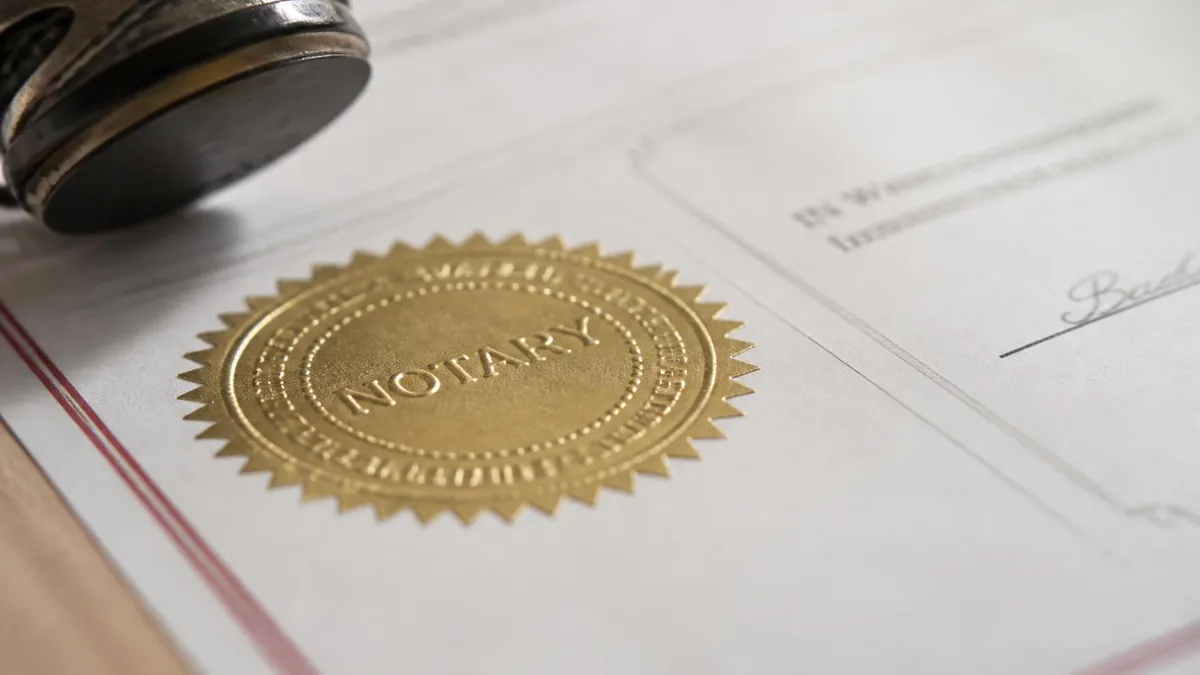
The physical tools of the notary trade — the notary public stamp and the notary public seal — are more regulated than most new notaries expect. Every state specifies exactly what information must appear on your official seal or stamp: typically your name as commissioned, the state name, your commission number, and your commission expiration date.
Some states also require the words "Notary Public" in a specific font size or the inclusion of a state emblem. Purchasing a stamp or seal that does not meet these specifications can render your notarizations legally invalid, so ordering from a reputable supplier who confirms compliance with your state's statutes is essential.
The distinction between a notary public stamp and a notary public seal is worth understanding clearly. Historically, a notary seal referred to an embossing seal — a mechanical device that presses a raised impression into paper. A stamp, by contrast, uses ink to imprint the required information. Most states today accept either format, and many notaries carry both: an ink stamp for general use and an embossing seal for documents that require a more formal appearance. California, notably, requires an ink stamp rather than an embossing seal for official notarizations, making the specific requirements of your state critically important.
Electronic and digital seals have become relevant as remote online notarization has expanded. In RON transactions, notaries apply a digital seal and electronic signature to documents using an approved technology platform. These electronic seals must comply with the same informational requirements as physical stamps but are generated and authenticated through software rather than hardware. Professional organizations publish guidance on which electronic sealing formats are accepted in each state, and RON platform providers typically include compliant seal generation as a feature of their software subscriptions.
Journal requirements are closely related to seal and stamp practices. Most states require or strongly recommend that notaries maintain a sequential journal of every notarial act performed, recording the date, type of notarization, document description, signer name, identification type and number, and signature. Proper journal maintenance protects you if a notarization is later challenged in court — your journal entry provides contemporaneous evidence that you followed correct procedures. Professional organizations offer compliant journal formats both in printed booklet form and as digital journal applications approved for use in their respective states.
The notario publico designation requires a special note for notaries who serve Spanish-speaking clients. In Latin American countries, a notario publico is a highly trained legal professional with authority similar to that of a US attorney. In the United States, however, a notary public has far more limited authority — primarily to verify signatures and administer oaths.
Unauthorized practice of law (UPL) by notaries who allow clients to believe they have legal authority they do not possess is a serious problem in some communities. Professional organizations publish multilingual resources — including Spanish-language materials — that help notaries communicate the scope and limits of their authority clearly to all clients.
Finding a mobile notary public has become dramatically easier in the digital age, and professional organizations play a key role in that accessibility. The NNA's Notary Locator, ASN's directory, and state association member lists allow consumers to search by ZIP code, document type, and availability — including after-hours and weekend appointments. For notaries, being listed in multiple directories maximizes visibility across different consumer search behaviors, from formal Google searches to word-of-mouth referrals from attorneys and real estate agents who rely on association directories to find vetted professionals.
Document-specific knowledge is another area where professional organizations add real value. Notaries frequently encounter document types they have never seen before — from international adoption papers to power of attorney forms for incapacitated individuals to complex trust certification documents. Association training libraries cover these specialized document types in depth, explaining what a notary can and cannot do in each situation, which certificates apply, and when to decline a notarization and refer the client to an attorney. This knowledge reduces liability and builds the kind of professional reputation that generates repeat business and referrals.

Notaries who advise clients on which documents to sign, explain the legal meaning of contract terms, or allow clients to believe they have legal authority equivalent to an attorney are committing unauthorized practice of law (UPL) — a criminal offense in most states. Always refer clients with legal questions to a licensed attorney, and display clear signage in your office or on your website stating that you are not an attorney and cannot provide legal advice.
Building a sustainable notary career requires more than passing an exam and ordering a stamp. The most successful notaries treat their practice as a business from day one — establishing a professional brand, setting competitive fees, marketing their services to the right client types, and continuously investing in education and credentials that justify premium pricing. Professional organizations support all of these activities, but they work best when paired with deliberate business planning and consistent client service that generates referrals over time.
Fee schedules are a logical starting point for career planning. Every state sets a maximum fee per notarial act — ranging from $2 per signature in states like North Carolina to $15 per signature in California. However, mobile notaries can charge separate travel fees, and loan signing agents charge package fees that typically range from $75 to $200 per signing depending on document complexity and geographic market.
Understanding the fee structure in your state and market segment is essential to projecting realistic income and making informed decisions about whether to pursue general notary work, loan signing, or specialized fields like medical or legal document notarization.
Loan signing is the highest-volume revenue opportunity for most independent notaries. Title companies, escrow offices, and signing services route thousands of mortgage closings through independent notary signing agents every day, and the demand for qualified signers with background screenings, E&O insurance, and verifiable credentials consistently exceeds supply in most markets. Becoming a certified loan signing agent through the NNA or a similar organization, completing a background screening, and registering with major signing services like Snapdocs, SigningOrder, and Notary Rotary can generate consistent assignment volume within weeks of completing your certification.
Real estate market cycles directly affect loan signing volume, so financially savvy notaries diversify their client base. In addition to mortgage closings, diversified notaries serve attorneys (estate planning and probate documents), financial advisors (annuity and investment account paperwork), hospitals and care facilities (advance directive and healthcare proxy documents), and businesses (corporate resolutions, contracts, and HR forms). Each client type has distinct document needs, scheduling preferences, and payment timelines, and building relationships across multiple verticals protects your income when any one sector slows.
Marketing strategies that work particularly well for notaries include Google Business Profile optimization (especially important for searches like free notary public near me or notary public in bank of america), LinkedIn presence for professional referral networks, and direct outreach to local law firms, title companies, and financial planning offices. Professional organization membership enhances all of these marketing efforts by providing credentials and directory listings that lend credibility to your online presence and make it easier for institutional clients to vet and approve you as a preferred vendor.
Continuing education keeps your skills sharp and your commission current. States that require continuing education for texas notary public commissions and those in other states typically mandate between three and six hours of approved coursework per renewal cycle. Beyond mandatory CE, voluntary advanced training in areas like RON, apostille services, and I-9 employment verification expands your service menu and allows you to charge premium fees for specialized knowledge that most general notaries do not possess.
Long-term career planning for notaries increasingly includes remote online notarization as a core competency. As RON adoption accelerates — driven by consumer preference for convenience and lender acceptance of electronic closings — notaries who are RON-certified and actively performing remote notarizations are positioning themselves for the direction the market is moving. States are continuously expanding RON authorization, and professional organizations are tracking and publishing those changes in real time, giving members the information they need to expand their service offerings as new state authorizations become effective.
Preparing for the notary public exam requires a structured study approach that combines statutory knowledge with practical procedural understanding. The most common mistake first-time candidates make is relying exclusively on flashcard-style memorization without developing the ability to apply rules to realistic scenarios. State notary exams — particularly California's — are scenario-based, presenting fact patterns where you must determine whether a notarization is proper, which certificate type applies, or what the notary should do when a signer cannot be physically present. Practicing with scenario-based questions is therefore far more effective than rote memorization of statutes alone.
Time management on the exam matters more than most candidates expect. California's 45-question exam has a 90-minute time limit — plenty of time for candidates who are well prepared, but tight for those who second-guess every answer. The key is to move through straightforward questions quickly and flag complex scenario questions for review, then return to them after completing the easier questions. Professional organizations publish timed practice exams that replicate these conditions, helping candidates build both knowledge and test-taking stamina before the official exam date.
Identification verification is one of the most heavily tested topic areas on the notary public exam in virtually every state. Notaries must know which forms of identification are acceptable — typically including state-issued driver's licenses, passports, military IDs, and in some states, foreign passports or consular identification cards — and must be able to identify documents that are expired, altered, or otherwise inadequate. The NNA's identification guide, updated annually, is one of the most useful reference tools available for both exam preparation and real-world practice, and many professional organizations include access to it as a member benefit.
Notarial certificate wording is another critical exam topic. Acknowledgment certificates and jurat certificates are the two most common notarial act types, and while their purposes differ significantly — an acknowledgment confirms the signer voluntarily executed the document, while a jurat confirms the signer swore to the truth of the document's contents — their certificate wording is specified by state statute. Most states have adopted Uniform Law Commission model language, but variations exist, and notaries must be familiar with the specific wording required in their jurisdiction. Professional organizations publish state-specific certificate templates that notaries can use as references in practice.
Ethics and professional conduct questions appear consistently on notary exams and in continuing education requirements. Core ethical principles — impartiality, refusal to notarize when in doubt, prohibition on notarizing one's own signature, and mandatory refusal to notarize documents known to be fraudulent — are tested directly. Professional organizations reinforce these principles through their codes of ethics, which members agree to uphold as a condition of membership. Internalizing these principles before the exam is valuable not just for passing the test but for avoiding the real-world situations that lead to commission revocation and civil liability.
After passing your exam and receiving your commission, the work of building a professional notary practice truly begins. Your first notarizations may be for friends, family, or colleagues — low-stakes situations that help you build procedural confidence before handling complex or high-value documents for clients who are counting on you.
Document everything carefully, follow your state's journal requirements from your very first notarial act, and never hesitate to decline a notarization that feels improper. The ability to say no when something is wrong is one of the most important professional skills a notary can develop, and professional organizations provide the education and hotline support that make it easier to make that call correctly.
Ultimately, the notary profession offers a unique combination of public service and entrepreneurial opportunity. Whether you serve as a hospital notary who helps patients execute advance directives, a mobile signing agent who facilitates real estate closings across a multi-county territory, or a general notary who helps neighbors authenticate documents for immigration and legal proceedings, the work you do matters. Professional organizations — from the Academy of Notaries Public to the NNA to state-level associations — exist to ensure that notaries have the knowledge, tools, and community support to do that work with integrity and excellence every single day.
Notary Public Questions and Answers

How to Become a Notary Public: Complete State-by-State Training Guide

NC Notary Public Course: Complete Training Guide for North Carolina

Notary Public Commission Application: Complete Step-by-Step Guide for 2026

What Is a Notary Public Office? Everything You Need to Know

Notary Public Directory: How to Find, Verify, and Use a Trusted Notary in 2026
About the Author
Notary Public Law Expert & State Notary Exam Specialist
Georgetown University Law CenterAttorney Sarah Williams is a licensed attorney and National Notary Association (NNA) certified notary with a Juris Doctor from Georgetown University Law Center. She has 13 years of experience in notarial law, document authentication, and real estate closings. Sarah coaches candidates through state notary public examinations, notary signing agent certification, and loan signing agent training programs.