
NFPA 921 and 1033: Complete Guide to Fire Investigation Standards 2026 August
Master nfpa 921 and 1033 fire investigation standards. Learn methodology, evidence collection, investigator qualifications & exam prep. ✅

Understanding NFPA 921 and 1033 is essential for anyone pursuing a career in fire investigation or preparing for professional certification in the United States. NFPA 921, formally titled Guide for Fire and Explosion Investigation, serves as the definitive scientific reference for fire investigators, attorneys, insurance professionals, and safety engineers.
Together with NFPA 1033, the Standard for Professional Qualifications for Fire Investigator, these two documents form the backbone of competent, legally defensible fire investigation practice. Whether you are a firefighter transitioning into investigation work or an insurance adjuster seeking formal credentials, mastering both standards is the first step toward professional recognition in this field.
NFPA 921 was first published in 1992 and has been revised through multiple edition cycles, reflecting the growth of fire science as a forensic discipline. The document is explicitly classified as a guide rather than a mandatory standard, meaning it does not carry the force of law on its own.
However, courts across the country have repeatedly cited NFPA 921 as the authoritative scientific basis for evaluating fire investigation testimony. Expert witnesses who deviate from its methodology without sound scientific justification face intense scrutiny, and in many jurisdictions, testimony that contradicts NFPA 921 principles has been excluded under Daubert standards for scientific reliability.
NFPA 1033, by contrast, is a standard — a document that establishes minimum job performance requirements (JPRs) that fire investigators must demonstrate to be considered professionally qualified. It defines exactly what a competent fire investigator should be able to do, from scene documentation and evidence collection to report writing and courtroom testimony. Certification bodies such as the International Association of Arson Investigators (IAAI) and the National Association of Fire Investigators (NAFI) use NFPA 1033 JPRs as the framework for their credentialing examinations. Aligning your study and practice with these JPRs dramatically improves both your on-the-job effectiveness and your examination readiness.
The relationship between NFPA 921 and NFPA 1033 is symbiotic and intentional. NFPA 921 provides the scientific methodology and body of knowledge that investigators must apply, while NFPA 1033 defines the performance outcomes that demonstrate mastery of that methodology. Think of NFPA 921 as the textbook and NFPA 1033 as the competency checklist.
A fire investigator who understands the science behind fire dynamics, origin determination, and cause classification — as laid out in NFPA 921 — but cannot document, communicate, or defend those findings fails to meet the professional standard. Conversely, an investigator who checks procedural boxes without grounding their conclusions in sound science produces findings that are legally and scientifically vulnerable.
For those preparing for certification examinations, the intersection of nfpa 921 standards with broader fire protection knowledge is critical. Questions on credentialing exams frequently test not just isolated facts but the application of scientific reasoning to realistic scenarios. Understanding how fire behaves in different environments, how to interpret burn patterns, and how to distinguish accidental from incendiary causes requires both memorization of key concepts and the ability to apply the scientific method under pressure. Practice examinations that mirror this applied approach are among the most effective preparation tools available to candidates.
The legal landscape surrounding fire investigation has evolved significantly since NFPA 921 was first introduced. Before its publication, fire investigation was often criticized as more art than science, with investigators relying heavily on intuition, anecdotal experience, and myths — such as the idea that certain burn patterns automatically indicate the use of accelerants. NFPA 921 systematically dismantled many of these myths and replaced them with peer-reviewed science, fundamentally changing what courts and insurance carriers accept as valid investigative conclusions. Today, investigators who cannot demonstrate familiarity with NFPA 921 methodology may find their conclusions challenged in civil and criminal proceedings.
This guide covers everything you need to know about NFPA 921 and 1033, from their organizational structure and key provisions to practical application in the field and targeted preparation strategies for professional certification. Each section builds on the last, giving you both the conceptual foundation and the practical tools to advance your career in fire investigation with confidence and scientific rigor.
NFPA 921 and 1033 by the Numbers

Key Sections of NFPA 921: What Every Investigator Must Know
These opening chapters establish the scientific method as the mandatory framework for all fire investigation. They cover basic fire science, fire dynamics, building systems, and how fires grow and spread — forming the conceptual foundation that underpins every subsequent chapter.
The heart of NFPA 921. These chapters guide investigators through scene examination, burn pattern analysis, identifying the area of origin, and classifying fire cause as accidental, natural, incendiary, or undetermined. Each classification carries distinct legal and insurance implications.
Addresses complex scenarios including wildfire investigations, vehicle fires, marine fires, and explosions. Each chapter adapts the core scientific methodology to the unique physical and evidentiary challenges of these specialized environments.
Covers the investigator's role in legal proceedings, documentation standards, report writing, evidence handling, and courtroom testimony. This section bridges scientific findings with the requirements of the civil and criminal justice systems.
Detailed guidance on investigating electrical fires, appliance failures, and common ignition sources. Includes technical analysis of arc mapping, overload scenarios, and the forensic examination of electrical components recovered from fire scenes.
The scientific method is not simply a recommendation in NFPA 921 — it is the foundational requirement that elevates fire investigation from guesswork to forensic science. The document mandates a systematic, objective, and hypothesis-driven approach to every investigation.
Investigators are expected to gather data, form hypotheses about fire origin and cause, test those hypotheses against the available physical and documentary evidence, and either confirm or reject each hypothesis. Only hypotheses that survive rigorous testing should form the basis of a final opinion. This iterative process mirrors the methodology used in other forensic sciences and is what makes NFPA 921-grounded testimony defensible in court.
One of the most important contributions NFPA 921 made to the field was the explicit rejection of the negative corpus methodology. For decades, investigators routinely concluded that a fire was incendiary simply because they could not identify an accidental cause. NFPA 921 makes clear that the absence of an identified accidental cause is insufficient, on its own, to support an incendiary classification.
An investigator must affirmatively identify positive evidence of intentional fire-setting — such as the presence of an ignitable liquid accelerant, an improvised incendiary device, or multiple separate points of origin that cannot be explained by fire spread. This shift fundamentally changed how arson cases are built and prosecuted.
Data collection under NFPA 921 encompasses physical evidence, witness statements, fire department records, weather data, utility records, and any other information relevant to how the fire started and spread. The document emphasizes that investigators should approach a scene with no preconceived conclusions, collecting all available data before attempting to form hypotheses. In practice, this means thorough photographic documentation, systematic debris removal and examination, and careful mapping of burn patterns before any conclusions are drawn. Scene preservation begins at the moment of arrival, and investigators must coordinate with firefighting personnel to ensure that suppression activities do not unnecessarily disturb potential evidence.
Burn pattern analysis is one of the most technically demanding aspects of fire investigation and one of the areas where NFPA 921 has had the greatest scientific impact. The document provides detailed guidance on interpreting char depth, heat shadowing, smoke deposits, fire movement indicators, and the effects of ventilation on fire growth and spread.
Critically, NFPA 921 debunks many historical myths about burn patterns — for example, the old belief that low burn patterns, irregular floor burns, or certain char formations automatically indicate accelerant use. Modern fire science has demonstrated that many of these patterns can be produced by ordinary combustibles under specific ventilation and heat conditions, a fact that has overturned wrongful arson convictions.
The role of fire dynamics in NFPA 921 analysis cannot be overstated. Understanding how heat transfers through radiation, convection, and conduction; how flashover dramatically changes fire behavior and evidence; and how different fuel loads and building configurations affect fire growth allows investigators to reconstruct fire development from its aftermath. NFPA 921 integrates computer fire modeling and computational fluid dynamics as supplementary tools, while making clear that physical evidence at the scene remains the primary basis for origin and cause determinations. Investigators who rely solely on modeling without integrating scene observations risk producing conclusions that do not reflect actual fire behavior.
Laboratory analysis plays an important supporting role in NFPA 921-guided investigations. Samples suspected of containing ignitable liquid residues must be collected, packaged, and submitted to accredited laboratories using proper chain-of-custody procedures. The document references ASTM E1188 for evidence collection and ASTM E1412, E1413, and E1618 for laboratory analysis protocols.
Gas chromatography–mass spectrometry (GC-MS) is the accepted method for identifying ignitable liquid residues, and investigators must understand both the capabilities and the limitations of this technology. A positive laboratory finding does not automatically prove arson — the presence of an ignitable liquid must be interpreted in the context of all other evidence.
For professionals studying the broader landscape of fire protection, understanding how investigation standards intersect with inspection and system maintenance requirements adds important context. The nfpa 921 standards framework connects directly to other NFPA documents that govern fire protection systems, building codes, and safety management. Investigators frequently encounter fire protection systems during scene examinations and must be able to assess whether those systems functioned as designed, failed due to defect or maintenance issues, or were deliberately compromised — all of which are relevant to cause determination and potential liability.
NFPA 921 Fire Investigation: Origin, Cause, and Evidence
Identifying the area of origin is the single most critical task in any fire investigation. NFPA 921 directs investigators to work systematically from areas of least damage to areas of greatest damage, following the physical indicators of fire travel. These indicators include char depth gradients, heat shadowing on protected surfaces, smoke and soot deposition patterns, and the direction of flame movement revealed by the orientation of burned materials. The process is methodical and requires patience — rushing to conclusions about origin before completing a full scene examination is one of the most common investigative errors.
Once the general area of origin is established, investigators narrow their analysis to identify the specific point of origin — the exact location where combustion began. This requires detailed examination of all potential ignition sources within the origin area, including electrical equipment, heating appliances, open flames, and smoking materials. Each potential ignition source must be evaluated against the available fuel and oxidizer to determine whether it was physically capable of initiating the fire under the conditions that existed at the time of ignition. NFPA 921 emphasizes that origin and cause determination are separate analytical steps, and cause analysis should not begin until origin is established with reasonable confidence.
NFPA 921 Compliance: Benefits and Challenges for Investigators
- +Provides a scientifically defensible framework that withstands Daubert scrutiny in federal and state courts
- +Eliminates reliance on disproven investigative myths that have led to wrongful convictions in the past
- +Creates a common language and methodology that improves communication across agencies and disciplines
- +Guides investigators to reach correct undetermined classifications rather than forcing unsupported conclusions
- +Updated regularly to incorporate advances in fire science, materials science, and forensic technology
- +Accepted by courts, insurance carriers, and regulatory agencies as the national standard of care for fire investigation
- −The scientific rigor required by NFPA 921 demands substantial ongoing education and training investment
- −Strict hypothesis-testing methodology can be time-consuming and expensive on complex large-loss scenes
- −The guide status of NFPA 921 creates jurisdictional inconsistency — some areas have not formally adopted it
- −Investigators without strong physical science backgrounds may struggle to apply fire dynamics concepts correctly
- −Frequent edition cycles require investigators to stay current, which can be challenging for part-time investigators
- −The undetermined classification, though scientifically correct in many cases, can frustrate legal and insurance stakeholders seeking definitive answers
NFPA 1033 Job Performance Requirements: Core Competency Checklist
- ✓Establish and secure a fire investigation scene using appropriate legal authority and scene management protocols.
- ✓Document the fire scene thoroughly using photography, sketching, and written notes before disturbing physical evidence.
- ✓Locate and collect physical evidence using proper packaging, labeling, and chain-of-custody procedures.
- ✓Interpret fire patterns including char, smoke, heat, and flame indicators to determine fire travel direction and origin area.
- ✓Examine and evaluate all potential ignition sources identified within the established area of origin.
- ✓Reconstruct fire events by integrating physical evidence, witness information, and fire dynamics principles from NFPA 921.
- ✓Classify fire cause as accidental, natural, incendiary, or undetermined based on the totality of available evidence.
- ✓Collect and preserve witness and subject interview information using ethical and legally sound interview techniques.
- ✓Prepare a complete, accurate, and legally defensible written fire investigation report suitable for court proceedings.
- ✓Testify as a fact or expert witness, presenting findings clearly and withstanding cross-examination in legal proceedings.
The Undetermined Classification Is Never a Failure
Many certification candidates incorrectly believe that an undetermined fire cause reflects investigative incompetence. NFPA 921 is explicit: when evidence is insufficient to support a confident classification, undetermined is the correct and scientifically honest conclusion. Exam questions frequently test this concept, and choosing undetermined when facts are ambiguous demonstrates mastery of the standard — not weakness.
Preparing for fire investigation certification examinations — whether the IAAI Certified Fire Investigator (CFI), the NAFI Certified Fire and Explosion Investigator (CFEI), or the ICC Fire Investigator credential — requires a structured, multi-phase study approach grounded in both NFPA 921 and NFPA 1033. The most successful candidates treat examination preparation as a professional development project, not simply a test-cramming exercise.
They begin by completing a thorough self-assessment against the NFPA 1033 JPRs, identifying specific knowledge gaps, and building a study plan that allocates more time to weak areas without neglecting strengths. This diagnostic-first approach maximizes the efficiency of study time and produces better retention of the material.
NFPA 921 itself is the single most important study resource for any fire investigation credential. Candidates should read the entire document at least once, taking notes on key definitions, classification criteria, and methodological requirements. Pay particular attention to chapters covering the scientific method, fire dynamics basics, origin determination, cause classification, and the characteristics of incendiary fires.
The document is dense and technical, but reading it in full provides context that isolated study guides cannot replicate. Many candidates find it helpful to read NFPA 921 alongside a fire investigation textbook such as Kirk's Fire Investigation, which applies NFPA 921 principles to case-based scenarios.
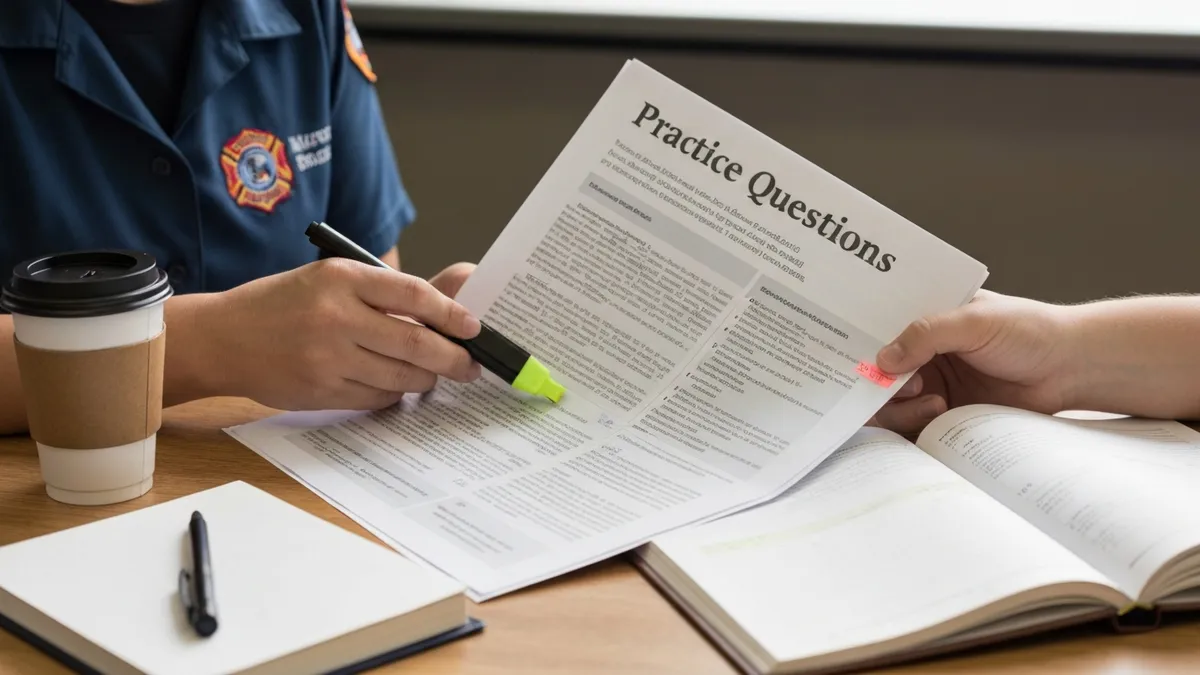
Practice examinations are an indispensable preparation tool because fire investigation certification exams emphasize applied knowledge rather than rote memorization. Questions frequently present realistic scenarios — a residential fire with multiple potential ignition sources, a vehicle fire with questionable origin indicators, or an industrial explosion requiring cause analysis — and ask candidates to select the most scientifically appropriate conclusion.
Working through large numbers of practice questions trains your brain to recognize the analytical patterns that drive correct answers and exposes you to the range of scenarios and terminology that appear on actual examinations. Timing practice is equally important: candidates who are slow readers or who overthink individual questions risk running short on time.
Study groups and mentorship relationships with experienced fire investigators provide benefits that solo study cannot. Working through complex case scenarios with peers exposes you to different investigative perspectives and helps you identify blind spots in your own analysis. Many professional organizations, including the IAAI and NAFI, offer study group resources, review seminars, and mentorship programs specifically for certification candidates. Attending these programs also provides networking opportunities that can advance your career after you earn your credential. The fire investigation community is relatively small and collegial, and the connections you make during your certification journey often pay dividends for years afterward.
Hands-on training is a non-negotiable component of fire investigation competence, and most certification programs require documented field experience as a prerequisite for examination eligibility. Simply reading NFPA 921 and NFPA 1033 without corresponding field practice produces candidates who understand the theory but struggle with application.
Seek opportunities to participate in actual fire investigations under the supervision of a credentialed investigator, attend fire investigation training exercises, and if possible, conduct controlled burns that allow you to observe fire behavior and post-fire evidence firsthand. The National Fire Academy offers fire investigation training programs that combine classroom instruction with practical exercises, and several universities offer undergraduate and graduate programs in fire protection engineering and forensic fire analysis.
Time management during examination preparation matters as much as content mastery. Most certification examinations allow three to four hours for 100 to 200 questions, which sounds generous until you encounter a long scenario-based question that requires careful reading and analysis.
Candidates who have not practiced under timed conditions often discover during their actual examination that they are spending too much time on difficult questions and rushing through easier ones. A disciplined testing strategy — answering every question on the first pass, flagging uncertain questions for review, and returning to flagged items with remaining time — consistently produces better scores than an unpredictable question-by-question approach.
Physical condition and logistical preparation on examination day are often overlooked but genuinely matter. Arrive at the testing center well in advance, bring all required identification, and ensure you have eaten and slept adequately. Fire investigation certification examinations are cognitively demanding, and fatigue or hunger significantly impairs the analytical reasoning that these exams require.
Many candidates also benefit from a brief review of key NFPA 921 definitions and classification criteria in the days immediately before the examination — not as a last-minute cramming exercise, but as a way to activate familiar mental pathways and reduce examination-day anxiety. Confidence grounded in thorough preparation is one of the most powerful performance advantages a candidate can bring into the testing room.

Certification examinations are typically based on a specific edition of NFPA 921 and NFPA 1033. Before registering, confirm which edition your chosen credential uses and ensure all study materials reference that edition. Studying from an outdated edition can result in learning superseded methodology that directly conflicts with current exam answer keys — particularly in areas like fire pattern interpretation and burn indicator analysis, which have been substantially revised in recent editions.
Fire investigation as a career offers multiple entry points and diverse professional pathways, attracting professionals from backgrounds as varied as structural firefighting, law enforcement, insurance claims, engineering, and the legal profession. Many fire investigators begin their careers as career or volunteer firefighters, developing firsthand experience with fire behavior and scene conditions before transitioning into the investigative specialty.
Others enter directly from related forensic science or engineering programs, bringing technical analytical skills that complement field experience. Regardless of entry path, NFPA 1033 establishes the universal minimum competency standard that all professional fire investigators must meet, creating a level playing field across the profession.
Public sector fire investigators typically work for fire departments, fire marshal offices, or law enforcement agencies, with primary responsibilities that include determining cause and origin, identifying potential criminal activity, and supporting prosecution of arson cases. These positions often require peace officer status, which carries arrest authority and enables investigators to work crime scenes alongside law enforcement partners.
Salaries for public sector investigators vary significantly by jurisdiction, ranging from approximately $50,000 in smaller municipalities to over $90,000 in major metropolitan areas with strong collective bargaining agreements. Benefits packages, pension programs, and job security in public sector roles are generally superior to private sector equivalents.
Private sector fire investigators work primarily for insurance companies, independent investigation firms, engineering consulting firms, and legal defense teams. Insurance company staff investigators handle claims involving suspected arson or disputed cause and origin, while independent investigators are retained by multiple carriers, attorneys, and corporations on a case-by-case basis.
The private sector typically offers higher earning potential for experienced investigators — senior independent consultants with strong credentials and courtroom track records can earn well over $100,000 annually — but with less job security and the business development demands of building and maintaining a client base. Many successful private sector investigators hold multiple credentials to maximize their marketability and billable expertise.
The intersection of fire investigation with adjacent professional fields creates significant cross-disciplinary opportunities. Fire protection engineers who add fire investigation credentials can provide origin and cause analysis that integrates deeply technical system failure analysis — evaluating whether sprinkler systems, alarm systems, or passive fire protection features performed as designed. Electrical engineers bring specialized expertise in analyzing electrical ignition scenarios. Forensic accountants sometimes collaborate on large arson-for-profit investigations that involve complex financial fraud. These interdisciplinary collaborations reflect the reality that complex fire cases increasingly require teams of specialists rather than a single generalist investigator.
Continuing education and professional currency are not optional for serious fire investigators — the field evolves constantly as new materials, construction methods, building systems, and consumer products create new fire scenarios. The IAAI and NAFI both require credential holders to complete continuing education hours during each recertification cycle, ensuring that certified investigators remain current with evolving science and standards. Active participation in professional organizations, attendance at technical conferences such as the annual IAAI Symposium on Fire Investigation, and subscription to peer-reviewed publications like the Journal of Fire Sciences are hallmarks of professionals committed to lifelong learning in this demanding discipline.
The legal and regulatory environment surrounding fire investigation continues to evolve, with significant implications for both investigators and the organizations they serve. Post-conviction review projects have identified cases where investigators using pre-NFPA 921 methodology contributed to wrongful arson convictions based on scientifically unsupported burn pattern interpretations.
These cases have prompted reforms in training standards, investigative protocols, and expert witness qualification requirements across multiple jurisdictions. Fire investigators who ground their work in NFPA 921 methodology and maintain detailed, transparent documentation of their analytical process are best positioned to withstand the increasing legal scrutiny applied to fire investigation opinions in both civil and criminal proceedings.
For professionals looking to build a comprehensive understanding of the full fire protection ecosystem — including the inspection, testing, and maintenance requirements that fire investigators evaluate during scene examinations — resources covering companion NFPA standards provide essential context.
Understanding how fire suppression systems, alarm systems, and passive fire barriers are supposed to function under NFPA standards like NFPA 13, NFPA 72, and NFPA 101 enables investigators to recognize system failures and assess whether those failures contributed to fire origin, spread, or loss of life. The nfpa 921 standards ecosystem extends well beyond investigation methodology into the full life cycle of fire protection system management.
Practical field experience is irreplaceable as a preparation strategy for both examination success and career effectiveness. New investigators should actively seek mentorship from experienced credentialed practitioners, accompanying them on investigations whenever possible and asking detailed questions about the analytical decisions made at each step of the process.
Watching an experienced investigator work through the systematic documentation of a scene — from initial walkthrough and photography through evidence collection and final opinion formulation — provides insight that no textbook or practice examination can fully replicate. Many professional fire investigation organizations have formal mentorship programs designed to connect aspiring investigators with experienced mentors, and participation in these programs pays substantial dividends.
Keeping a professional portfolio of completed investigations — with documentation of your specific contributions, the analytical methods you applied, and the conclusions you reached — is valuable both for certification eligibility documentation and for career advancement.
Credentialing bodies require applicants to demonstrate a minimum number of supervised investigations across different fire categories, and maintaining organized records of your investigative experience from the beginning of your career ensures you will have the documentation you need when application time arrives. Photographs, reports, and chain-of-custody records from your early investigations can also serve as powerful learning tools when reviewed years later with more experienced eyes.
Technical writing skills are surprisingly important for fire investigators and are often underdeveloped even among experienced practitioners. A fire investigation report must accurately document scene conditions, investigative methodology, and analytical reasoning in language that is clear and understandable to non-specialist readers — including judges, jurors, and attorneys — while simultaneously being technically rigorous enough to withstand scrutiny from opposing expert witnesses.
NFPA 921 provides guidance on report content requirements, but actually developing strong technical writing skills requires deliberate practice. Candidates preparing for certification examinations should review sample investigation reports from professional training programs and practice writing their own narrative summaries of investigation scenarios.
Courtroom testimony is another skill that requires dedicated development beyond simply understanding the science. Experienced expert witnesses are able to explain complex fire dynamics concepts to lay audiences without oversimplifying the science, maintain composure under aggressive cross-examination, and provide appropriately qualified opinions that neither overstate certainty nor undermine legitimate conclusions.
Participating in moot court exercises, attending courtroom proceedings as an observer, and working with experienced attorneys to understand how they evaluate and present expert testimony are all valuable preparation activities. Many professional fire investigation training programs include courtroom testimony workshops specifically designed to help investigators develop the communication skills that make their scientific findings persuasive.
Understanding the insurance claims process adds important professional context for fire investigators who work with or for insurance carriers. Property and casualty claims involving fire damage are subject to complex policy language, subrogation rights, and coverage disputes that the investigator's cause and origin opinion directly influences.
Investigators who understand the business context of their work — including how carriers use investigation findings in claim decisions, litigation strategy, and subrogation recovery — are better equipped to produce reports that serve their clients' legitimate needs while maintaining scientific integrity. This business literacy also enables investigators to communicate more effectively with claims professionals, coverage attorneys, and risk managers throughout the investigation process.
Documentation technology has transformed fire investigation practice over the past decade, and staying current with new tools is an important aspect of professional development. Three-dimensional laser scanning systems can capture entire fire scenes with millimeter precision, creating permanent digital records that can be revisited, measured, and shared without returning to the physical scene.
Drone photography provides aerial perspectives that reveal fire spread patterns invisible from ground level. Thermographic imaging cameras detect temperature differentials that can indicate smoldering materials or highlight areas of greatest heat exposure. Investigators who integrate these technologies into their practice produce more comprehensive documentation and are better positioned to reconstruct complex fire scenarios for legal proceedings.
The ethical dimensions of fire investigation deserve explicit attention, particularly given the potential consequences of an investigator's opinions for criminal prosecution and civil liability. NFPA 921 implicitly demands ethical practice by requiring investigators to follow the evidence rather than advocate for a predetermined conclusion. Investigators must be vigilant against the biasing effects of confirmation bias, client pressure, and the emotional weight of fire casualties.
Maintaining objectivity when investigating fires involving serious injuries or fatalities, when clients have strong financial interests in particular outcomes, or when evidence points toward a conclusion that contradicts initial impressions requires both professional discipline and a strong personal ethical commitment to the pursuit of truth above all other considerations.
NFPA Questions and Answers

NFPA 25 Inspection Forms: The Complete Guide to Water-Based Fire Protection System Documentation

NFPA 13 Requirements: Complete Guide to Sprinkler System Design, Installation, and Draft Curtains

NFPA 90A: Complete Guide to the Standard for the Installation of Air-Conditioning and Ventilating Systems

NFPA 70 National Electrical Code: Complete Guide to Understanding and Applying the NEC

NFPA Training: Complete Guide to Fire Protection Standards Education and Certification
About the Author
Certified Safety Professional & OSHA Compliance Expert
Indiana University of Pennsylvania Safety SciencesDr. William Foster holds a PhD in Safety Science from Indiana University of Pennsylvania and is a Certified Safety Professional (CSP) and Certified Hazardous Materials Manager. With 20 years of occupational health and safety management experience across construction, manufacturing, and chemical industries, he coaches safety professionals through OSHA certification, CSP, CHST, and safety management licensing programs.
Join the Discussion
Connect with other students preparing for this exam. Share tips, ask questions, and get advice from people who have been there.
View discussion (8 replies)